• “I like clothing as a material. For me it is not simply cloth, but a ‘second skin’ that carries many other things, like personal memory and different historical epochs and social backgrounds.

    -Yin Xiuzhen

    Arguably one of the best-known Chinese artists today, artist Yin Xiuzhen, has been exploring personal experiences of social transformation in her installation works from a subtle, female perspective. Contrasting personal clothes, handmade crafts, and daily objects with industrial products Yin visualizes, in an appealing and intimate way, the intertwined relationship between urban modernization and memory, society and the individual, gender and body.

    As a local who was born and grew up in Beijing, Yin began her professional artist career after graduating from Capital Normal University of Beijing in 1989. Inspired by new ways of artistic expressions, Yin, bored of traditional media, became interested in making three-dimensional and outdoor works. She married another artist colleague, Song Dong, in 1992 and continued to live and work in Beijing. The couple’s home, a small traditional courtyard house (siheyuan), was demolished alongside many other siheyuan houses during the massive urban reconstruction of Beijing in 1998.  The artist’s personal feelings towards the rapid urban transformation of her hometown and the sudden emergence of new ruins in central Beijing culminated in the installation piece Ruined City (1996), which was displayed at the art museum of the Capital Normal University of Beijing.

    In Ruined City, which occupies the 300-square-meter exhibition space, Yin reconstructs a ruined siheyuan house by using fragments of roof tiles and pieces of abandoned furniture, all collected from demolished sites. She poured tons of dry cement dust all over the place, piling it on the top of the bed, chairs, closet, desk, dresser, and water washstand. Roof tiles were laid out in a diagonal path across the entire space. The installation, which looks like an interior of an old, collapsed house buried under cement dust, is a metaphor for the disappearance of old Beijing under rapid urban modernization. The constellation of fragmented pieces of roof tiles and furniture in the debris expresses a sense of nostalgia that has haunted many Beijing citizens who have shared the intense moment of witnessing history erased.

    Cement has been one of Yin’s most powerful visual languages and her juxtaposition of cement with clothes and personal objects has become a recurring theme in her works of the 1990s, such as Suitcase (1995), Dining Table (1998), Scenery (1999), and A Thousand Shoes (1999). For example, in Suitcase, Yin laid out her own clothes on the ground, folded them into a suitcase, and then sealed the clothes with cement. In Dining Table, she embedds fresh fruit into a cement table, which was left with dots when the fruit eroded gradually. Yin’s longstanding obsession with handmade crafts and clothes can be traced back to her childhood hobby of sewing. The contrast of extremely opposite textures—hard, industrial, and permanent cement versus soft, personal and perishable cloths or fruit—have led critics to interpret her work as an allegorical comment on the relationship between an immobile industrial society and a suppressed, fragile individuality. The artist’s performance of sealing clothes and fruit into the cement therefore represented her attempts to “coagulate” her personal past, a futile attempt that failed alongside the decomposition of objects.

    The dotted holes in the cement table, left by the decomposition of fruit or clothes, parallels the dust-covered furniture and roof tiles in Ruined City, as both were traces of a process of disappearing and fragmentation of the past in the present. However, the dry cement dust in Ruined City uncovers new meaning. In an interview, the artist recalled the pervasive existence of cement dust when working in a factory. The soft and refined cement dust was not merely a symbol of industrial power but also, personal to the artist. It became a tangible form of her private memories as well as an intersection of past and present.

    Having participated in various international exhibitions in the recent decade, Yin has become increasingly interested in expressing personal experiences in the context of globalization. Inspired by international travel, Portable Cities (2001-present) is an on-going series of opened suitcases, on each of which the artist has made a cluster of landmark architecture out of old clothes. The number of suitcases increases as the artist visits more new cities. The personalized souvenir-like suitcases not only represent the artist’s experiences of living in transit, they also give each city a distinctive character against the monotonous uniformity of globalization.

    In addition to shifting to the global context, Yin’s recent work also grows in scale. She has wrapped entire airplane fuselages with cloth in International Flight (2006), and in the installation Collective Subconscious (2007), exhibited at the Museum of Modern Art in 2010, Yin wrapped a long tube structure with four hundred different pieces of clothing and inserted it into a bisected blue minivan to form a 38-foot-long sculpture. Visitors could enter the vehicle and sit on the small benches inside the colorful tube, while listening to an old-fashioned Chinese pop song from a speaker. Clothes collected from different people transformed the minivan into a public space of personal memories. The cozy atmosphere in warm-toned lights recalled a time tunnel of the recent past in Chinese urban progression, when the minivan was the symbol of a Chinese car dream. In this piece, as well as in her other works, Yin expresses her keen sensitivity to personal stories in everyday life, characterizing a unique living experience in contemporary Chinese society, namely, a changing present infused with a fragmented, haunting past.

    By. Yu Yang

    I have been in New York since the summer of 2011, when I moved to the city upon graduating from the MFA program at VCU in Richmond, Virginia. My interest in ‘curating’ probably stemmed from having an interest in making new meaning simply by putting together things that already exist. When I was very young, I was really into the original version of Sim City on Super Nintendo and then the computer game, Age of Empires. I would build elaborate cities and civilizations out of frugal means. Once I got a little older, I made mix CD’s for all of my friends, especially my ex-girlfriends. By the time I got to art school, I started to hang my paintings and other works, and was beginning to think of them as sentences. I still find this to be a novel way to look at works of art, though I suppose it’s easier to do so with wall-based art. Later, I devised ways to apply this to my writing and other projects. Eventually, I decided to give it a shot with other folks’ work and tried to legitimately assemble a ‘proper show.’

    I started by co-curating a show at the incredibly progressive, yet somewhat short-lived gallery, Reference, in Richmond. Props to them for showing so many great artists before they became majorly hot commodities!

    Anyways, I curated this show, titled Exit Light, with Michael Kennedy Costa, who at the time was a fellow VCU graduate student. Reference was a gallery that was beginning to gain a reputation as a space that showed a lot of Internet art and new media work, and the guys who ran it were really lovely, and great party hosts.

    Michael and I thought it’d be interesting to create a show that served as a loose metaphor for the arc of a party, where the works wrapped around the perimeter of a gallery from the ‘start’ to the ‘finish’ of the ‘party.’ We used no Internet art and really no new media, at least as far as 2010 was concerned. This exhibition included many artists for whom I have endless respect, and many who have since found a great deal of success, including Joshua Abelow, Talia Chetrit, and EJ Hauser.

    The show also propelled my ongoing interest in collaboration. In the past three years, Michael and I have begun making work and putting together shows under the name Picture Menu. This is a fairly open, cooperative practice between the two of us, and one project often leads into the other, naturally and organically. Picture Menu has become a gallery, a press, and we’re open to see where it goes from here.

    Aside from Picture Menu, I have been working on many other curatorial projects.  I recently hosted a closing reception / performance event at Open Space in Baltimore for a show I curated there, titled Liberti(n)es. I am co-curating two upcoming three-person shows with Rachel LaBine. One is titled Style Points & Substance Pangs and will take place at Tiger Strikes Asteroid in Philadelphia; the other is titled Style As Substance and will take place at David Shelton Gallery in Houston. These two shows will both concurrently open on April 5th, and as evidenced by the titles, are designed to be semi-complementary exhibitions.

    Something that I think has strongly affected my relationship to making art and curating art is my sort of unorthodox artistic background. I came to art later than a lot of my friends who are artists, including Michael and Rachel. I didn’t start making art until I was in college. I grew up playing team sports and playing in somewhat wild bands. So I was sort of initiated with a sense of camaraderie I haven’t been able to shake. I went to school for painting. Like anyone, I need my alone time. But unlike some painters, I can’t revel in the precious alone time of the studio. Whenever I read interviews with or articles about artists who are able to do that, part of me gets jealous. I just can’t work that way. But I also don’t sleep much, and I can’t help but bounce ideas off people and work with other people.

    When working cooperatively, I tend to enjoy some element of trust and comfort; I think it’d be weird and uncomfortable to be assigned to co-curate something, like what happens with monumental survey exhibitions. Much like the relationships I’ve forged with teammates, bandmates, or best friends such as Michael, or with my girlfriend, Rachel, I believe it’s true that your biggest critics are those closest to you. If I work on projects with those closest to me, I believe that we’ll scrutinize each other’s ideas in a fruitful and productive manner, for the sake of the others involved.

    I am not simply interested in putting together art shows, or at least the sorts of art shows I think we have come to expect and accept. This goes for me working by myself or with others. I think I am really eventually interested in bringing back a vaudevillian vibe in opposition to the spectacle that has become the art world, without all the superfluous and superficial associations. I suppose I just want exhibitions to have more energy. I want to create environments that are at once inclusive and jarring without claiming to have some sort of political agenda like relational aesthetics. I think I’m more interested in relative aesthetics— or how text relates to image, which relates to sound, to space, and back to text.

    By. Keith J. Varadi

    keithjvaradi.com

    I grew up in a small state, (the smallest) Rhode Island. When I was a child I had many ear infections and my mom would drive me to the East Side of Providence, for what seemed like weekly visits to the pediatrician. We would drive up College Hill past RISD and their famous lawn, and I remember always seeing the typical 90’s punk “Art School” kids with  purple dreads and chains carrying their drawing boards and utility boxes. I always knew them as the “RISD Kids.” At around age six, I started taking classes at RISD. I did this until I graduated from high school, meeting many like-minded young artists with whom I still have strong bonds. My passion to become one of those art students and make art and design my career began then. I went to Parsons at the New School, here in New York City, to focus on my design career, and I like to think that choice has shaped how I approach all of my artistic endeavors.

    When I moved to New York ten years ago, I majored in graphic design and began a career in creative marketing and art direction. After college graduation in 2007, on the cusp of the economic recession, I worked for a magazine making designs for marketing programs. I moved on to a swiftly growing youth media colossus that was artistically minded. Amongst all of this, I still felt a pull to get back to my roots, to build upon my passion for art and design.

    During these ten years in New York City I have met many extremely talented people, and continued to make my own art. After years of planning and building upon my experiences in marketing and advertising, in 2012 I launched Ballast Projects. I began working with my network of friends and looked to the emerging artists I respected, those who I believe to be the next, new generation of remarkable artists. One of my passions is painting, and so that was the area of art on which I focused. I feel it is one of the most humanistic of art forms and one that people seem to relate most to on a personal level.

    Ballast Projects is not a space, not just a gallery, but a curatorial initiative amongst a growing group of young, contemporary artists and supporters who believe in the necessity of showcasing the new generation of artists who are breaking boundaries, both large and small. Ballast Projects is what keeps me working every free hour, constantly making sure it continues to grow, show after show. The programming has been able to expand incredibly fast as these talented artists and peers come out and voice their excitement for the new platform that Ballast Projects provides. My goal is to build a bridge with emerging artists who take themselves and their work seriously, with new and established collectors and institutions that are open to seeing a new generation mold the art world into what it will become in the twenty-first century.

    My most recent show was with the SPRING/BREAK Art Show this March at a former Catholic school on Mott Street in Soho. It was a pleasure to curate a show in a venue with so much character, especially given the location. Knowing that it was an empty building in one of the high rent areas of the city that was to allow curators to show fine art really made me smile. I appreciated what a rarity it was. A large majority of the work that was shown throughout the fair was video art, installation based sculptures, and interactive pieces. I felt that the theme of New Mysticism was perfect to showcase the ritualistic nature of paintings and sculptures. Having a history of showing young contemporary abstract work, I felt I would go this route again to illustrate to the the public that Ballast Projects’s goal is to exhibit strong paintings from this new generation of successful abstract painters. Myself and two of the artists spent a rigorous day (and night) using fifteen gallons of white paint to bring the gallery atmosphere to the school.

    A few months before the show, I was on a studio visit in Bushwick, and saw these intimately wrought hand sculptures that had recognizable objects cast within them. They were colorful and raw, and I knew this would be the finishing touch to the show. I wanted to juxtapose the paintings with a figurative, humanistic element that would bring the viewers back to how the works were created. Rachel Rossin created the hand sculptures that encircled the paintings of Russell Tyler, Matthew Hassell, Chuck Webster, Matt Mignanelli and Ted Gahl.

    The SPRING/BREAK SHOW has been a springboard into early summer programming for another show with the SPRING/BREAK founders and the New Museum as well as a show at Kinfolk Studios’ gallery this June. In addition I am planning an outdoor show that I will be announcing in May for the end of summer!

    Ballast Projects has been established to create open programming and to showcase and embrace the emerging, intelligent, cutting-edge artists of our generation.

    By. Adam Mignanelli

    ballastprojects.com

    Courtesy of the artist.

    Courtesy of the artist.

    The largest group of my works, to which I have devoted myself exclusively for four years, is entitled “Fish”. It is constantly being enriched with newer pieces which parallel the other bodies of work. At first sight, these new bodies of work may seem totally different from one another as well as from the fish series. This may be the case because I either get interested in different ways of expression or I refuse to regurgitate the ideas which have established my work in the public’s conscience. As far as time permits, I keep exploring new areas, methods, subjects and materials and I leave myself open to the influence of current events and newly generated images. I believe that all forms of my work are related simply because they present various expressions of the ideas of the same person. All of them center on the human actions and aim at raising the public’s awareness on issues of artistic, social and environmental interest.

    http://matiartgallery.com/

    Courtesy of the artist

    Courtesy of the artist

    Although I am a ceramic artist, glass is an essential part of my sculptures. What fascinates me about glass is the way light penetrates the glass, how the rays travelling through the work make the colours shine and glow, and how the ever-changing light transforms the work. In my sculptures, ceramic forms the frame and glass gives it a new dimension – a dimension of space and timelessness.

    paivilappalainen.com

    Courtesy of the artist.

    Courtesy of the artist.

    I am  a landscape and portrait photographer. The collection showing an old man attracted the most attention in the world. With landscape photos I try to warn  people not to destry our beautiful planet. The story about the man tells about his last days. He was living alone in the mountains in a 200 year old house in the heart of Slovenia.  He had 11 children, but was happy to be in a beautiful nature. The winter was cold and he was frozen. I was very sad. I will never forget his eyes. Through them you could see the pain suffered by so many.

    caterherman.webs.com

    Courtesy of the artist.

    Courtesy of the artist.

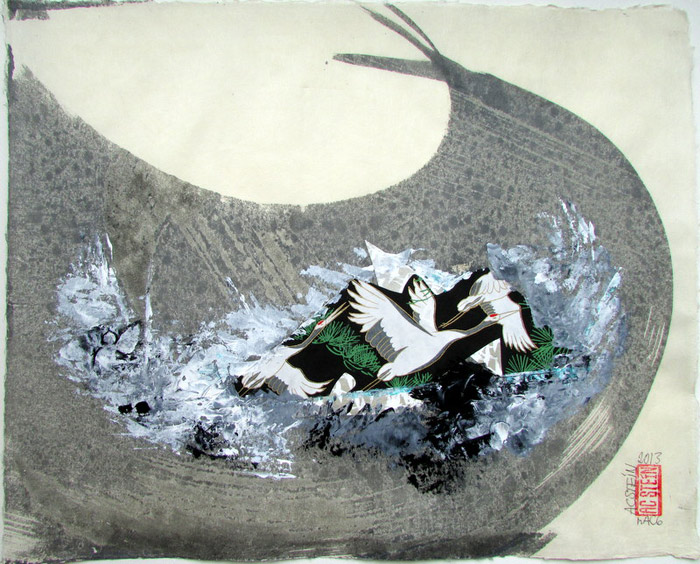
    I use Japanese paper and acrylic paints with various nice paper insert. A special tool for the acrylic paints. Also, a little black stretch-figure in all my artworks above my signature. All artworks are original. My paintings are influenced by travelling and different cultures.

    www.artacstein.com

    He had shown that the image did not exist, only chains of images, and that the very way these were assembled, from the genetic code to the Renault production chain, this assembly itself constituted an image, an image that reflected how we fit into the center or the periphery of the universe.

    –Jean-Luc Godard, “Changer d’image”

    In a video commissioned for French television in 1982, whose narration is quoted above in translation, Godard wrestles with the question of whether and how images can resist commodification.  The exhibition that joins works by Linda Francis, John O’Connor, and Ken Weathersby similarly makes me think about how artists can have a critical relationship to the near-omnipresent forces of the commodity market, in a culture of capital that has expanded even further over the past few decades.  The artworks here provoke questions about the flow of capital exchange that seems to saturate every aspect of our lives.

    Fluidity, flexibility: oft-cited keywords of the transnational corporate economy, which penetrates public space and institutions through privatization, and personal experience through digital information technology.  The mobile realm of production contracts labor wherever profit is greatest, while the deregulated financial industry increasingly speculates on the flow of symbolic capital itself.  Smooth operation is ostensibly the order of the day.

    Placing high stakes, making hearts ache / He’s loved in seven languages / Diamond nights and ruby lights, high in the sky / Heaven help him, when he falls

    –Sade, “Smooth Operator”

    Linda Francis’s recent work is based on electron-microscope images of the surface of a failed heat shield of a 1990s space shuttle, images that she overlays repeatedly on the computer.  Her pieces present technological visualizations of physical structure—a structure designed, unsuccessfully, to harness resistance.  The artworks also incorporate into the imagery evidence of the media that produce them, such as pixelation.

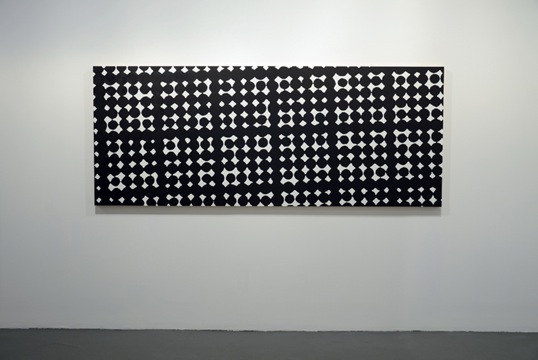
    Linda Francis, We Can Build You. 2013. Oil on panel, SIZE.  Courtesy of the artist

    Linda Francis, We Can Build You, 2013 Oil on wooden panel, 38 x 95 in.

    In Interference, the crystalline components arrayed within the image suggest patterned organization while eluding it.  Yet across the multiple silkscreened prints assembled in the piece, repetition and alignment at the edges structure the image. Thus pattern recognition in Interference is both fugitive and precise.  Indeed a strong diagonal current crosses a literal gap to a separate, larger panel that leans on the floor against the wall.  Shifts in scale and near-repetitions are vertiginous.

    Also patternlike but dizzyingly evasive, We Can Build You is a more physically factured, painted version of the image at greater magnification.  It resembles representations of biological code, and its title (taken from the Phillip K. Dick novel) evokes the manipulations of biotechnology, and more generally the way technological capitalism works on us.  Francis’s pieces invite contemplation of hypermediation and replication, as well as contingency, fissure, and friction, with a coolly observant gaze.

    John O’Connor also indexes research material in his drawings, which underscore the imbrication of psychological experience with an information economy.  As the Surrealists channeled the illogical logic of the unconscious, O’Connor cultivates delirious overloads of information processing.  He produces drawings by using shifting, idiosyncratic codes: converting text into numbers, reversing letters, translating letters into colors by randomly devised systems, running garbled text through an electronic dictionary.

    Turing (named for the computer scientist and his famous test of whether machines can think) presents an oval loop of linked bits of textual data.  The loop surrounds a set of inwardly folding, bunching shapes that evoke an organism introjecting and expelling.  O’Connor generated the incomprehensible data by a dialogue between his free associations, processed through multiple overcodings, and an electronic dictionary’s responses (one of which eerily speaks to Alan Turing’s persecution for his sexuality).  Characteristic of the artist’s work, the drawing appears both diagrammatic and indecipherable.

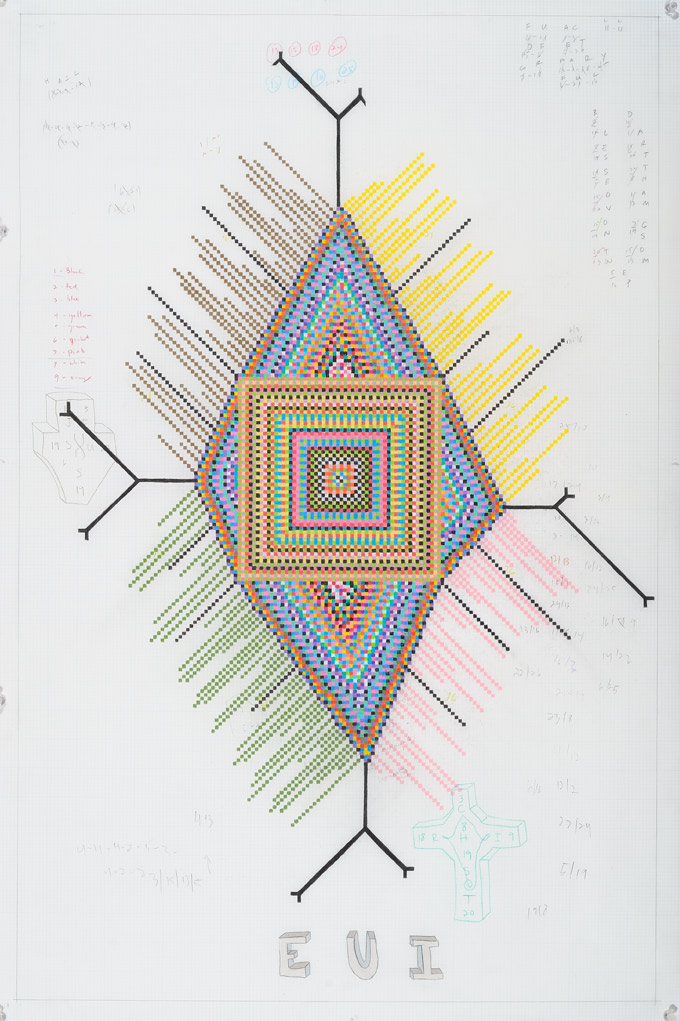
    In SUSEJ, a drawing of intricately colored grids, O’Connor includes notations of his text-to-color coding at the paper’s edges.  The piece invites us to comprehend the design of the delicate arrangement of colors, but its structuring principles are opaque.  Similarly, the thin, almost weightless sculptures Future Rods are covered in blocky text concerning prediction, which resists deciphering.  Obtruding on the gallery floor, they evoke the forces of futures speculation that invest contemporary life.

    O’Connor’s artistic practice mines the extra-aesthetic, representing processed information from the provinces of socioeconomics, politics, science, mass culture, and personal life.  His work does not so much assimilate these realms into absorbable images, but rather creates incongruity, discordance, uncanny disconcertment.

    John O'Conner, Suse J, 2013. MEDIA

    John O’Conner, SUSEJ, 2011. Colored pencil on graph paper, 43 x 25 in.


    197dccchWeathersby_opt

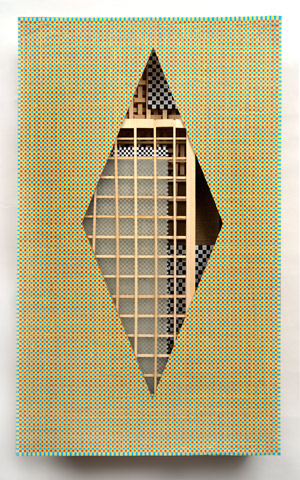
    Ken Weathersby, 197 (dcch),
 2012. 
Acrylic & graphite, linen, wood
. 25 x 15 in.


    Ken Weathersby, on the other hand, makes dissonant the constitutive elements of conventional art objects themselves, specifically paintings: that is, paint applied for perceptual activity, canvas or linen, and wooden support.

    In 198 (dc), paint is applied to a wood support, but that substrate is also image: it’s an elaborate grid of layered wood strips, which cutouts in the painted front surface reveal from the picture plane.  Meanwhile the painted image, an optically active grid of black and white squares, is a material slab of acrylic film directly glued to the wood.  The resemblance of the grids, and the equivocation of figure and ground at the level of image and physical material, confound distinctions between structure and surface.

    In the freestanding 194 (z), another painted grid of tiny squares echoes a larger grid of wood strips that supports the painting.  In this piece, the wood strips enclose the painting, holding it within.  The structure is a delicate cage that partially obscures the painting, here in its conventional form of acrylic on a rectangle of fabric over stretcher bars.  Planar yet viewable in the round, the hybrid 194 (z) presents us with ambiguity about what is supportive structure and what is visual display.

    Weathersby’s work foregrounds how the realms of visual image and material production are implicated with each other.  It is as though painting is posing questions about its constituent terms.  In 197 (dcch), what looks like a painting—a thin plane of an optically active grid of colors—is dissected to present a literal, physical interior that contains overlapping parts of other gridded paintings and wooden grids.  The piece highlights a sense of imbrication and conditionality.

    Interestingly, the container is also a key figure in contemporary economics; the container ship is pivotal to global exchange, as it’s designed to make the supply chain as smooth as possible.  Indeed, as the forces of transnational capitalism are ever more pervasive, they operate largely below the threshold of perceptibility.  The artwork of Weathersby, Francis, and O’Connor each raises issues of imbrication, of congruence and incongruity.  It resonates keenly with the extra-artistic socioeconomic situation, and its discontents.

    by Michele Alpern

    James Turrell, long known for his work with light and space, has devoted more than four decades to creating a naked-eye observatory out of the cone of an extinct Paleolithic Era volcano located in Arizona’s Painted Desert. Roden Crater and Autonomous Structures opened at Pace Gallery last March in anticipation of the light artist’s exhibitions in museums spanning three different time zones this spring.

    The exhibit was comprised of three parts: photographs of the Roden Crater, bronze and plaster models of areas within the crater, and fifteen Autonomous Structures.  These freestanding chambers are inspired by ancient structures like Machu Picchu, where the Incas built rooms and named them for the viewing experience each created for its visitors. They are: the Hitching Post of the Sun, the Temple of the Sun, and the Room of Three Windows.  The goal behind the Roden Crater and these structures is to create spaces in which intergalactic light and cosmic movement can be experienced.

    After becoming a pilot at 16, Turrell delivered supplies to remote mine sites and mapped the skies.  At a young age, he became used to perceiving the earth from above, seeing the photons around it.

    “We live within this reality we create, and we’re quite unaware of how we create the reality. So the work is often a general koan into how we go about forming this world in which we live, in particular with seeing,” he told Interview Magazine in 2009.

    Turrell calls for experiencing nature in a more profound way. He has called us light-eaters, crustaceans, people who build and become cities. With the Roden Crater he’s showing us how to crack open our surroundings and reach for that kernel inside us that promises the light we ate was not wasted.

    by Maria Anderson

    pacegallery.com

    Courtesy of the artist

    Courtesy of the artist

    For me as an artist, the city is a symbol where all reflections, experiences, and presumptions can be placed. As well as strong emotions, experienced identifications with cities control ways that the past affects the present or directly influences the future. Therefore, I create imaginary maps of different cities based upon precise places, focusing on the phenomenon of “The Tower” through the history of art and civilization. I named this body of work Urban Utopia.The  name by itself is not a mere coincidence but a result of an almost twenty year process of creating art forms, and way of living as well.

    svetlana-dragojevic.com

    News | Exhibitions