• There were forty galleries that participated at artMRKT.  From New York, to Beverly Hills, to St. Petersburg they all migrated to a singular billowing white tent with one collective goal in mind: to sell.

    I walk in a little unsteadily. The tent hums with activity. I feel as if I have just entered a hive—a highly chaotic, yet innately systemized heterogeneous structure. Each gallery is a single honeycomb, and within each of these chambers lies a hampered, assiduous little bee. Some of them nestle into their cells. Their delicate wings arch back, as their forelegs rest upon sleek white desks. The others, who don’t appear as self-satisfied, dart around the peripheries of their designated cubicles; their antennas begin to twitch if you appear just a little too interested. The space is permeated with a continuous buzz, and before I can help it I’m buzzing too.

    One relatively young artist attracted my attention. A Philippines native, Miguel Libarnes uses his mixed media objects as surfaces that engage and address the evidential dichotomy between his very catholic upbringing, and his self-proclaimed queerness.  Vessel, which was amalgamated with Fuchs Projects at artMRKT this year, quite obviously illustrates this duplicitous ethos. Libarnes employees a lenticular print method, which produces images that appear to have depth—therefore transforming the two dimensional spatial limits of the photograph into a three dimensional object. Two different images are spliced and then rearranged on a substrate. Libarnes interlaces images taken from vintage 1970’s gay pornographic magazines and vintage photographs of archetypal catholic sanctuaries.

    The piece, in and of itself, was fine in that it was executed successfully, and will quite possibly attract critical attention and become part of ongoing dialogues concerning the body and its relation to queerness in contemporary art. However, as a visitor to artMRKT, this piece immediately takes on another dimension solely on the basis that it is being exhibited at an art fair. Over the past ten years, there has been increasing discourse surrounding the negative ramifications of the multiplying number of art fairs around the globe. Art fairs have become notorious playgrounds for the bougie and bored. For those who want a very superficial taste of what’s “happening right now.” A space that inflates the prices of artworks that are mediocre at best, and conditions artists to produce work on the principle that it is to be sold above all else.

    To many art critics, galleries and museums, art fairs have become “The Real Housewives” franchise of the art world. The low-brow, flashy step-child of the art market—the remnants of the over stimulated, botoxed, Kardashian crazed world we live in today.  Art fairs begin to resemble a carnivalesque space, where the illegitimate becomes acceptable, and the Bravo “Housewife” in all of us comes out and mingles with the bawdy, the trashy, the glitzy, and yet ever so tantalizing carnival.

    The modern art fair is a drag show. Rather, a Bahktinian carnival where the spectator’s presence is concurrent to the performance. When you enter that white tent, and you engage with the artwork, reside on those oversized chaise lounge chairs, and even accept a glass of some brand of prosecco that sponsored the event—you’re there, so why the hell not!—you immediately become an active member of the performance. You go in with the intention to just observe, but even being an observer is part of the show. In perfect Brechtian fashion, we simultaneously become one with the performance, even though we are not on stage, so to speak.

    We have been conditioned to define our sense of self against the art fair.  However, within the space our self-awareness is in fact a conglomeration of our preconceived notions of art fairs and our body’s personal response to the experience. Mired in art culture as too flamboyant and unfathomably gauche, the art world’s defining itself against the art fair subverts the former’s disapproving gaze.

    Because even the art world revels in the trash. We all indulge some kind of guilty pleasure. We all like to think that the woman in the floppy white hat and over sized Chanel sunglasses, who seems really close to paying way too much for a photograph of a hermit crab eating a shoelace, is “one of those people” who buys into that whole “art fair thing.” But you’re still the guy standing next to her with that glass of free prosecco.

    By Ashley Temple
    Leah Oates: How did you become an artist and what is your family background?

    Brian Getnick: Art for me is a way of joining thoughts that might not belong together in any other discourse. When you make art, you can actualize these thoughts into forms and create models where they are indisputably united. I like that stubborn insistence.

    As far as my family is concerned, I’ll start with Halloween. We would start sewing costumes in early September. There’s a picture of me as an 8-year-old howling at the camera in a green tunic, swim goggles, witch nails and a felt rat sewn to my chest. Obviously, I was rat-man. I almost never wanted to be a recognizable character. When the holiday was over, I would make small figures with fabric and florist’s wire drawn from the world I had inhabited in costume, playing out stories around the house and in the woods. I never wanted the fantasy to end.

    LO: What’s your working process?

    BG: Play is my process. When I begin working on a performance, I make an object, mask or costume and start activating it by moving inside it or handing it off to a collaborator. For The Pest Horse, a performance I’m doing with Bryatt Bryant this August, I hand him the horse bodies and say, “Give me two performances.” It can be as simple a directive as that. He intuitively knows how to make something come alive and find out how it wants to behave. We record what he comes up with, we try it again, and eventually whittle it down.

    LO: Where did you go to school and how did that effect your artistic development?

    BG: I got my MFA in the Material Studies Department at the School of the Art Institute of Chicago. The department’s philosophy of encouraging the intuitive and pleasurable process of experimenting with materials gave me the breathing room to grow. Five years after getting my MFA, I went back to making plays with figures and costumes. 

    LO: What are the ideas in your work?

    BG: Memory, control, freedom and the body. In the total sensorial experience of my performance work, I want these subjects to weave in and out of visibility and articulation. My first desire is to mesmerize the audience with how the sculptural bodies that I make come alive, later fall apart, and how they behave in general. What they interpret this interplay to mean is up to them. That is a type of research that I couldn’t get if I simply installed my costumes as static sculpture in a gallery. I could only theorize about what the audience’s response would be. When I first moved to LA, I performed exclusively in queer nightclubs. The audience would shout back, walk away, and participate unexpectedly. No one felt cowed into submission by the pressure to interpret. They came to the club for pleasure and I wanted to give it to them. If they walked away entertained I was happy. If they absorbed some of the nascent content later, that was even better.

    LO: You are a performance artist who also creates sculptural objects. How is performance different from making objects conceptually for you as an artist?

    BG: My sculptures often take the form of theaters nested inside other things: a hog’s head, a prison, or a decrepit airport, for instance. I think of the theater’s architecture as a body or an extension of the architect’s body, which implies that the audience is being digested by the play. My performances are the inverse; all the fantasy is attached to the body and surrounded by the audience.

    LO: What is it like to be observed as a performing artist, and to also be observing the audience?

    BG: It feels like a political moment to be the center of attention. I feel that pressure. What am I saying in this arena? What are my values? I think this is why I tend not to perform as myself but as other things and with other people. I’m not interested in presenting a singular representation of selfhood. I’m not interested in the audience reifying me in a cult-like way. I’m interested in showing the audience a system of reorganizing or exploding the self into multiple, independent beings. I also prefer to have the audience mobile and unseated if possible, so that they can choose to see what they want, or to leave.

    LO: What kind of reactions and impressions have your performance works engendered from audience members?

    BG: My friend told me once that she thought of my performances as “home-school kabuki theater,” and I like that. My work has a lot of absurdist elements, so laughter is one of the first responses I get in galleries. Artists come to galleries prepared to scrutinize forms and analyze their meaning. I get this too. It’s hard to shut off the politic and history-seeking part of my brain, but with performance, the opportunity is to experience art bodily. The analysis is important, but it can happen later, or at certain moments within the total experience.

    LO: Why do you think art is important to people and to the world?

    BG: Art offers models of ways of being that are at best, deeply, internally researched. This is so important in the era of social media determined identities. I’m speaking here not of all art which, of course, can use social media as a material or a vehicle, but specifically of the fabrication of objects and of live performance. Solid things are derived at a slower rate and that gives you time to fantasize about an audience or ignore the possibility of an audience. I don’t think that can happen when you make things for the web.

    LO: What advice would you give an artist who has just arrived in NYC and who is not sure where to begin?

    BG: I would say: Consider measuring the energy expended on seeking prestige with the effects that it has on your body and your creative output.  Instead, find a community of people who will support you making your work and find places where you can experiment freely. I live in LA where the rent is low and the pay-off for experimentation and collaboration is very high. What I would suggest to the New York performance artist is to visit LA. I run a performance art journal and platform called Native Strategies with my partner Tanya Rubbak. If you’re a performance artist reading this and are thinking of visiting LA, look us up if you want an orientation. nativestrategiesla@gmail.com

    LO: Who are you favorite artists and why? 

    BG: There are so many. I love Asher Hartman who is more of an experimental theater director and works closely with an ensemble of perfomers who have worked together for over five years. Hartman tends to collide narratives and switch the identities of his characters in the script. The language he uses is often very dense and chaotic but because of the strength of his ensemble, the abstraction in his narrative(s) become grounded through the obvious humanness of the actor’s relationships. I just saw Glass Bang by Hartman, which is about violence, real estate, and ghosts. I also love Mike Kelly’s Day is Done project. He made this parallel universe of ghosts, vampires, virgins, pagan rituals, and bits and pieces from a pseudo biography all extrapolated from high school yearbook photos. It’s a template for someone like me who starts his process by making objects and then finds the performances inside them. I also have found precedent in his writing for the way I treat subject matter, how it comes in and out of focus in my work. In an Art21 interview he talks about beauty in relationship to a deliberate confusion between different contents: “I think what I make is beautiful … because terms and divisions between terms are confused, and divisions between categories start to slip. That produces what I think of as a sublime effect, or it produces humor. And both things interest me.”

    LO: What are your upcoming projects?

    BG: I’ve started color-coding my yearly output. What I’m presenting at Station Independent Projects this summer is the culmination of a year’s production of green performances and objects. I realized I was coloring work in 2012 when I was making Memories, a performance in which a big puppet’s limbs and head are controlled by dancers and musicians in blood red costumes.  I decided to research how color resonates for my work by starting this year by consciously choosing a color.

    I think of intuition as faith in finding substance in darkness. For the next several years I’ll be coloring that void until I have the complete works of the rainbow.

    Image Courtesy of Postmasters Gallery

    Image Courtesy of Postmasters Gallery

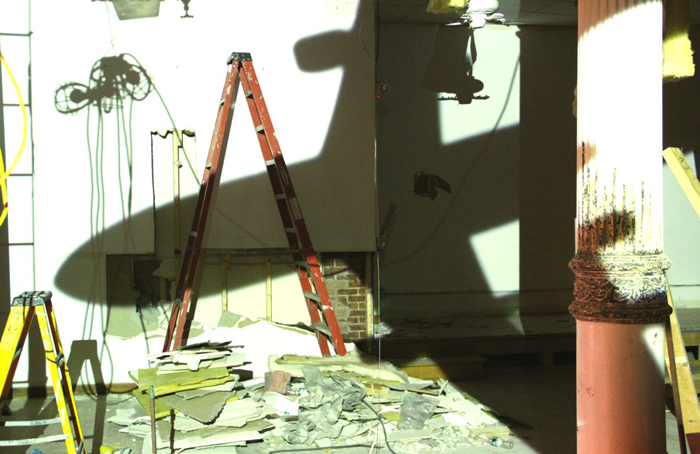
    Postmasters Gallery celebrates it’s new location in Tribeca and lets us get a sneak-peek of the unfinished space with an exciting installation by Serkan Ozkaya.

    Beta Launch of Postmasters Tribeca With Serkan Ozkaya’s Installation
    July 30- August 3, 2013
    Postmasters Gallery
    54 Franklin Street, New York City
    postmastersart.com

    From The Lightning Field, 1977, to The 2000 Sculpture of 1992, Walter De Maria was a dynamic artist whose work seemed to cover many bases including earthworks, Conceptualism, and Minimal pursuits; often executed in a strikingly large scale. Despite the overwhelming size of  his prominent explorations, Mr. De Maria was something of a recluse in his personal life, and did not readily expose himself despite indisputably being one of the most influential artists of the era. His work often embraced the form of selected environments and it’s inherent space, accenting the harmony of the meticulously placed object within the setting where it is installed. Using simplistic forms, he was able to elicit complex conversations including those of viewer relationships to perception and the importance of one’s positioning in relation to the object.

    According to his studio director, Mr. De Maria had passed away in his sleep, possibly due to a recurring stroke, on Thursday, July 25th. He is survived by his 100 year old mother and his brother, Terry. This soft spoken art giant always let his art do the talking. Now that he has permanently moved on we are left where we always were in relation to his work: in a perpetual state of awe, entrusted to continue the conversation in his absence.

    Image courtesy of the artist.

    Image courtesy of the artist.

    My work reflects emotion and passion for life and for different cultures. I was born in Paris grew up between Munich and the south of France. I now live in Luxembourg and I’m fascinated by New York and Singapore.

    My Italian heritage loves to express itself with a balance between the effect of strong painting knife work and a varying mix of techniques. This reflects all the different impressions I have crossed during my life. I love to create my own world on the canvas with warm and contrasting colors, where every dream could happen … and I love to share it with others!

    art-sophia.com

    When the Danish-Icelandic artist Olafur Eliasson was invited to submit his idea in a design competition, he had no idea that proposal would change the landscape and identity of an entire city.  That is exactly what happened when Your Rainbow Panorama opened on the roof of ARoS Aarhus Art Museum.

    Your Rainbow Panorama is a 250 ton artistic work made of 96 colored glass panels.  The 150 meter corridor (approximately 492 feet) is supported by 80 structural columns placed throughout the museum. “This is the future,” says  ARoS Museum Director Jens Erik Sørensen. “This is Blade Runner.” Sørensen explains, referencing Eliasson’s work to the 1982 science fiction thriller featuring Harrison Ford.

    Sørensen describes Eliasson’s circle as a symbol of eternity, the celestial or divine; sitting on the square museum building, representing all things static and earthly. But, Elof Westergaard, art, culture, religion author, and priest, emphasizes that Olafur Eliasson is not trying to make a religious statement. “What Olafur does is explain science through this work in a way that we can understand it and experience it,” says Westergaard.  Regardless,Westergaard also concedes that it is nearly impossible to experience Your Rainbow Panorama without feeling a divine presence or influence.

    The work is about understanding what’s around you; the ordinary, or mundane in extraordinary ways. It is your space, your perspective, and your experience defined only by what you filter through your lens.  Although a rainbow itself bears great  significance in terms of religious symbolism, Eliasson is quick to point out that his work with color is not symbolic nor is it his intention to project any esoteric meanings.

    One factor in the construction of this work is that it is not controlled. Visitors are encased in the glass corridor, but the experience is not manipulated. “No two visits are ever the same,” ARoS Communications Director Bjarne Bækgaard explains.  The time of day, the weather and even the people inside the exhibit when you visit effect the individual experience.  “This is really about what you bring to the rainbow and how you perceive your surroundings,” says Bækgaard.  Visitors interact with the space by  walking at their own pace. Some stop just to take in city from a view not otherwise seen..

    Your rainbow panorama also plays a significant role in the narrative of ARoS Aarhus Art Museum and the design of its architectural story.  The museum was constructed to have each floor and exhibition take part in its overall story.  “When we built this museum in 2004, it was based on Dante’s Divine Comedy,” says  Sørensen.  “That is why you start in the basement in the nine spaces, or hell if you will, and ascend the spiral to the roof top where you have this heaven type experience in the rainbow.”

    The exhibit opened in 2010, but, now even Eliasson admits it has become sort of a lighthouse or compass for the city.  Aarhus residents sometimes identify where they live according to the color of the panels facing their section of the city. “Before we had this rainbow, we didn’t have a landmark,” says Aarhus artist and designer Line Dyrholm.  “Now,” says Dyrholm, “we have an icon for our city.”

    More than a half million people visit the exhibit each year.  Aarhus tourism officials suggest there is a direct correlation between the opening of Your Rainbow Panorama and the growth of tourism in the city.  “If you look at the total number of visitors that we had to our 13 major attractions in Aarhus for 2011, you can see an increase of  300,000 visitors over the previous year,”  says Peer Kristensen, Visit Aarhus General Manager.  “That’s the same number that ARoS shows as the increase it had in visitors for the same year.  So, you can see people are coming to see the rainbow,” says Kristensen. And, the numbers are continually increasing,

    The next step for Your Rainbow Panorama is a metal ball to be placed outside the circle with space for visitors to enter. That phase has yet to be funded but many are confident it will soon be a reality. Currently, ARoS is completing a sky lounge as phase two of this exhibition and Eliasson is creating a sun to be placed inside the sky lounge, reflecting light from multiple angles. To sum up the purpose of Your Rainbow Panorama  according to ARoS museum’s director, this exhibit is the place to come to meet with art and yourself.

    By Jeanette Jordan


    The second feature film of the Ukrainian director Sergei Loznitsa, who is largely known for his documentary works, not only reached great attention at Cannes Festival in 2012, but stirred some debates as to his approach to the subject of war and humanity.

    In the events of WWII Belarus lost a quarter of its population and many villages still remain wastelands. There are still some gaps left over between what can’t be said and what hasn’t been understood or properly reflected on. Sergei Loznitsa, Belarus born, tries to bridge those gaps and makes us do exactly what we don’t want to do—be enclosed in a nightmarish existential reality where human nature is examined and stripped down to bare bones.

    Similar to some of the most important historical films, which have often not been very pleasing or comfortable, Loznitsa’s In the Fog is hard to swallow. Based on the novel by Belarusian writer Vasil Bykov, the film takes place in German occupied Belarus during the year 1942. A wrongly accused man, Sushenya (Vladimir Svirski) accepts his doomed fate and readily takes on a journey with his would-be executioners Burov (Vlad Abashin) and Voityk (Sergei Kolesov). Walking forlornly through the woods, they are looking for a place to carry out the sentence when Burov is suddenly shot and Voityk flees for safety.

    Fate, humanity, and free will are being questioned throughout the entire film in which Sergei Loznitsa seems to relate war as an external factor produced by internal conditions. In the beautiful visual choreography of Romanian cinematographer Oleg Mutu, the vastness of the forest with all its hidden dangers and thickening fog only reflect the uncertainty and helplessness of characters’ position. It is at this point that Sushenya chooses to stay with wounded Burov and carries him on his shoulders, making a vivid allusion to Christ carrying his cross.

    Unlike most war films that would incorporate battle scenes and crowds of actors, Loznitsa manages to reveal a humanistic tragedy set to the background of war, using only three main characters. With occasional flashbacks to their past, the director penetrates into their human behavior in a Dostoevsky-like fashion. Sushenya, who fails to persuade anyone, including his wife of his innocence, is left with a single question; “how is a human being able to change so fast?” All the fever of hesitation, unease, and suspicion in the air make the choices of Loznitsa’s characters ever more poignant and dramatic.

    By Masha Froliak

    Masha also had a chance to conduct an interview with Sergei Loznitsa about the film:

    Masha Froliak: War, or outer and inner destruction are common subjects for many of your works. Why?

    Sergei Loznitsa: There is something personal in it and perhaps it doesn’t only concern me, but others as well. Something very significant was broken and it is sad. I want to get back to that point of rupture, to understand what happened or at least to re-live that experience.

    MF: How important is a re-thinking of the past in your work?

    SL: I wouldn’t say re-thinking, I would say understanding of the past. Then the question is–is it important to understand anything at all about ourselves? Everything that connects us to the past exists in our present. Time doesn’t move linearly towards the events in our lives. Certain problems freeze unresolved; and even though the situation itself belongs to the past it may still trouble us with its uncertainty in the present. In order to understand what happens in the present we need to look again at those events of the past where our current condition stays still, awaiting that resolving effort.

    MF: Do you think that the whole tragedy of war can be portrayed with just three actors?

    SL: The whole tragedy of war can’t be portrayed with any film. One can only portray a short personal evidence in the background of this larger catastrophe.

    MF: Your documentaries are so visually beautiful that they seem staged and your feature film In the Fog seems almost too realistic. Where is the boundary between history and fantasy?

    SL: Everything in cinema is a fantasy. And what is most interesting is that it is a fantasy of the viewer. You say it is too realistic however it is not clear what that means exactly. Any film is staged. I chose a location, a subject, and I place a camera. Everything the camera records is evidence of what happens in front of it. After which begins a fantasy and a variety of interpretations, which creators of the film think they are able to control.

    MF: Please tell your thoughts about the last scene when the main character makes his final decision.

    SL: I don’t have thoughts regarding the last scene. It is a story, a story that ends that way. Why does it end this way? What is the story about? That’s what a viewer should think about.

    MF: Are you fully satisfied with any of your films?

    SL: So far I have been lucky. I have always been satisfied with my works. Sometimes this feeling comes with time. As Volodya Golovnitskyi, a sound producer I work with said, “If you don’t like the film, watch it again.”

    MF: Are you currently working on a new film and what is it going to be about?

    SL: At the moment I am working on a short documentary and preparing for a feature film. It will be called “ Babyn Yar.“  It is a film about the tragic events that happened in the fall of Kiev in 1941.

    Image courtesy of the artist.

    Image courtesy of the artist.

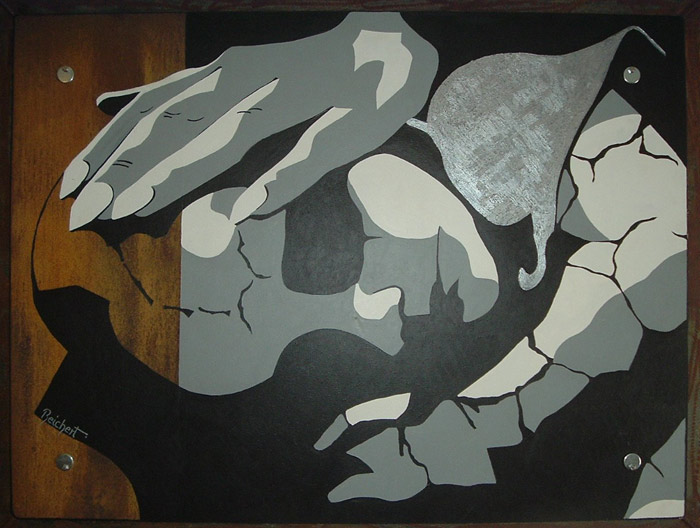
    My first steps are applying watercolor paints and pastel, then I use an abstract style in oil and acrylic.
    After living a few years in the abstract world, I began to be disgusted by huge global abstract productions.
    My style now is very much trivial or primitive.  I adore letting off steam and creating a unique design from scenery, faces, nudes, drifts, emotions, and so on. Next, I’d like to take pictures in B/W, and to give them a special mark with my paintbrush, of course in acrylic and with a lot of effects.

    lucreichert.com

    Image courtesy of the artist.

    Image courtesy of the artist.

    I write poetry with watercolor, mixing the presence of light and shadows with unpredictable patterns and layers of vivid colors.

    The definition of a sacrament—an outward and visible sign of an inward and spiritual grace—describes my artwork, why I make it and what I hope it stirs in others.

    julieannstevens.com

    Design for Museums, Theaters, and Cultural Institutions


    “Now that culture is for everyone and everyone is for culture, culture is everywhere.” It’s a bold statement indeed, and one that appears along the spine of this smartly bound hardback title recently put out by Gestalten Press. Identity is a reflection of the cultural tempo of the times. museums, theaters, galleries, and other cultural hubs have come to represent spaces that educate us, and eventually culture us. However, when we look at the posters, banners, catalogs, and transport graphics that have been the reticent voices of these institutions for decades, we begin to wonder what has pinpointed the cultural tempo most effectively. Is it the artwork housed within these venues, or the design of the institution’s tangibly branded press artifacts?

    Branding has been associated with industry, a comparatively lowbrow sect of culture, at least when defined in comparison to cultural institutions. Yet the gap between high and lowbrow culture is rapidly closing and overlapping. As art has become increasingly commercialized and branded, institutions have had to follow suit. This phenomenon is responsible for the evolving function and identity of the cultural institution as a whole.

    This book reveals exceptional graphic designers that have worked with curators, forming an alliance or bridge between “institutions, artwork, and audience”—synthesizing a personality for these institutions that visitors engage with on a regular basis. Introducing: Culture Identities pays homage to the graphic designs and branding patterns that have shaped the way we perceive these salient cultural institutions. Graphic design in all forms, however subtle, from local to national museums, galleries, art fairs, and theaters, creates a web connecting cultural identities. The glue of this web is a connective aura produced by selective branding.

    This title presents a collection of case studies and analyses forming a superb recourse for understanding the role of museums and other institutions. It is often overlooked that museums, such as MoMA, do in fact engage their viewers with highly effective branding tools, not unlike the ones we would find at the local Starbucks or dare I say it, McDonalds.

    News | Exhibitions