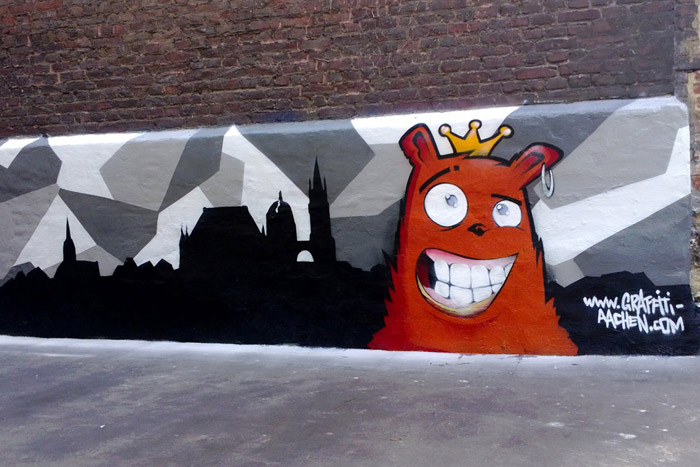
For more than 25 years, my life has been filled with graffiti and street-art, which should brighten up the public areas and beautify grey walls. To follow my passion, I need some spray-cans and a piece of wall or canvas. My work connects figurative characters with detailed graphic elements in the background. The longer you look at one of my paintings, the more details there are to discover!
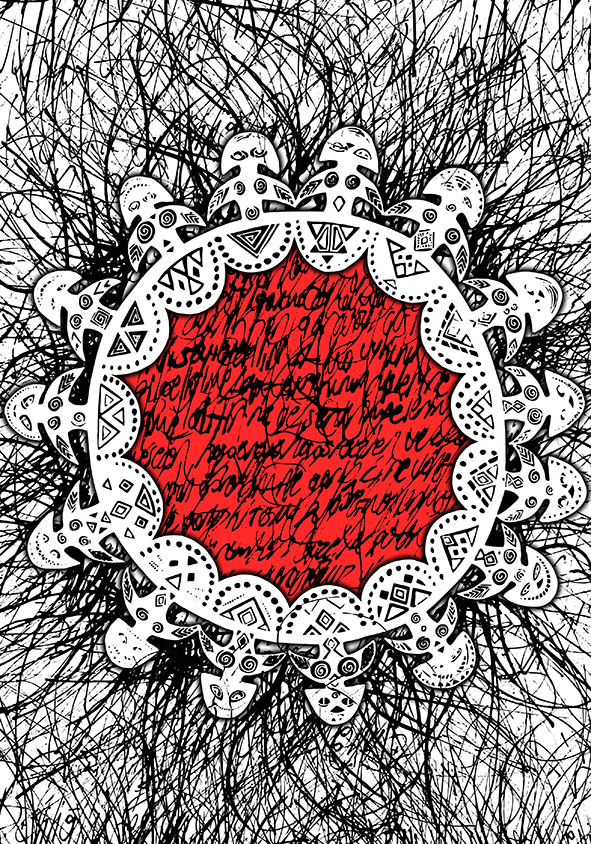
In my designs, I mostly inspired with the cultural environment that I have been. The geography I live has a rich historical past, which has been host to many different cultures for centuries. Legends, laments, tales, belief systems, and tragedies are still part of our lives. Endless fights and political games are normal for the life of each of us in these lands. Here, all these rich cultural accumulations and intensive political agendas are the source of my designs.
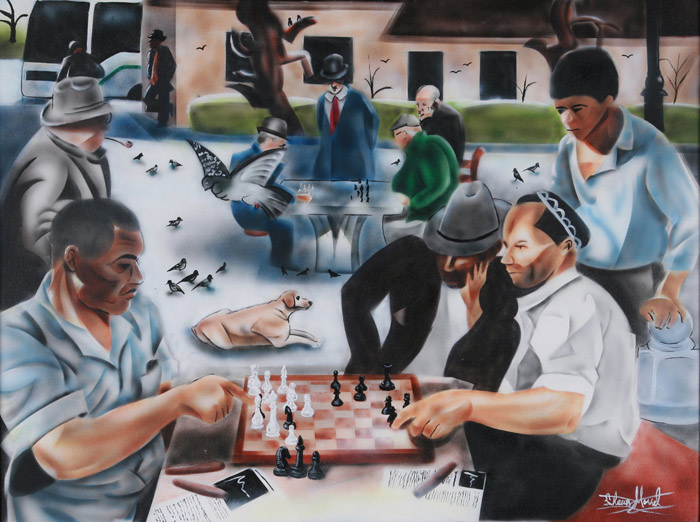
My work is inspired by the aesthetics of the Art Deco and Cubism movements, and pays close attention to shape. The “Urban Moment” collection focuses on people in everyday urban settings around the world. Celebrating the beauty of multiculturalism has led to a diverse following of the series.
1. Eh, voilà! Inside the commune mailbox is an old fashioned, hefty brown flat packed with books from Antenne Publishing in London. All of them are by or about one Victor Boullet, a migrant artist with a French name, who claims to be of Scottish origin but was brought up in Norway, and is now waving the flag of Paris. Who exactly is Victor Boullet and what is his project? The only sane way to approach the subject is by fiction, in which Victor Boullet is a character. Which, it turns out, is precisely his goal.
2. The flat has three books: Kronos by said Boullet, a slick and glossy photo tour of the artist’s work circa 2012 (vegetables and beach scenes thrown in haphazardly), The Institute of Social Hypocrisy by Victor Boullet, a massive white tome with photos and text, and Time is the Assassin, which purports to be something like a novel, and which I have been tasked to review. I dismiss Kronos as being yet another artsy exercise in self-justification and note that despite the intriguing title, in Social Hypocrisy much of the text is written by others.
3. Time is The Assassin is the black sheep of the bunch. With more than a hint of anxiety I wonder if this V. Boullet can pull off the ritual exercise in self-justification. Being a literary type, I miss neither the reference to Rimbaud’s Illuminations (the line “Now is the time of the assassins” appears in Matinée d’Ivresse) nor the cheap cut-up of the cover of Henry Miller’s Time of the Assassins. Those two are from another world, prophetic texts, records of the author’s confrontation with himself. Mr. Boullet is setting high standards on which to impale himself.
4. On the largely black cover, Victor Boullet’s name appears in blazing white – in this first five minutes, I’ve already gotten the point that this gentleman likes to bruit his name about—the title is in gray letters and down near the bottom in barely perceptible type, “Ghostwritten by Kristian Skylstad”. Ahem. My sensors quiver wildly. Out come the scapels. I prepare to move in for the kill. Mr. Boullet has his very own ghostwriter to do the work for him.
5. Let me tell you something I didn’t know at the outset of this review, although it should have been obvious from the moment the box was open: this Boullet is a trickster. He is canny, and not without his humors — although he is careful to avoid the comedian’s fate. One example: he invited the curator Damien Airault to a week’s residence at the Institute of Social Hypocrisy’s gallery in the Marais and — held him hostage. Airault could neither leave the gallery space nor communicate with his captor — the artist — for a week. Food was ferried up the side of the building in a basket. A neat role reversal — a curator trapped inside a gallery — as well as a commentary on power relations in the always-ethical art world. “I want to make him a better person, a better curator,” the droll Boullet said by way of explanation.
And now you know more than I did when I took Time Is The Assassin with me into the metro, to ride around for a few hours and read the book twice.
6. The novel takes place in a dreary suburb on the outskirts of Oslo, in a dreary bar that is way closer to Hell than, “fucking, swinging Pennsylvania.” (The author’s words.) The opening pages are exceptionally dubious, a messy, post-modern wank-a-thon. For example? Everywhere:
“There was a time when art could alter society, but that chance was missed. This in front of me, these four imbeciles sitting with me, a hypocrite either way, cannot and will not be changed by art. And these four in an absurd way control society in their passivity and I don’t even know or care if I know or care if that’s OK or if it matters.”
Who is speaking, Victor Boullet or his ghostwriter Skylstad, and who cares? I’m barely to Trocadero and I’m tempted to spin the book out the window at an angle. With a bit of luck there will be a car passing the other way and the book will land on someone else’s lap. That’s part of Boullet’s plan, too.
7. It gets better: people are getting drunk and they make fools of themselves, humanity enters, a possible novel raises its head. There is a cast of characters: Boullet, endlessly pontificating, superior to the others; his brother the photographer, the butt of most of Boullet’s jibes; the occasionally glimpsed Skylstad himself; Tim the Jacuzzidude and Tina, the drunk, who sobers up long enough to deliver a fascinating excursus on what blind people may or may not see. A kind of anti-novel takes shape, in which drunks in the middle of nowhere debate life.
“Maybe I’m blessed with standing in a twilight zone here in the road of Saturn, in pure delight, almost touching delirium… It’s genuine frenzy this, standing here at the bar. I’m consumed with gladness. A taste of heaven. The moment of inspiration, brought to me by intoxication.”
I dodge the cops at Republique and take the No. 11 to Place des fetes.
8. Boullet’s idea is to be a fake, a hypocrite, an actor — while saying something real about the art scene and life. His paintings are bad, his sculptures derivative, and there he is, feeling his way, asking us, “But are we really alive?“ A pest, a nebbish, a loser, like your current NYC mayoral candidate, who, while claiming to be faithful to his wife, cannot keep his grubby fingers away from the naked pix. In Boullet’s case, Art is his wife. It must be everything he wanted when he was a kid, and now he finds the only way to be faithful to the original idea is to drag his bride through the mud.
But with humor. He imprisons curators and forces his empty work which looks good into exhibitions and raw space — and no one can tell the difference from the other stuff on display. When the Institute went bust and Joseph Tang opened a gallery, Boullet created an installation that loaded the space with dim sum noodles which slowly moldered away.
9. Whether it is Boullet’s intention or Skylstad’s, the novel is constantly searching for a way out of our society’s materialism and the trite, platonic otherness festering inside conceptualism. Gilles Deleuze’s A Thousand Plateaus is mentioned at length. Then Shelley’s Defense of Poetry, Anais Nin, and an angelic appearance by Marina Abramovic somewhere in the dark between two bars — surely one of the book’s high points — even if it’s clear that these Grand and Glorious Guardian Spirits won’t get Boullet out of his jam, which is: “What to do now?“ For that you need the supernatural, an extra-human agency. The book delivers it in the form of a talking bear that out-talks Boullet.
Miserable miracle, the book is awkward, excruciating and funny. (Its reflections on Norwegian and Scottish cultures alone will be enough to make the Tourist Boards grind their teeth.) In other words, a night of serious drinking. It is 87 pages long and the best Anti-Novel of the year so far. By anti-novel, I mean a piece of fiction that says what it wants and doesn’t give a damn about commercial rules of order.
10. Back home, the two other books from Antenne look considerably different now. They are both funnier and more pathetic and I can’t help but wish Boullet luck. He exists in a kind of agony of self-awareness, ceaselessly asking, Is that all there is? His generation, ten years on either side, have all gotten the point: one can create safe, “conceptual” or post-Dada work and, on the European model, glide quite smoothly into the academico-gallerist-museum structure where your more or less meaningless work will pad out show after show. You will get residence after residence and live reasonably comfortably. Boullet meanwhile paces the beach like a Scottish Hamlet, has photos taken while he pushes driftwood around in various poses of Artist At Work, and worries the Whole Thing. He is a messy version of this generation’s Duchamp.
11. “Never think of minimizing the importance of challenging accepted truths, and you should go against the flow — you will go where no one else dares to go. You will enter the eternal uncertainty, and you will never come back — but even if you know it’s a road you have to take, and even if you know that road is closed, you should go there — in the dark. Alone. There you will find something real.” So saith the Bear in his broken English.
“We shall not forget that yesterday you glorified each one of our ages. We have faith in the poison. We know how to give our whole life every day. Now is the time of the Assassins.” – Rimbaud, Illuminations.
By Iddhis Bing
The 5th Auckland Triennial
Auckland, New Zealand
May 10-August 11, 2013
Fresh Paint: Festival of Artists at Work
Tel Aviv, Israel
Aug 17 – 18, 2013
Art Copenhagen
Forum Copenhagen, The Netherlands
August 30-September 1, 2013
Joshua Liner Gallery is pleased to present Summer Mixer, a spirited get-together of emerging and established voices from national and international galleries. The group exhibition will feature works by nine artists, all of whom are debuting at Joshua Liner Gallery. Each one takes a fresh approach to the material and historical bases of artmaking, flouting conventional notions of genre, discipline and context.
Alex Lukas, Ann Toebbe, Eric Cahan, Mark Fox, Neil Ayling, Nicola Lopez, Wayne White, William Bradley, Rebecca Shenfeld
Summer Mixer
August 8 to August 30, 2013
Reception: Thursday August 8 from 6-8pm
Joshua Liner Gallery
540 West 28th Street, NYC
joshualinergallery.com
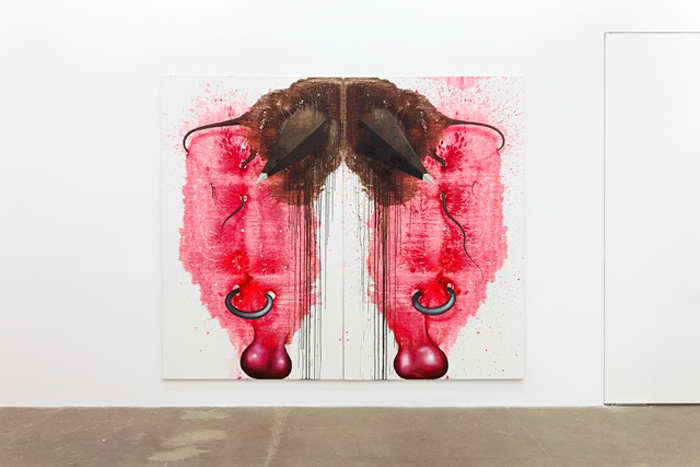
Irena Jurek: You hang your paintings off meat hooks, place them on pedestals, or even catapult them. Within all of your paintings there’s this idea of painting as object.
Caitlin Cherry: At the core of it, there is this impulse to take traditional painting on stretchers and alter the way its displayed. I feel like painting in general, out of all of the mediums, has this aura of protection around it.
IJ: Like a sacred medium?
CC: Yes, it’s like a sacred medium or respected or feared in a way. That’s why I’ve always been inclined to keep paintings on the stretcher, and I haven’t been the type of artist who wants to do assemblage. I want to maintain that as a face, there’s this history or trajectory of painting and I want to use how I display paintings to speak about that. I want to use my paintings as weapons but they are also used sometimes to enact violence.
IJ: Can you talk more about painting being a metaphor for a battlefield?
CC: Painting is the best way that I know how to communicate. It’s essentially me throwing my ideas at you in a literal, slapstick way. People are always invested in seeing the painting upright and on the wall. They’re almost invested in this safe way of viewing.
IJ: It’s like a control group almost.
CC: Yeah, I want them to see a painting on a catapult or they see it away from the wall. Makes them think about it differently. That whole conversation of painting as object, painting beside itself, is a typical conversation around painting. I view painting as an object, and there’s just as much conversation coming out of its back, the stretchers, where the stretchers came from, the canvas that it’s on, and the signature on the back; there is as much information as on the front. The back speaks to this history and the front has the ideas. I view them both as speaking at the same time, so it’s necessary to show both. As far as painting as battlefield, I’ve never wanted to make it seem like I’m against painting. It’s not that I hate painting, I love painting.
IJ: I could see that, but I think there is a history of the idea that there is this romantic battle; painting a painting is a battle, especially found in the works of the Abstract Expressionists or Expressionists in general. There is a certain sense of humor found in that aspect of your work.
CC: Right. Sometimes you come into the studio and it’s the best studio day and you think that you made the best piece of art ever. Then the next day you think, “this is shit, I don’t know what this is but I’m never going to show it.” I want to show you that battle on the canvas. I think all artists have to deal with their medium as a battlefield, and that’s just the process of creation. It’s never a straight lined good thing, or if it is you’re doing it wrong! Or you have way too many assistants or you planned everything out too early.
IJ: I think that it’s also more of a newer attitude to show that aspect, to show more vulnerability in art. Older generations weren’t as prone to do that.
CC: It’s totally different from this idea of bad painting, where somebody consciously attempts to show a struggle that is not real.
IJ: It’s almost hyper ironic, bad painting. It’s self aware of being bad. By using the metaphor for painting as battlefield, you’re actually reintroducing the idea of effort or importance and significance.
CC: In all of those battles, which go down, the end result isn’t always the same. There are times when the painting survives and becomes the most important part of the installation, and it doesn’t get graffittied or covered up. Then there are times that it does, and the sculpture or installation has to win in order to redeem the whole project. Sometimes the paintings are heralded, and celebrated, they’re put on a pedestal literally and other times they are leaning over like they’re ready to commit suicide. I’m interested in showing all of that. It’s just more real. It is just really the process of working in the studio, and the studio is a battlefield, you know?
IJ: Sometimes you set paintings on fire, using fireworks. There is this performative element to you work. How important is your role as performer/painter to authorship? Where do you see yourself? Are you always present?
CC: I guess the question is am I the perpetrator or the savior? I’m definitely a performer in my work. I never want to be present completely in the physical way. In the Loyalist installation, where I had the canon fuse, it was never my intention to show the canon fuse being lit in the gallery. It’s theater that isn’t meant to be seen, it’s theater that’s happened in the past. It was supposed to be a past action; this canon fuse had already set off a canon that was shooting at the other painting, the Queen Victoria painting. I’m more interested in you seeing all of those layers of possible destruction, and the actual painting that was previously there, than I am watching the whole disaster go down. Either I would show up before the action or after the action, but I wouldn’t show the action itself. I think that takes a lot away from people seeing two-dimensional objects like paintings.
I’m trying to concentrate on this 2D/3D tension where you’re moving through different realities. You’re creating a reality through painting, and the sort of reality of seeing ready-made or constructed objects next to each other. Performance is just another can of worms that I’m not interested in opening.
With my installation at the Brooklyn Museum, there’s two pieces that have the potential to be launched, and there’s one piece that has been launched. I’ve debated in the past whether I’d show a painting being launched as a performance, that’s the obvious question that everyone asks. I would never show a painting being launched.
IJ: You have a recurring cast of characters in your paintings, you have this amphibian every person creature, the black santa, and the sexy bunny, among others. Could you talk more about the characters in your work?
CC: The Golem character, the every body, everything character, is actually from Jewish folklore. There are tales of this anthropomorphic being that gets created out of clay or sand or dirt and then becomes animated and then essentially kills its creator.
IJ: That’s almost like a twist on the Narcissus myth. Do you identify with any of the characters?
CC: If I were to identify with anybody, I would say it would be the Golem figures, but they identify with everything. Their purpose is to be chameleon like, I identify with that sort of way of living. You have to be a chameleon to be at a certain party, you have to be dressing like everyone else. Golems can be any color, and sometimes they have to change genders.
I’ve always had this narrative of a post-human world. Maybe they’re aliens that have come back that are trying to pick up the pieces of American civilization.
IJ: There’s definitely this idea of time in your work, you’ve recreated the DaVinci catapults for your installation at the Brooklyn Museum. Could you talk more about that?
CC: It’s funny that we were just talking about the Golems taking over the future, but most of my work is about the present or the past. I have a personal fascination with history, but I’m also interested in war and politics. I really don’t want to talk about those things that specifically.
IJ: It almost seems that there is a sense of play and humor that references much more serious issues. That’s a way of allowing people to think about those things using satire.
CC: It could be considered satire, because the paintings seem light-hearted on the surface. Depending on how you look at them. If you’re just looking at the paintings, things could come out looking quite humorous and light-hearted, but if you look at everything at once you get a different interpretation. I’m not trying to necessarily make fun of war or politics, I’m just trying to give light to the fact that things you would think are very serious are humorous at the same time. When I make pieces like the Sarah Palin paintings or paintings of politicians in them or black Santa, or the Easter Bunny girl, they’re all equally fictional and absurd. The humor exists in recognizing that Sarah Palin is not much different from…
IJ: There’s this fallibility in the characters. Although none of them are really human, even Sarah Palin, they’re all deeply human on a level. By removing the human elements, you make them more human in the end.
CC: Totally. That’s the purpose that the Golems serve. It makes it easier for me to insert dialogue, whereas to put humans in the paintings, for me, would make them very weighed down. These Golems can be whatever I want them to be at any given time.
As far as the whole satire and war, it’s not that I’m trying to make war seem lighthearted, but I’m trying to get people to recognize that these things are not sacred. These things are a part of who we are. At the same time as I’m representing Queen Victoria, Britain, and America as a battle, it’s also connected to how we all have these times of great hatred for other people, fights, and jealousy. We all shoot the canon and launch paintings.
IJ: There’s a little heaven and hell in all of us.
CC: It’s not that there’s humor in that, it’s just that I’m trying to point out the humanity in war just as much as I’m trying to point out the humanity in laughter.
IJ: Do you have any upcoming events coming up?
CC: As far as upcoming events, I am curating a show, TIS BANK, at Torrance Shipman Gallery, in Sunset Park. It is an artist-run space I co-run. The show will feature work by Lisa Cobbe and Troy Michie. I will also be giving a talk at the Brooklyn Museum on August 29 with art writer and critic, Nick Faust.
Leah Oates: How did you become an artist and what is your family background?
Kristen Copham: I have identified myself as an artist for as long as I can remember. I had strong drawing skills as a kid, so I benefited from early encouragement. I now find the title to be a little vague and commonplace, so sometimes in response to “whaddyado?” I say I’m an illustrator, an entrepreneur, an international playgirl, or a janitor. My family background is about as idyllic as it gets: close knit, working class, Midwestern, rural, fun, genuine, devoted, quasi-religious and to top it all off, lucky.
LO: What are the ideas in your work and what is your working process?
KC: First, I try to work at all. It’s easy to be busy, discouraged or frustrated with what I’m trying to express. And since it’s pretty entertaining to create work in my head and takes a lot of effort to do it in reality, discipline can be a challenge. But, I know that practice is crucial to successful expression. I keep a sketchbook in my purse most of the time. I draw in it some of the time, and I embark upon drawing sprees and then drawing famines. In the studio I paint because it’s easier and feels more natural. Painting is all about my process – organizing and mixing color and materials, and supporting the ideas both have to coalesce into one cohesive moment. By the time I do all that, the brush does the rest. Unlike a pen, a brush is fairly forgiving. I need the pen in order to quickly capture ideas or images that seem to come out of nowhere, and usually those are the ideas and images worth exploring further.
My specific ideas tend toward interpretation and representation of the natural world. This planet and the human experience fascinate me every single day. I’m working on merging the internal with the external world – practicing both seeing and feeling. I try to paint looking at both the outside world or “reality” and the inside world, my place of intuition. I like to paint people from life verses photographs, which flatten out expression and nuance. I’m not saying I can capture those things in a painting either, but the process of building the personality through layers of color and tone while watching how someone moves and interacts with the world seems more dynamic to me than capturing the shadows and light across a face in a fraction of a second. Doing the latter successfully takes way more talent than I have! Mostly I just have a color addiction.
LO: You’re a portrait painter, which is a tradition that has produced some of the best works of art ever created. What is it about the human face in painting that fascinates us and what are some of your favorite portrait paintings?
KC: In terms of portraits, some of my all-time favorites are Alice Neel’s portrait of Andy Warhol, affected and fresh; Lucien Freud’s raw, honest and unapologetic portrayal Queen Elizabeth; Sylvia Sleigh’s various paintings of her hairy, handsome Latino model with the humungous afro; Dana Schutz’s portraits of her fantasy last-man-on-earth “Frank”– especially the one where he is bright orange and floating on an ice chunk in an endless sea; Nicole Eisenman’s fabulous prints of faces; Elizabeth Peyton’s romanticized depiction of Kurt Cobain; and Frances Bacon’s disjointed portraits of his lover. Classically, I appreciate the rawness of Rembrandt’s moody self-portraits, and figuratively I’m a fan of El Greco’s movements and gestures as well as Jenny Saville’s big juicy nudes. Don’t get me going, I could go on and on … I love all of it!
The face expresses so much. It’s how we connect with each other. And faces are so varied and interesting, yet they are all fundamentally the same. Eyes, mouth, nose, ears, and hair (or not!) on a head. We all have a face, and we simultaneously express through it and receive information through it: through all the features of the face we see the world, we hear and listen, we speak, breathe and consume. It’s telling how we tend to find faces in abstract works, isn’t it? The face is the first thing we recognize as babies. I must add that the human body is equally incredible: how it moves in space and interacts with the world, its curves and lumps and lines, the way it can express feeling.
LO: How do you select the subjects that you paint?
KC: Often I let them select me, as with my 1000 faces project. Sometimes I’ll see a person who I just want to paint because they look so unique or their expression is especially intriguing. Occasionally I’ll ask a stranger to sit for me, but usually they just think I’m strange and don’t respond. For my “Male Artists Exposed” Series, I painted men who were artists, not models – in order to subvert the idea of the model as object, explore ideas of subject-hood, and because I thought it was fun being a woman artist painting nude men. I’ve also done a series of nude paintings of my friend David Gibson, a talented curator about town. He’s a big guy, which for me is exciting because the resulting works challenge our ideas about beauty and the human form.
Painting family, friends and lovers is a natural inclination. I want to study the faces of the people I love and record my vision of them. It’s a perceived form of making them immortal, I suppose. I never want them to die!
LO: You ran a gallery called LZ Project Space in the Lower East Side for several years. How was this experience and how was it to be part of the emerging gallery scene in LES?
KC: NY Studio Gallery started with my studio rental on the fifth floor of the Whitehall Building on 25th street in Chelsea. I consolidated my living and working space in 2007 and moved myself and NYSG to my building in the Lower East Side. Later we expanded to a small annex space in the back of the building and called it LZ Project Space. We hosted artists such as Arielle Falk, Emmy Mikelson, Ernest Concepcion, and many more amazingly talented voices. It is a tradition that continues to this day with Leah Oates’ sophisticated vision at Station Independent.
At the time we had a great line-up of dealers with exceptional exhibits on the block: Alix Sloan, who still deals at fairs and has shown out of the NYSG space, Collette Blanchard on Clinton Street, the non-profit Participant who is still a player. I feel honored to have been a small part of the emerging scene in the area. It continues to grow. Today longtime East Village art dealer Paul Bridgewater runs Smart Clothes Gallery out of the space.
LO: Why do you think art is important to people and to the world?
KC: Art captures the time, place, and feeling of a culture and on a grander scale, of the collective unconscious of the planet. We preserve art because people relate to it at a fundamental or archetypal level and in turn it relates back to the experience of being human. It speaks to something universal, which is why humanity has the urge to preserve art and look to it for answers. It offers a time-space thread of connection to our past and future, to shared and personal experiences. It’s the same reason people are often threatened by art. Why else would ancient relics be defaced, or coveted or stolen, or traded at breathtaking prices? As E. H. Gombrich points out in The Story of Art, why would you care if someone poked holes in the eyes of a picture of your mother? Because the image has power!
Another interesting thing about art is that it is both all around us and inside us. Making art is a way to give yourself a voice, give yourself that power. The emergence of graffiti-art all over the world is just one example of how young people use mark-making as an outlet.
LO: What advice would you give an artist who has just arrived in NYC and who is not sure where to begin?
KC: It depends on what you want to achieve. I can’t really give advice generally since everyone has different dreams. Do you want to make more work? Organize your life so that you can work. Do you want to sell your work? Figure out your niche, find your audience, create a selling plan. Maybe you use the Internet or throw open studio parties or connect to an interior designer. Do you want a dealer? Do your research and make a plan to find representation. Having representation outside New York can help, especially if your rep does art fairs and has a solid collector base for whose taste your work fits.
There’s nothing that feels worse than being an artist and not working. Even if other things are out of place – money, or love, or logistics, of life – find some way to make work, even if it’s simply jotting down ideas on napkins you carry in your pocket. If you have a serious practice or think you’re good enough to be represented, research your possible galleries and make a plan to have your work considered. Haha, I should take my own advice!
LO: What are your upcoming projects?
KC: That’s top-secret information! (smiles) But I can tell you a little bit … In my upstate studio I’m working on a series of mountain paintings based on the time I spent last year in Colorado and the Swiss Alps. In entrepreneur-land I am developing a cartoon character that teaches yoga to kids. Of course I still regularly paint portraits, either in Manhattan or on the road. Can I paint yours?
Lately I’ve been trying to synthesize aspects of the external world, specifically the natural world, with ideas of the internal world: living life, learning, making errors, being human and animal at once. I’m trying to mesh those ideas in the mountain paintings, which are both large and sparse – a challenge for a painter who typically covers every square inch of canvas with paint. I may need to bring the practice into plein air for a while. Now and again I’ll find myself fussing with collage, culling old sketchbooks, and looking at art in NY in order to find inspiration and make connections. I meditate and ask the universe for clarity, focus, and clues to discover that next big project that will consume my passion. Anyway, those are just a few of the grand and sometimes ridiculous ideas that I wake up and go to sleep with. I’m ashamed to say I have another three or four non-art related projects that regularly distract me as well, like fitness, food, writing, or real estate, to name a few. Unfortunately, I’m a busybody, and that’s never done my art any favors.

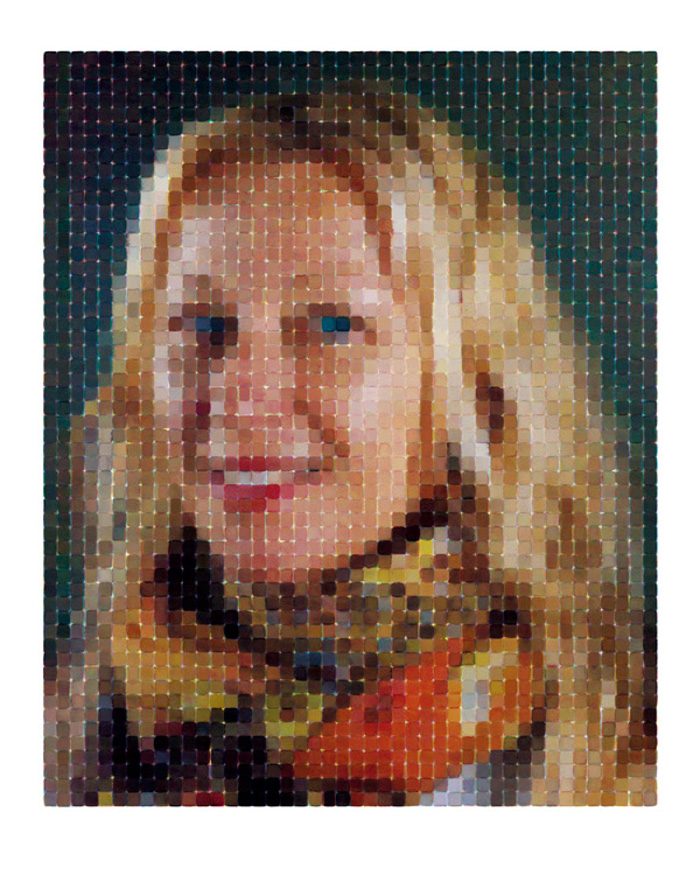
Celebrated artist Chuck Close will show his recent work at Guild Hall in East Hampton, NY, for the second time since his solo exhibition of large scale Polaroid photographs, Chuck Close Up Close, in 1991. Mr. Close always had been an experimental artist who consistently strive for new methods in making his art. In the upcoming show at Guild Hall, his recent works in a variety of mediums including tapestries, large-scale watercolor prints, and hand-stamped portraits on paper will be on view.
Chuck Close
August 10- October 14, 2013
Guild Hall
158 Main Street East Hampton, NY
guildhall.org
-
Tarsila do Amaral: Inventing Modern Art in Brazil
Tarsila do Amaral: InventingModern Art in Brazil “I want to be the painter of my country,” Tarsila do Amaral. Her signature style was ... -
ASIA WEEK MARCH 15 – 24,
15 Thu 16 Fri 17 Sat 18 Sun 19 Mon 20 Tue 21 Wed 22 Thu 23 Fri 24 Sat... -
NYC ART FAIRS MARCH 2018
The Armory Show March 8 – 11, 2018 New York, NY NYC Art Fairs March 2018 The New York City Art Fairs for March is referred to as Armor... -
17 Cuban artists: All That You Have Is Your Soul
Dear Abraham, Gallery 8 New York opens in Harlem next Thursday with an inaugural exhibition 17 Cuban artists from FACTION Art Project... -
Currents: Abortion A.I.R Gallery January 4-February 4
Abortion is our country’s Scarlet Letter, an impassioned “A” writ large on our conscience. We shame, blame and deny wome... -
CURRENTS: ABORTION
CURRENTS an exhibition in which artists respond to the theme of ABORTION. In this turbulent moment in history, abortion remains a signifier ... -
No Image
Guantanamo art in NYC makes Washington nervous
“Untitled (Alan Kurdi)” [Courtesy of Muhammad Ansi/John Jay College]... -
No Image
7th Moscow Biennale
Being late to speak at the 7th Moscow Biennale, I try the Russian car service Yandex, rather than taking the ornate Moscow subway. My driver... -
Louise Bourgeois at MOMA
The MOMA exhibit, Louise Bourgeois: An Unfolding Portrait, showcases the prints, books, and creative process of the celebrated sculptor Loui...


br> br>