• Image courtesy of the artist.

    Image courtesy of the artist.

    My art is relational. I have always been fascinated by creation myths and I perceive the universe as having evolved from one catastrophic event. From one point, everything emerges, with the best scenarios trying to rush to completion.

    I’m drawn to experimenting with combinations of elements, sometimes alluding to air, earth, fire, and water. I try to represent nature’s electron dance, with an ambient underlying sexuality. It is unfolding as a shimmering becoming—a synchronicity between disparate elements.

 My theory of art and life is dialectical. From the one point of creation, all contradictions arise. My art tries to reconcile this.

    jackjasperart.com

    A rainbow opens like a pink-red mouth across the sky. A man crouches in front of a lit-up fridge like it’s an oasis of light in the dark room. Light like yellow sweat is drying on a man’s face. In a self-portrait, Kim sticks out her tongue and a wave of reflected light fans out behind her like arms on an Indian god. These are a few of the photographs in Sandy Kim’s Into the Light. Kim is the kind of artist whose days are lived most vibrantly at sundown, inside, or at dusk. She moths towards subterranean lamps and chain link fences, trespassing into odd places that promise a new kind of pleasure.

    The settings for these photos vary—there are hallways with lamps stuck onto ceilings like lit eggs, and subterranean venues whose strobes seem aquatic. There are rooftops, gas stations, and bar bathrooms. The cover image, a girl with a band of blue light coming from or shining down onto her head, gives the impression that light is an alien force, something foreign with the power to guide urges. The light in these images is indeed spectral, unearthly, and mesmerizing. It’s more than visual—it’s a feeling, a Martian atmosphere. The curly-haired woman climbing the fence in no clothes has a back so bright that her hair falling across it becomes another being altogether. The light will take her up and over the fence, you think—and you feel good about that and wherever this nude woman is heading.

    After Into the Light you might find yourself lost in considering how light enters into the way you perceive a given moment. Your girlfriend may be telling you, “I think we need some time apart” or, “I’m leaving you,” and all you’ll notice is how the beam of light from the lamp is melting together the two cats lying on her desk into another creature entirely.

    Reviewed by Maria Anderson

    Image courtesy of the artist.

    Image courtesy of the artist.

    My abstract works arise powerful and expressive in thoughtless painting.
    The perspective of my mosaic-type arrangement of shapes imparts depth to the paintings and draws the eye to the very center of the picture.
    These windows seem to keep gloomy secrets.

    kunstmalerei-schulz.de


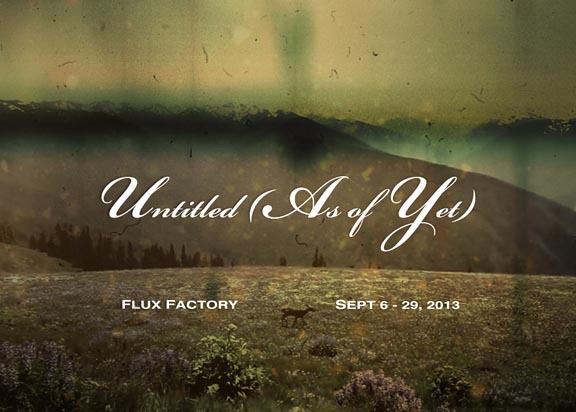
    Untitled (As of Yet)

    “Untitled (As of Yet) takes its point of departure from events that first appear to be disruptive, even catastrophic, but eventually open the door to new thoughts, practices, and opportunities. Many of the artists in this exhibition examine the responses to unfamiliar circumstances and the breakdown of routine, while others deliberately incorporate these disruptions as mediating parameters or catalysts for inspiration.”

    Featuring: Louise Barry, Chloë Bass, Cristian Chironi, Dillon De Give, Ryan Estep, Michelle Levante, Ander Mikalson and Alex Hayden, Jan Mun, Douglas Paulson & Christopher Robbins, Christopher Ulivo, and Angela Washko, with a limited edition exhibition reader by Heather Kapplow. Curated by Sally Szwed and Christina Vassallo, with special thanks to Athena Denos for production assistance.

    Untitled (As of Yet)
    Weekends, September 6th – 30th

    Opening reception: Friday, September 6th, 6pm
    Flux Factory
    39-31 29th Street, Long Island City, NY
    fluxfactory.org

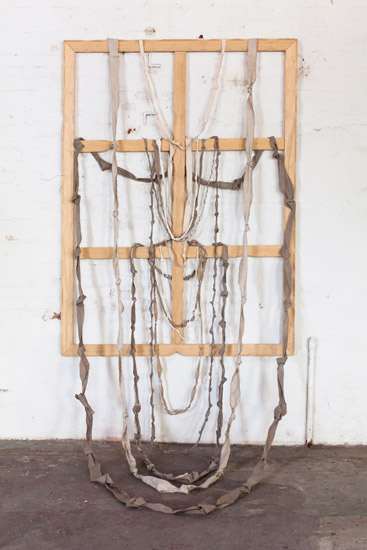
    David Subkoff, Garlands of Views, 2013 Wood, canvas, linen, primer Dimensions variable

    David Subkoff, Garlands of Views, 2013
    Wood, canvas, linen, primer
    Dimensions variable

    With raw materials such as canvas, smoke, and tarnished metal, Subkoff alludes to developments as disparate as
    Cave Painting and Arte Povera while embedding it in a more contemporary dialectic.

    Daniel Subkoff
    August 1 – September 8, 2013
    James Fuentes Gallery
    55 Delancey Street
    jamesfuentes.com

    15-Untitled-(Double-Lightning)7117

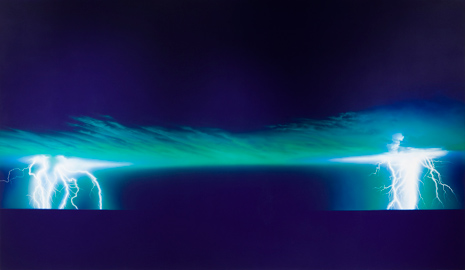
    Jack Goldstein, Untitled, 1983. Courtesy of the Jewish Museum.

    A key member of the Pictures Generation, Goldstein is well know for a diverse group of works ranging from films to paintings, sound, installation, and writing. Highly visible as a pinnacle member of the art world throughout the 70’s and 80’s, a large collection of his work is now on view at the Jewish Museum through September 29th.

    Jack Goldstein x 10,000
    May 10th – September 29th 2013
    The Jewish Museum
    1109 5th Ave at 92nd St
    thejewishmuseum.org

    The 20th annual Jornadas de Estudio de la Imagen is the kind of luxurious discussion event that happens regularly here in Madrid. This June, the CA2M (Centro de Arte Dos de Mayo) in the town of Móstoles near Madrid, hosted “Speculating on Change”–an enormously wide brief during these very interesting times. Present behind nearly all the talks that week were the inaudible sounds of riotous repression of popular protest: the tear gas we could not smell, and the smack of rubber bullets we could not feel.

    What lured me in to Móstoles for nearly a week was the presence of Ayreen Anastas and Rene Gabri who were doing a workshop on “After Work.” I miss the great discussions and genial interactions at 16 Beaver Studio, a place that they founded and currently run in NYC. Their work has been a lodestone for me.

    The conference was very rich and interesting. It helped me to draw a bead on many recent works in the realm of political art. However, that’s fatuous to say now, about the ideas behind the artistic practices that are engaging the overbearing problems of our day. I did not draw a bead so much as get absolutely soaking wet from the dense theoretical fog the presenters pumped out.

    Unlike the formal fumings of decades past, the presenters here were dealing with subjects of immediate importance: the nature and constitution of value and property, remuneration for artists, concepts of political action separate from labor, and curatorial and artistic frames which could contain those economic and political speculations.

    As the conference began, on June 17th, Hyperallergic reported that “Over the weekend, a group of 100 or so activists protesting Tadashi Kawamata and Christophe Scheidegger’s ‘Favela Café’ were teargassed at Art Basel.”

    Attending the conference in Madrid was Andrea Phillips, the English co-curator of the Istanbul Biennial. Events she arranged had been disrupted by protests there only weeks before. She spoke about this during her presentation. During conversations about the Basel incident during social time, some voiced skepticism. “It looked like an Aernout Mik production.” Could the whole thing have been staged? The coincidence between representation and an intervening reality had been too neat.

    I was uncertain as to what they were talking about. After the talks were done, I learned more. This was a harsh event, but totally fascinating, interesting and ambiguous, both politically and, in the emergent terms of what must be called, a new aesthetic discourse.

    If the attack on the faux-favela party was a set-up, the police were in on it, because they commented to the press afterwards. And cops don’t do art. A video posted to one blog was shot from behind the Kawamata installation, almost as if this YouTuber was waiting for the event to happen. It’s a slow pan, shot from behind the favela, just before and as the police arrived. When the event does happen it does it isn’t directly visible. The classic frame is at 2:45 or so, as a chair hurled at police appears in the air above the favela roofline. It begs for the Beuys/Nauman/Johns question: “What is under the chair?” (This video is linked on Greg Allen’s blog, “greg.org: the making of: movies, art, &c”; clearly this is “&c.”)

    The ambiguities of representation are in full play in an event that unfolds in an artwork. It purports to open up global urban poverty in a fair catering to the world’s rich and their artist servitors. In Basel, in very rich, very secure Switzerland, this event has a very different meaning than the disruption of the biennial-sponsored performance in Istanbul.

    That same lecture-performance was restaged in Móstoles by the Brussels-based duo Katleen Vermeir and Ronny Heiremans. They had the tables in the meeting space arranged like a boardroom, and proceeded to hold a kind of corporate presentation of a fictional art index fund, complete with simulated tele-chat by a financial expert. This character was a fictional composite, performed by an actor, and inspired by Herman Melville’s mid-19th century novel “The Confidence Man.”

    Their work, “Art House Index”, concerned the proposition–with distributed prospectus–of a kind of investment vehicle based on art. By now I understand a great deal of this terminology, although the whole notion of an index on which one may “place bets” remains obscure. I suppose Willi Bongard kicked this off with his “Top 100 Artists” list in the mid-1970s. By now this seemingly innocent guide to comparative value among “investment grade” artists, based on their museum and one-man gallery shows in key art cities and auction sales, is a relic of a distant past. I met the short-lived German Bongard, and thought him an odd guy, in some way also an artist with a conceptual project. I was an art fool. He was a business visionary. This shit is now real, or as real as fictional financial instruments can make it. The Art House couple revealed in a Q&A that some experts have offered to help them make their index project a real investment vehicle. Yow.

    The activist artists of Turkey broke into the Art House performance with banners and chants. One artist trailed co-curator Fulya Erdemci with his video camera for a long while, which led to an ongoing legal dispute over privacy rights. It is unsurprising that these artists should be inattentive to a parodic project to turn creative production into a speculative financial instrument. Already in 2009, the Istanbul Biennial purported to deal with the concerns of precarious labor. That outing was themed “What Keeps Mankind Alive?” and curated by collective What, How & for Whom. It was protested by anarchists, which the art world ignored. To move in four years later with a theme of presentations around public space on the eve of a revolt around the same issue was too much to bear.

    The part of the biennial that was disrupted in Istanbul was the educational section. It is funded by Koç Holding, an enormous Turkish conglomerate deeply involved in the rampant hyper-development tearing Istanbul apart. Gezi Park, one of the last green lungs of the city and the site of recent riots, is slated for a shopping mall and a historical reconstruction of military barracks in fond recollection of the Ottoman imperium.

    When I heard “Koç” in the Móstoles table talk, I thought they said “Koch,” the right-wing billionaires who have also thrown money into the NYC culture pot, and whose sponsorship there has been protested by Occupy Museums.

    In her talk, Andrea Phillips discoursed learnedly on notions of property around art today. In her view, art fairs like the Istanbul Biennial and Art Basel “protect art from indiscreet speculation” of the kind burlesqued by Art House by asserting other meanings for art. Auratic, profound, transcendental significations are advanced over the mere significations of art as property.

    I’ll buy that. Still it’s a rear guard action at best and waged on the plane of ideas where neoliberal capitalism has not bothered to deploy its forces. What was more germane in Phillips’ analysis was her understanding of the role of neoliberal culture in the “post-welfare state” as responsible for a certain constant “fictionalization of concepts of publicness.”

    Art is promoted as a social necessity, a “socially ameliorative tool, a healing tool,” which is more important than its commodity status. Still, it “holds up a spectacle of freedom to unfree spectators.” Art fairs, then, are vistas onto what Grant Kester calls the “ontic spaciousness of the bourgeois subject.” That is, they are social, political and philosophical comfort food for an increasingly precarious bourgeois class.

    The activists of Occupy are precisely those “unfree spectators.” They are moving to free themselves from the “nightmare of participation” in cultural and discursive arenas by disrupting these toy public spheres which cannot stand in for the absent forums and mechanisms of democratic participation.

    At this moment, when artists have taken leading roles in the Taksim Square occupation (said Andrea Phillips, who should know), another spectre of Melville’s fiction has emerged – Bartleby. The clerk of the short story who “prefers not to” – move on, protest, fight the police, resignedly watch TV, take up armed struggle, etc. – has reappeared in Turkey in the form of the “duranadam,” or standing man protest, begun by an artist, which has gone viral.

    It’s a great public action, and clearly a work of art: a public sculpture.

    By Alan W. Moore

    Image courtesy of the artist.

    Image courtesy of the artist.

    They surround everyone of us everyday yet still we are rarely perceptive. Visual jewels, usually devoid of humans, a mixture of pattern, color and material. Fluke acts a certain part, things appear or are swallowed by light, a different angle brings to light surprises. Harmony as well as dysphoria exist utterly equitable, and every so often details are the spice. If the “urban patterns” pursue a goal at all it is: to be great fun, to cause curiosity, and to amuse – at a first glance or on closer consideration.

    urban-patterns.de

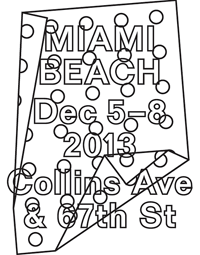
    miami basel satellite fairs

    There’s no mistaking the fact that the art fair germ has taken root in Miami Beach. Ever since the big boys of Basel have come into town, it seems a new fair pops up every year. Here are a few that are newer to the game but from an art viewer perspective are still bringing that Miami heat.


    imgres

    Ink Art Fair

    Based in a hotel and specializing on works on paper, this fair has it’s own niche cut out for it from the beginning. the atmosphere is light and fun, with works by emerging and more well established artists at more palatable prices.


    December 4 – 8, 2013
    inkartfair.com


    Aqua08

    Aqua Art Fair

    Also hotel based and featuring emerging talent, this fair has been around for going on nine years. Aqua showcases work from North and South America as well as Europe and Asia in a venue that also hosts performances  and solo booths, all geared toward a slower pace than the hustle and bustle of the larger venues.

    December 4 – 8, 2013

    aquaartmiami.com


    nada_2013_miami_slideshowgraphics_3_462

    Nada Miami Beach

    NADA is a non profit collective organized to promote the success of newly emerging dealers working with contemporary art. It is a fresh and exciting fair putting forth an international roster of artists offering a diverse perspective into the world of contemporary art.

    December 5 – 8, 2013

    newartdealers.org


    scope

    Scope Miami Beach

    Literally located on the sands of Miami Beach this year, Scope will be hard to miss in a new 70,000 square foot venue. The location will feature an outdoor beach lounge. Their emerging contemporary art will look even better with the backdrop of the ocean.

    December 3 – 8, 2013

    scope-art.com


    untitled_1_0

    Untitled. 

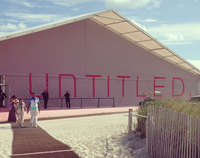
    The decidedly anti-Basel, Untitled is so cutting edge it refuses even to really pick a name. Open and airy, this huge tented space includes great natural light to illuminate the work by day, and hosts a lovely bar scene overlooking South Beach at night.

    December 4 – 8, 2013

    art-untitled.com

    The blue hour eased itself into the end of what had turned out to be a beautiful day despite a rainy morning. Adult couples on Saturday night dates showed their IDs at the door of the Old American Can Factory in Gowanus as volunteers gave them wristbands for courtyard or rooftop seating. Some patrons filed into the courtyard as a selection of non-abrasive indie pop songs floated down into the courtyard “cheap seats.” 150 chairs were set up before a large screen on the wall of a factory wing.

    Those with rooftop wristbands followed signs through the long halls and winding staircases of the factory, operated and maintained by XØ Projects Inc, before stepping into the open-air theater. Plastic folding chairs offered a decadent escape, thanks to generously spaced rows, no doubt painstakingly placed by a team of hungry volunteers pursuing filmmaking careers.

    In its 17th year, Rooftop Films is a non-profit film festival and production collective based in Brooklyn, New York that teaches filmmaking to young people, and rents equipment at low-cost to artists and non-profits. It is also well known for screening a summer-long series of films, rotating through a cache of 20 different venues around New York City.

    There was plenty of behind-the-screens effort, as a team managed the synchronized broadcast of the film onto the courtyard screen at the same time it was playing on the roof. The rest of Brooklyn carried on with itself. Planes made their descents, while saxophone music and laughter from a neighborhood gathering somewhere in nearby punctuated the quiet moments.

    The last of seats were filled as the music ended and Program Director Dan Nuxoll approached the microphone to introduce the film, Cutie and the Boxer, its director Zach Heinzerling, and subjects Noriko and Ushio Shinohara. “I feel very at home here,” Noriko shared, “where I live opens onto a balcony which is the roof of the next door factory.” She was confident, yet demure, the epitome of a Japanese wife, welcoming the audience into the life that Heinzerling captured on film.

    Cutie and the Boxer is a brief chapter of the difficult symbiosis of Noriko and Ushio, two flowers struggling to thrive in a single pot for close to 40 years. Introduced to the artist couple by a journalist friend, Heinzerling approached the Shinoharas in 2008 with cameras and began an obsessive collection of footage. A young cinematographer, Heinzerling was compelled to focus on a relationship that has little time for romance. He saw their meager DUMBO home as a perfect backdrop for the life of a starving artist.

    Ushio Shinohara has been making inroads to the art scene since the early 1960s, with cardboard motorcycles and Boxing paintings, which grasp at the fury of Jackson Pollock, if Pollock had tapped into a meditative state, dipped foam-covered boxing gloves in pans of paint and boxed his way across a blank canvas. Early in his career, his colorful irreverence attracted young Noriko, an affluent student who quickly fell into a passionate affair with her countryman.

    Right hooks and left jabs trademarking Ushio’s brand of action painting seemed to lack the punch Heinzerling was searching to power the story.  He instead relied heavily on art-docs from the 1970s and 80s to help describe the Japanese Neo-Dadaist character.

    Reflecting on her past, Noriko uses calligraphy to illustrate the life of the impressionable “Cutie” who came to New York City and fell passionately in love with the volatile “Bullie,” an ineffectual artist who is often sprawled beneath a table, having emptied bottles of wine.

    Heinzerling used Noriko’s art to animate the narrative, and the film is able to hint at the sadness that tints the life Noriko and Ushio have shared through the years. The young director exploits the light pouring into the couples home to expose the complicated kind of love that has sustained the creative dependence Ushio and Noriko work to cultivate. When the wind ruffled the outdoor screen, it gave the projection a shimmering quality.

    However, Heinzerling tends to dehumanize his subjects, a fact that was exposed by listening to him describe his methodology while seated beside Ushio and Noriko. Ushio apparently felt a bit misled by Heinzerling. The 80-year old artist was under the impression that Heinzerling was composing yet another art-doc, but to Ushio’s dismay, it turned out to be a love story. The lovers are a fascinating example of the breadth in what constitutes a healthy relationship. There is no lack of complexity to the film.

    Ultimately, it isn’t hard to forgive the young director. It is clear that he has much to experience, much to learn about love, but Cutie and the Boxer is a worthy effort at attempting to contribute something powerful to the world of art.

    By Brette Weinkle


    News | Exhibitions