• Courtesy of The Kitchen.

    Courtesy of The Kitchen.

    Among the most prescient yet overlooked figures of her generation, Gretchen Bender (1951-2004) anticipated our current state of image saturation, using scaffolds of screens, hypnotic repetitions of appropriated television footage, and aggressive sound as a critical match for an emerging cultural field of special effects and immersive viewing experiences.

    Gretchen Bender: “Tracking the Thrill”
    August 27–October 5, 2013
    The Kitchen
    512 West 19th Street
    New York City
    thekitchen.org

    Francesco Tristano by Aymeric Giraudel

    Francesco Tristano by Aymeric Giraudel

    In Fall 2013, Issue Project Room celebrates its ten year anniversary with Ten Years Alive on the Infinite Plain— a two-month festival revisiting seminal past projects and initiating new relationships with over 60 emerging and established artists working across and between the disciplines of sound, dance, film, performance, and literature

    Featuring: Omar Souleyman, Charlemagne Palestine, Richard Youngs, Marc Ribot, Pauline Oliveros, Charles Curtis, Pitreleh, Elliott Sharp, Cooper Moore, Lason Lascalleet, Francesco Tristano, Rhys Chatham, Lee Noble, Aki Onda, Marina Rosenfeld, and many more.

    Ten Years Alive on the Infinite Plain
    August 31 to October 26, 2013

    Issue Project Room
    22 Boerum Place
    Brooklyn, NYC
    issueprojectroom.org

    Once a mark exists on a page, for the most part that’s it. Erasing can make the pigment seem to disappear, but the impression the drawing implement has left on the surface remains. It usually cannot be moved around. Usually. Adam Fowler’s exhibition of new work titled Escaping Forward at Margaret Thatcher Projects offers one way to free the mark from it’s static position on the page.

    Utilizing a cunning ability to compose marks in both two-dimensional and low relief space, paired with a zen-like concentration abilities and a steady hand, Adam Fowler frees the mark from the page with the help of a sickly sharp blade. Layers of mark making are then able to be placed over each other in space, laid one on top of another before being fixed into their eventual compositional home. The negative space has been separated from the mark, but it has not disappeared from view. One can even argue that the paper that has been cut away was only temporarily holding the space of the areas between Fowler’s lines. The removal of this dead paper has enlivened and lifted the mark to a more liberated state where its character is able to be recognized without need for registration to a superfluous, restrictive ground.

    Working in this way for many years, Fowler’s work is seen to be growing steadily. Although one could never know this without seeing the new work, compositions have become more confident and engaging, feeling less calculated. The best example of this comes in Fowler’s wall installation named Untitled (41 Layers). In this piece the layers of unbound line work are further able to breathe in their unframed installation. Overlaid in a progression that expands horizontally, the work spans a distance of some 120 inches across the wall that confronts the viewer as they enter the space. The upper limits of the lacy layers of paper are aligned to mimic the rectangular shape of a frame while the bottom hangs free of delineation in a seemingly organic dispersion of looped line work. The work is almost imperceptibly fixed to the wall by incredibly minute insect mounting pins so that the work seems to hover magically, breathing ever so slightly at times with the caress of local air currents. The gorgeous fragility the work presents is able to be fully appreciated in it’s openness to the same air the viewer holds on baited breath.

    The beauty of Fowler’s process is in the simplicity of his project being elevated to a heightened sophistication. Fowler is simply cutting out and rearranging marks in space, but the level of expertise that he brings to this task is what makes the work so engaging to look at. Lingering with the work is one of those pleasantly evolving viewing experiences where one is able to float in and out between wonderous marveling at the tightness of the artists control of hand and the joy of becoming lost following one gesture or another as they wind in and around each other, never seeming to begin or end. Countless artists have used these materials, and somehow none come to mind in relation to seeing the work in person.

    Fowler is an artist’s artist. He has a supreme confidence and patience in his aesthetic pursuit that drives his work to levels of sophistication rarely reached by an artist of his age. The amount of time spent with each work and the complexity of the compositions seem to point to an artist far beyond his years. The work seems pointed in the right direction, and now that he has begun to work larger, in unframed wall based installation, the next works will definitely take time. Time is something that is on Fowler’s side. I can’t wait to see what’s next. If this show is any indication, it’s going to be gorgeous.

    By Matthew Hassell

    The relationship of art’s influence on architecture and vice versa is a phenomenon that grows steadily stronger as the fields continue to grow closer and closer together. The ambitions of leading figures in either field are constantly pushing them to find new ways to express their increasingly complex ideas, which often means bleeding over the line between these two corners of art.

    Foster begins by examining the practice of pivotal architects who have consistently been pushing the envelope not only with the structures they build, but the materials they experiment with, and the way they consider the interaction of the viewer with their various projects. Architectural leaders such as the Venturis, Rem Koolhaas, Renzo Piano, and Zaha Hadid.  Their work is evaluated in relation to pop aesthetics, the international style, and the widespread influence of minimalism.

    Aptly using Richard Serra’s work as a stepping stone between the two worlds, Foster glides seamlessly into an evaluation of how the loft-sized work aesthetic provided by the changing landscape of the New York art world of the 60’s and 70’s provided a need for larger viewing spaces. Foundations such as Dia stepped up to fill a gap between the exhibition space of the gallery and the museum. They began refurbishing larger industrial buildings and utilizing their massive interiors as new exhibition possibilities geared towards work that commanded larger viewing spaces but was not yet welcome into the categorically stuffy, academic validation of the museum.

    Moving from Serra, whose work utilized the space, to artists such as projection specialist Anthony McCall, the success of whose work was dependent on the space, Foster makes a move toward describing a further connection between architecture and perceptual art. From here the door is wide open to Irwin, Flavin, Judd, and Eliasson.

    Like any good piece of art historical or critical thought, Foster is trying to nail down one of those topics that continues to be something that is art-historically tangible, while it’s explanation somehow remains fleeting and ephemeral.

    The ownership of a gesture’s relation to space is something that has been under great debate between the circles of fine art and architecture for some time. Should a mark laid onto a surface be enough unto itself, or does it yearn for more­—is it also the seed of an idea ready to grow into a description of how a body relates to this original gesture in real time and space? Foster does his best to corner this idea and put it into terms that any aesthetic thinker can approach. He does so quite convincingly, when all is said and done, producing a book that will continue to gain relevance as we move forward. Like a newly shelved bottle of wine, it is presently quite consumable, but promises only to get better with time.

    Hal Foster’s The Art-Architecture Complex was published last year by Verso Books.

    Reviewed by Matthew Hassell

    In the past half hour, chances are you’ve noticed something about sound—friends interrupting each other, cell reception breaking up, a noise you thought came from your home that in fact came from the apartment below. There are a lot of strange things happening in our sonic universes. But what happens when you render sound tangible? What does transposing sound from its original object to another do to our perception? What are ways in which we approach noise as a layer of reality we can manipulate, whether to bolster productivity or to simply play around?

    What’s unique about The String and the Mirror is its focus: unlike the survey of the field of sound currently on view at the MoMA, the 19 artists in this show are more interested in relationships than form, and in transmutations or tangents rather than technology. The artists were chosen by Justin Luke, director of Audio Visual Arts, and Lawrence Kumpf, who curates Issue Project Room.

    The String and the Mirror is an exhibition that explores and purposefully tangles our relationships with sound. Lenticular prints, raw record vinyl piles, arranged bamboo, decibel meters, an audio cable diptych spelling out hey, and stones conversing are a few of the objects employed to accomplish this goal.

    Artists pushed various aspects of sound into the tangible, creating what was largely a visual experience. How do you make the aural into a physical object? Data sonification is one way, seen here in Lawrence Abu Hamdan’s Conflicted Phonemes. In this project Hamdan creates a visual to complicate our notion of how languages in a country—particularly one with as troubled a background as Somalia’s—can change and torque over time. While many of the works in this show have a playful tone, Conflicting Phonemes hits a little harder. Here the artist creates a complex voice map that is at first difficult to fully comprehend. The goal: to work toward understanding the controversial use of language analysis employed by the government to determine the origin of asylum seekers. Hamdan’s voice maps act as offerings to the asylum seeker as “alternative and non-vocal mode of contestation.”

    One example of how are relationships with noise are snarled is Two Stones Singing, a concise piece by Rolf Julias that used electronics to displace sounds found in nature—in a forest field, to be exact—and appropriated them to two stones. Rocks represent nature to us, yet it bends the mind to hear this information rather than to register it through thought.

    Another piece makes suggestions for experiencing sound. Four proposals are printed on the wall below titles. Spencer Yeh, the artist, calls these Bad Ideas for a Sound Mind. To me these pieces are about reducing the irreducible—recording a noise and then reintroducing the noise to its origin, as in the idea below:

    One Hundred Dollar Bills

    One hundred $1 bills are buried under
    a ceramic tile floor. Participants are
    encouraged to treasure-hunt these with
    contact mic’d dentist drills, but must wear
    headphones playing the sound from the
    drills while doing so.

    Another striking piece was one hundred circles for the mind by Seth Cluett. This was framed as a repeatable experiment meant for propagation, with instructions and a list of materials. Sound here is a tangible object made to mimic the drawn circles. Cluett recorded himself drawing one hundred circles on separate pieces of paper and then listened to the recording. He removed the cassette tape from the tape housing, sliced it into 100 pieces, and carefully placed these pieces in a grid on the wall next to the circles on 100 pieces of paper. So, we have the sound of these circles’ conception mirroring the circles themselves.

    At the back of the main gallery space there is a second room containing an ongoing interactive installation. This is Office Riddim, created by the New York-based duo Essex Olivares. Surprisingly, it’s an office with all the familiar objects in it that identify it to be so: paper, filing cabinets, a desk, plants, desk chairs, a water cooler. Other elements indicate that this is an office meant to destabilize the traditional, sterile office ambience, such as a bench with soft grey fur and a distorted ‘smile you’re on camera sign.’ A television records the room in real time.

    “We have created a system,” a paper on the wall says. “A system that responds to you,” says another. “Release your mind, feel the present,” says a third. Other instructions, which you’re meant to do with a partner, urge you to “line the perimeter of your body with binder clips. Divide yourself in half.” It’s strangely relaxing being in someone else’s office. There’s a freedom in being asked to stuff your pockets with paper clips. Another suggestion reads, “lace an extension cord through the other user’s chair. Keeping both ends of the cord in hand, take a seat on the table.” The duo intended this work to examine how musical scores relate to start-up companies.

    The overall effect of The String and the Mirror is the feeling of tension between aural stimuli and the way they are translated from oral to visual. There’s a kind of slippage that happens when your expectations are denied, and this slippage can often be the most pleasurable part of the experience. Altogether this show is an elegant and interrogative push for reexamining our experiential world through sound.

    By Maria Anderson

    What happens when you turn a house into a gallery? This is what Jane O’Neill explores by way of essays in Austral Avenue: An experiment in living with art, which was recently published with Emblem Books. Austral Avenue was a house in Brunswick, Melbourne that O’Neill turned into an independent gallery with the goal of exhibiting underexposed artists. The space was geared not toward attracting a large volume of viewers, but toward creating a dialogue between these artists.

    O’Neill is bothered by the art writing norm, which she believes allows for little of the flexibility and creativity lauded in the art it describes. She cites the timing of exhibition catalogues as an example, many of which writers create in haste or without having seen the work as it is exhibited. O’Neill also takes issue with the fact that journals or newspapers rarely document the varied experiences inherent in viewing an exhibition. This book is O’Neill’s attempt to experiment with her own art writing and to incorporate and balance all elements found in displaying work. In O’Neill’s words, she tries to “convey the great pleasures to be had in making, exhibiting, and responding to art.”

    Austral Avenue was a gallery from 2005 to 2007, during which time over 20 exhibitions were held. O’Neill believes that displaying art in a domestic setting and immersing artists and viewers in the work created enabled more incidental, surprising observations than crop up in the typical white box of a traditional gallery. The work includes extreme salon-style drawing displays, oil and acrylic paintings, Belgian linen and cedar stretchers, decals on porcelain, and altered vehicles. The main room of the Victorian home functioned as the gallery, but work on display often meandered out into the hallways, the lounge, and even the street.

    One striking exhibit that lived in the street was Andreas Exner’s Angewandte Monochrome Malerei (Applied Monochrome Painting). Obsessed by empty space framed by man-made objects, Exner makes visual plugs for the gaps in these objects (which typically invite some type of interaction). Examples of gaps he’s plugged include arm and neck holes in clothing and the middles of toy train tracks. For Austral Avenue, he plugged a window in three cars with plywood panels painted in vibrant acrylic.

    Cathy Blanchflower’s pieces, titled Astral, also involved windows. She painted the gallery windows with a special, heavily textured paint so that the trees and Geranium shrubs from outside were distorted yet visible. The effect was similar to stained glass. When light shone through the windows, the paint saturated the room in a gentle blue-green fog of color. O’Neill describes these as “sub-aqueous three-dimensional landscapes,” which she compares to Monet’s waterlilies.

    Another artist who incorporated nature into her show was Mishka Borowski. The title of Borowski’s contribution stands out: With my lightnin’ bolts aglowin’ I can see where I am goin’.  Here she takes her hallmark fascination with the erotic and translates it into traditional oil painting. By linking the cyclic nature of plant regeneration with our bodies, she explores connections between decay, death, and the erotic. These three lurid paintings are of oriental lilies, and they represent the lush depths and pink folds of the human body. In one, a glans-like stamen with a globules of clear liquid calls back the “lightnin’ bolts aglowin” in the exhibition’s title—we can see where Borowski is going with this. Located in the living room of a traditional Victorian home, these paintings’ effect on the viewer are likely more intense than they would be in a typical gallery setting.

    What was foggy in Austral Avenue: An experiment in living with art was how the artists interacted, and what their reactions to each others’ work were. Where is the dialogue O’Neill wanted to create? It doesn’t seem to appear in this book, though perhaps it was not her goal to document this aspect of the process. Overall, the writing is an interesting conglomeration of how the shows spawned from an atypical gallery space, and the energy in the artists’ work makes clear the excitement and vitality to be found in this new gallery model.

    Reviewed by Maria Anderson

    Image courtesy of the artist.

    Image courtesy of the artist.

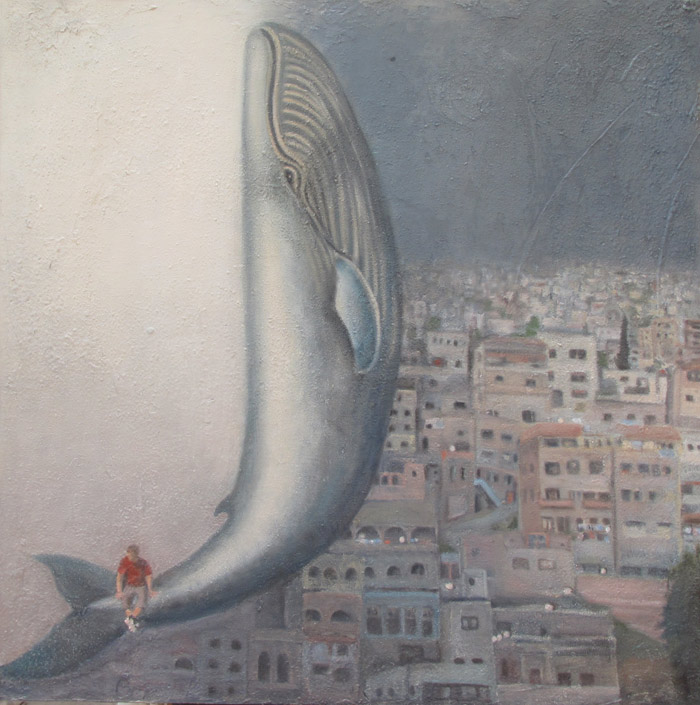
    I was born in Switzerland and have lived in Italy since 1984. In 1999 I started to show my paintings in exhibitions held in Italian cities such as Turin, Rome, Florence, Milan, Venice, and several others.

    According to art critics my works have a strong evocative power, sometimes recalling detached frescos, maybe due to my technique:  painting on top of a layer of ash and gypsum on raw jute.

    I am deeply inspired by my dreams and fascinated by the contradiction and absurdness of the daily universe, of sadness and irony, of tragedy and charm—all shrouded in silence.

    angelakeller.com

    The roster of exciting new films was released for this year’s New York Film Festival earlier this week, and it seems the festival is beginning a promising start to it’s second half century. Now in it’s 51st year, the NYFF will screen selections from both young up-and-coming filmmakers, as well as new work from directors who have consistently owned the silver screen in years past. Look out for what promise to be new motion picture gems from the brothers Cohen, Mr. Jonze, Clair Denis, and Jim Jarmusch, among others. Everything from animation to comedy and film noir seem to be lined up and ready to entice audiences with offerings as varied as film genres can be. The following is a snapshot of some titles NY Arts thinks you would be foolish to go without seeing.


    The Secret Life Of Walter Mitty (Centerpiece Gala Selection)
    Ben Stiller stars in and directs this sweet, globe-trotting (but New York-based) comic fable about an up-to-the-minute everyman.
    Director: Ben Stiller

    Her (Closing Night Gala Selection)
    Lonely Joaquin Phoenix falls in love with his new all-purpose operating system (the voice of Scarlett Johansson.)
    Director: Spike Jonze

    Abuse Of Weakness (Abus De Faiblesse)
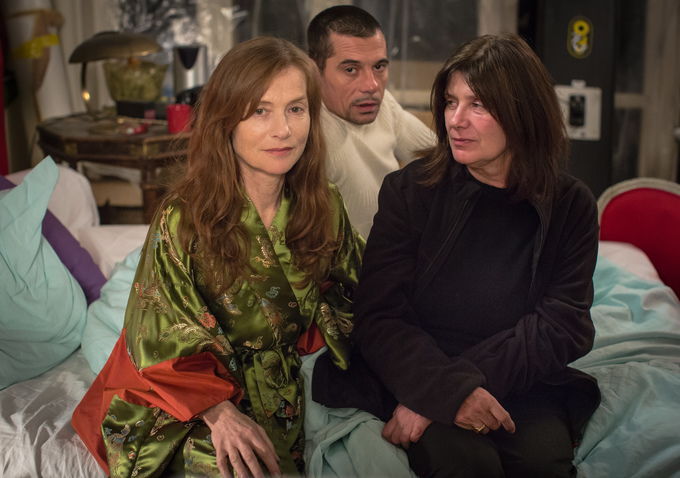
    Catherine Breillat’s haunting film about her 2004 stroke and subsequent self-destructive relationship with star swindler Christophe Rocancourt, starring Isabelle Huppert.
    Director: Catherine Breillat
    Isabelle Hupert and Catherine Breillat

    Bastards (Les Salauds)
    Claire Denis’s jagged, daringly fragmented and deeply unsettling film inspired by recent French sex ring scandals is the rarest of cinematic narratives—a contemporary film noir.
    Director: Claire Denis

    Inside Llewyn Davis
    The story of this singer/songwriter is set in the New York folk scene of the early 60s.
    Directors: Ethan Coen, Joel Coen

    The Invisible Woman
    More than just a talented British actor, Ralph Fiennes shows here that he can shine equally as bright from behind the lens.
    Director: Ralph Fiennes
    Ralph Fiennes, The Invisible Woman, 2013.

    Only Lovers Left Alive
    A wry, tender and moving take on the vampire genre features Tilda Swinton and Tom Hiddleston.
    Director: Jim Jarmusch

    The Wind Rises (Kaze Tachinu)
    The great animator Hayao Miyazaki’s new film is based on the life of Jiro Horikoshi, the man who designed the Zero fighter.
    Director: Hayao Miyazaki

    Charlotte Meyer: Your work has incorporated, and mainly been shot in the Israeli landscape. Your ideas have included raising something, a tractor from the earth in your most recent film elevating your father onto a high platform in your 2009 video 50 Blue, and saving somebody, as in the hanging entangled parachutist in Nothing New of 2012. How does the idea of community also become the subject of these works?
    Oded Hirsch: The core subject of my work is bringing the community to act together, to work together, and to be engaged in a communal collaboration. That is the core, all the rest is just an excuse. The visual language and the narrative are important, of course, but they come second. The heart of my work is convincing people to act, to make art together. That’s the main aspect, that’s what my work is about. Another aspect that interests me is creating challenging situations where people have to unite and work together as an organism. For example, in my last film there is a tractor buried underneath the ground. I asked a group of ten villagers to uncover and pull the tractor out, all by hand. That was the situation that the workers have to deal with. So the situational component is really a common theme in the work.

    CM: There is a palpable emotional force that is present, a back story to your work that is very connected to your psyche, even when the narrative is clear, there is ambiguity, you are still leaving a lot to the audience.
    OH: Basically it’s about my Dad, my relationship with my father. My father is always present in my life and work. He was a truck driver and when I was five years old he had a truck accident that left him paralyzed from his chest down. I have no memory of him walking, for me he was always in a wheelchair. Eventually I became interested in art and I had this vision of lifting him up and put him up on an unexpected spot just for a photograph. I wanted to place him on a big rock, a building, a ladder—an inaccessible platform and look up toward him. When I grew up I grew taller and taller and he always stayed the same height because he was in a wheelchair. So, my idea was to lift him up and look up at him, changing the angle of looking. This film has developed from this childhood longing.

    CM: You went to great lengths. Your father wasn’t able to be physically available in your life since you were five. That physical burden made visible or manifest in 50 Blue with not only your brother assisting him by wheeling him across the Israeli landscape, but you include your family and the community to raise him up the platform you had built. You physically pushed those limits. 
    OH: Right, when you growing up with an un-walking Dad you think of accessibility all the time. You think of motion, you see everything as a physical feat. Motion and accessibility became major issues in my life. The simple action of climbing the stairs becomes a huge challenge. I started to look at the world through my father’s disability. Its not just any person, its my dad—the person that set the example for me as a little boy. So it became a major issue, the burden, the hardships, the incapability. I think it’s also present in the situations that I develop in the films. Everything is awkward and heavy and cumbersome. People push big wheels uphill, they carry huge poles, it all comes from this primordial desire of mine to see my invalid dad on top of an inaccessible spot.

    Film still from The Tractor, 2013. Image courtesy of the artist.

    Film still from The Tractor, 2013. Image courtesy of the artist.

    CM: The mind-body connection somehow was disrupted or interrupted for you. There is a physicality that you are questioning always. The hoisting of the rope—it doesn’t take one person, it takes many people to make this happen. 
    OH: I think that’s another context story, I grew up in a kibbutz. It’s a small community, everybody knows each other, everybody depends on each other. It’s an ideology driven organization that is based on communist ideas of social equality and sharing. The community is like a big family that provides for its members, it creates living conditions of great dependence.

    CM: That is in complete opposition to being here in America.
    OH: Of course it’s a magnificent contrast. I think my work tries to explore the boundaries where the individual ends and the community begins. I seek the tension between the private and the collective. There is a theme that repeats in several of my works in which the entire society is being recruited to rescue one of their sons, this is where I manifest this tension. I also play with how much the identities are obscured, because the participants are usually covered.

    CM: They are anonymous. 
    OH: Yes, they look and act like an ant farm, everyone fills their role silently.

    CM: You make collaboration happen in Israel from here. You have this ability to get everyone involved in your films, and you are about to go and physically make work with people again in the Ein-Harod museum in Israel. How are you able to make that happen in Israel from here?
    OH: Maybe because I am in between, an insider, and an outsider at the same time. I left the Kibbutz and live in New York now, it gives me the opportunity to create these kind of spectacles. Since I come with the title of an artist, people actually go along with me. It’s really rewarding. In Nothing New I had a 90 year-old member, his name is also Oded. He came to me while filming and said that he hadn’t seen so many people together working in the field in 25 years. This is something I will remember forever. It’s very hard to convince people to participate, but with every production it becomes easier because the circle grows bigger and bigger. I started with ten people in my first film and it became 25, then it became a couple hundred. It’s a powerful experience to see all these people actually doing something together, and there is no incentive other than the pure idea of making art together.

    CM: You are touching on another important component of the work though. In the kibbutz lifestyle community is first, this is key to the work you are doing.
    OH: Yes, definitely. The context of my personal background, where and how I grew up, this is the junction where the community and the individual intersect and become present in my work. I try to create that equation.

    CM: Even though there are no words but still a narrative, you have developed a strong visual language.
    OH: Yes, in a way when you work with people in the field it’s exactly that. You don’t have to communicate with people verbally. As a worker in a factory you know your role in the assembly line and you know that each one must just do his job. There is no need for unnecessary distractions. You work together as an integral organized group that functions as a body together. For me talking is a distraction, there is no need for it in my films.

    There are so many things that are being communicated without saying a thing, so many visual codes. Everything is something that tells the story of who you are. It’s the same in the kibbutz, but in a very different way. The codes are different, for example how dirty your clothes are, how rugged your hands, how strong your grip feels when you shake hands.

    CM: The visual language is tied to who the person is and what they do with their day, which makes the mind-body connection so present in the work.
    OH: There are many visual codes. I think that what makes the mind-body connection is the strict authenticity. The participants are Kibbutz members, not just random actors, and they really work hard out there to create those spectacles. In my last piece I had a 75 yr old who broke his back on set, it wasn’t nice. I went to visit him in the hospital and he was so happy for the opportunity to participate. He is OK now. People work hard and you can sense it in the intensity of the actions that are being performed. For the short time of filming it’s a mini-scale utopia in a bubble. I think there is art that can bring people together, I try to integrate that notion into the visual language that I continue to develop and work on.

    odedhirsch.com

    Image courtesy of the artist.

    Image courtesy of the artist.

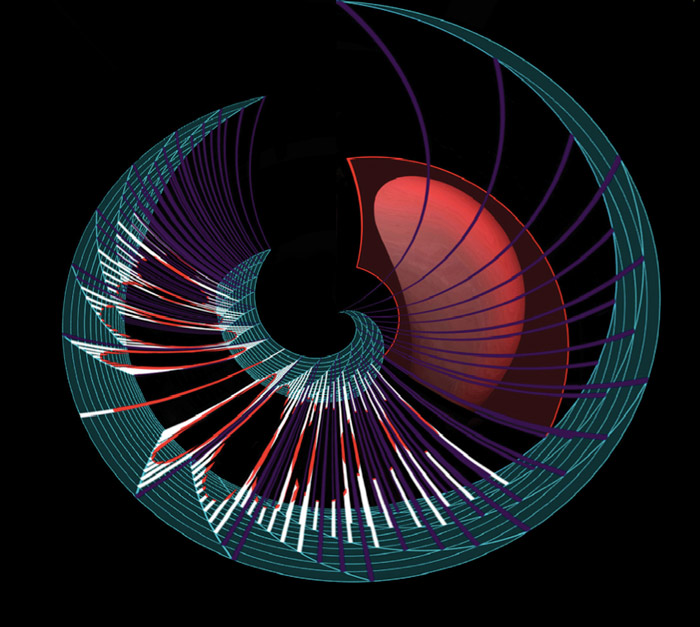
    The presented work displays an example of “Visual Space Polyphony” I’m working with.  The basic question to consider in this respect is how something like a form changes when it is placed from one reference system into another, and what are the resulting visual interactions connected to the change itself. When, say, a form moves from an Euclidian reference system to a Spherical reference system. Its visual outcome will be completely different. This principle is valid for forms, spaces and ideas when their reference systems change as well. It means that truths and facts change along with the reference systems.

    andrasmengyan.com

    News | Exhibitions