• Image courtest of the Lisa Cooley Gallery

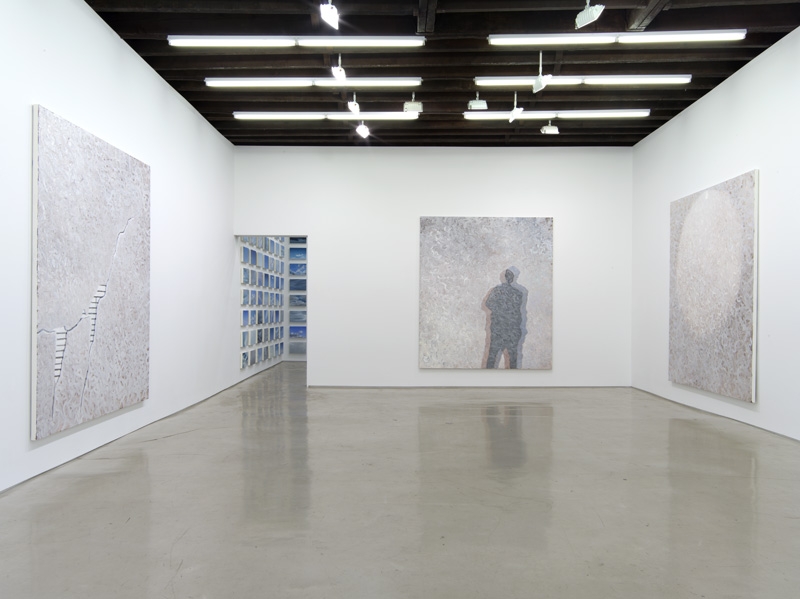
    Image courtesy of Lisa Cooley Gallery.


    Cynthia Daignault’s large format paintings utilize vast expanses of sinuous mark-making as fields within which to play with our notions of perception and light.

    Feauturing: Cynthia Daignault

    Which is the Sun and Which is the Shadow?
    September 8 – October 20, 2013
    Lisa Cooley Gallery
    107 Norfolk St, New York City
    lisa-cooley.com

    As a young man really sinking my teeth into what it meant to be painter in undergraduate school, I’ll never forget the day our professor hauled out the legendary Josef Albers book on the Interaction of Color. Hers was a really well-loved copy with loose pages spilling out from the tired binding here and there. The paper of each page was worn at the edges, but the color plates remained vibrant to the eye, having been carefully protected from water and sunlight over the years.

    I’ll never forget leafing through all the thoughtfully designed lessons throughout, each making more and more sense as we went along. My perception of how we things presented themselves to the eye was permanently changed from that day on. I lifted the pages and examined them in different lights, carefully noticing subtle shifts in how planes of color interacted given the tiniest of adjustments. The book was handed over to us as a treasure, already a rarity at the time, as original copies were becoming harder and harder to find.

    Thanks to the i-revolution, now all young artists need to have Albers teach them these stunning revelations is an iPad. Don’t look back, you read that correctly. Coming to us through the work of Potion Design for Yale University Press and now for sale on Apple’s App store, students are able to learn all there is to know about color from sliding their fingers across an interactive screen. The pages exist to be experienced as mediated via interactive technology, each lesson formatted to the slick screen in the same way that all exchange of information or knowledge seems to be headed these days.

    Generational advancement? Revolutionary art education leap? Experiential Travesty? I may be leaning towards a feeling of suspicion, but don’t listen to me, decide for your self here. After you do, let me know what you think. Maybe I’m just too sentimental about that wonderful day back in Connecticut, holding that prismatic treasure of an actual book in my hands. I imagine you just can’t get the same experience form a screen, even with a patented retina display. It’s possible even at the tender age of thirty that I’m just too old for this shit. After all, I initially wrote these thoughts down on a piece of paper. I still don’t have an iPad, yet.

    By Matthew Hassell

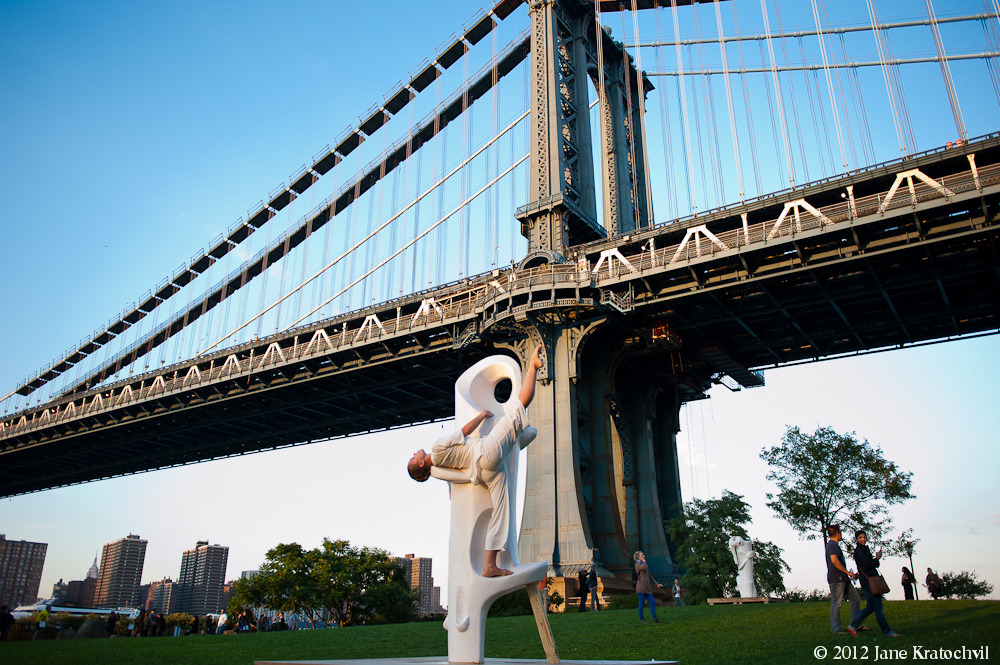
    Dumbo Arts Festival

    Each year the DUMBO Arts Festival seeks to highlight Brooklyn’s commitment to and presence in the arts community by presenting the best in local, national, and international art amid the breathtaking backdrop of the Brooklyn Bridge and the Manhattan skyline.

    DUMBO Arts Festival
    September 27-29, 2013
    Multiple Locations
    DUMBO, Brooklyn
    dumboartsfestival.com

    It is always a joy to see an exhibition that immediately establishes a specific intention. It is even more enjoyable when the artist goes about exploring and developing this intention and pushes a way of working into a place beyond an initial thematic logic, into something or somewhere else.

    James Cullinane’s show Limbus at Robert Henry Contemporary (opening Friday, September 6, 2013) goes to that other place—or maybe keeps us in place as its basic imposition of traps as metaphor works its way into the head of the viewer.

    At first, this new series of painted red squares (12”x12”) and rectangles (30”x28”) with a laminated image of an impossible situation, or a hunter’s trap, or snare imposed on the surface reminds me of a type of symbolic thinking. This thinking is developed, enumerated, and ultimately painted by a proliferation of map pins. They are hammered into the panel, ebbing and swaying across the surface of each painting, creating an abstracted layer of cartography. What seems to start as a practical decision to fix the subject to the surface develops into the point of the thing, or A point of the thing, or maybe the escape from the thing?

    Whatever the intent, the pins kaleidoscope and undulate across the surface and in so doing reinforce the image. They add to the sense that the image is trapped and buried but they also develop and intensify it. Initially, I was seduced into admiring these paintings as beautiful things, and then after extended viewing, reached this idea that they hinge into something more than themselves. Then, after thinking about what this something could mean for a bit, I was then moved by the painting again. Another trap!

    I often think about what I see as a really successful work of art and what it takes to make it. I keep coming back to the time and commitment it takes to make something. The process of making and thinking followed by more making and thinking takes time. The commitment plays a hand as an artist’s willingness to keep working. They are living and working through ideas and failing and repeating this and then repeating this again.

    It is one thing to come up with a good idea and another to integrate that idea purposefully, and in a slightly unhinged way within a practice of making. James is perhaps best known for large pounded drawings and installations. They were room-sized labors that felt big, were big, and contained many parts; graphite, sound, speakers, and map pins, to name a few. For me, I get a sense that the labour and intensity of those site-specific installations have benefited from narrowing and focusing down in scale to these little gems of concentrated thinking and making.

    By, Ben Pritchard

    Kris Scheifele: To call you a multimedia artist is an understatement. Online photos don’t do justice to how intentionally dense your work is, not only in the breadth and depth of your materials and techniques, but also in the way your practice is a kind of cannibalized familial gene pool. For instance, your paintings have been based on your sculptures, debris from paintings end up in collages. There’s a crafty resourcefulness and near fetishistic attention to detail combined with incredible technical prowess. Tell me a little about the inspiration for such a rich process. 

    Randy Wray: Well, I’m somewhat of a hoarder when it comes to my art. With each new body of work, I tend to introduce an idea, material, or technique into the mix, but I rarely discard anything completely or permanently. Things from the past eventually resurface. Experimentation is a big part of my process and I often work with what’s readily available. When I was just out of school and living in an old barn in Ogunquit, Maine, I had no money for art supplies. So during the day I gathered materials from nature—sea urchin and lobster shells, sticks, feathers, and rocks—and at night I joined them together to form small sculptures. More recently, I’ve fashioned works out of shredded junk mail, my old jeans and sneakers, and discarded furniture. I try to work with the ideas, feelings, and sensations that materials evoke in order to amplify the experience of an artwork. A degree of flexibility and inclusiveness prevents things from becoming predictable and allows for real exploration.

    KS: Materials do come preloaded with content, which is something that enhances your thematic multivalence. Your use of furniture adds traumatic dispossession, expired utility, and urban nomadism into the mix. It’s not nearly as sad and politically loaded as Doris Salcedo’s furniture, but a mournful Americana is a critical thread in your work. Why marry playfulness with your often serious themes?

    RW: I frequently join incongruous sensibilities and ideas, not only within a series or an exhibition, but also in individual pieces. I might paint a nineteenth-century figure in a landscape and then interject passages of glitter-flocked, gestural abstraction within that tableau. That kind of juxtaposition represents shifts in time, space, etc., which I believe allows for multiple entry points into the work. Diverging perspectives create tension while simultaneously paving new connections.

    KS: You’ve encountered people who are still surprised that an “eccentric abstractionist” sculptor is able to paint.

    RW: When I first started exhibiting my work, people sometimes focused on and emphasized what separated my sculptures from my paintings. However, over time there has been growing recognition of the common visual and conceptual threads in my work and an appreciation of how these practices are interrelated and inform each other. Now, curators and collectors choose to present these mediums side by side.

    KS: Good! There really isn’t room for limiting ideas about a person’s ability to constantly reinvent his or her work, life, or style. It seems like THE contemporary skill is transformational dexterity—in all areas of life. And transformation is exactly the theme of your most recent body of work.

    RW: Why shouldn’t we metamorphose, especially when it comes to creativity? We’re inquisitive beings, accumulating knowledge from experiences and adapting to circumstances. When an idea or project demands that I learn a new skill or find a fresh approach, that’s exciting to me. You have to trust your urges because the creative process is both cerebral and visceral.

    As far as transformation is concerned as a theme in my work, I’m using humble materials such as waste paper, polystyrene packaging, and other by-products of consumption to create abstract sculptural forms that suggest vehicles like ships, wagons, and wheels. Modes of transportation serve as metaphors for transformation. My paintings also depict vehicles such as carriages, trains, and horses and are inspired by Currier and Ives lithographs. I repaint these images completely by hand on a much larger scale, alter them, and add passages of abstraction. This recycling and converting of lowly materials and common imagery is attempted alchemy and alludes to ideas about material and spiritual redemption.

    KS: In the early 20th century, cheap repros of Currier and Ives images were everywhere: on food canisters, plates, and calendars. It’s interesting that you’ve chosen a long-gone relic of popular culture. Those guys were all about inexpensive, easy images for the masses.

    RW: Familiar images can be comforting and provide easier entry into works that contain weightier ideas. I like works that immediately seduce yet also challenge the viewer with a more complex experience. To me, the deepest beauty needs to elicit more than mere admiration.

    KS: Your use of Currier and Ives imagery makes me think of kudzu, that vine that was imported to this country and proceeded to smother everything in sight. You like to trade in cultural kudzu: what is ubiquitous and a little scary in its ability to reproduce and proliferate, almost like a cancer. You even made a sculpture called Kudzu. So what is it with you and parasitic growths?

    RW: Have you seen the kudzu growing all around the Southern States? It completely covers the landscape, including entire buildings, like a soft, green blanket. It’s gorgeous. Then you realize it has overtaken all the other plants and buried everything in its path. The vine can grow up to a foot each day and seems almost supernatural. My sculpture titled Kudzu is an accumulation of linear elements that suggest vines. The work incorporates a small table as a base and at one point, I just started adding elements to its underside so the sculpture appears to be growing out of control. A lot of my sculptures and paintings include forms that bring to mind fungi or tumors, which is meant to suggest that the work of art is a living, evolving thing.

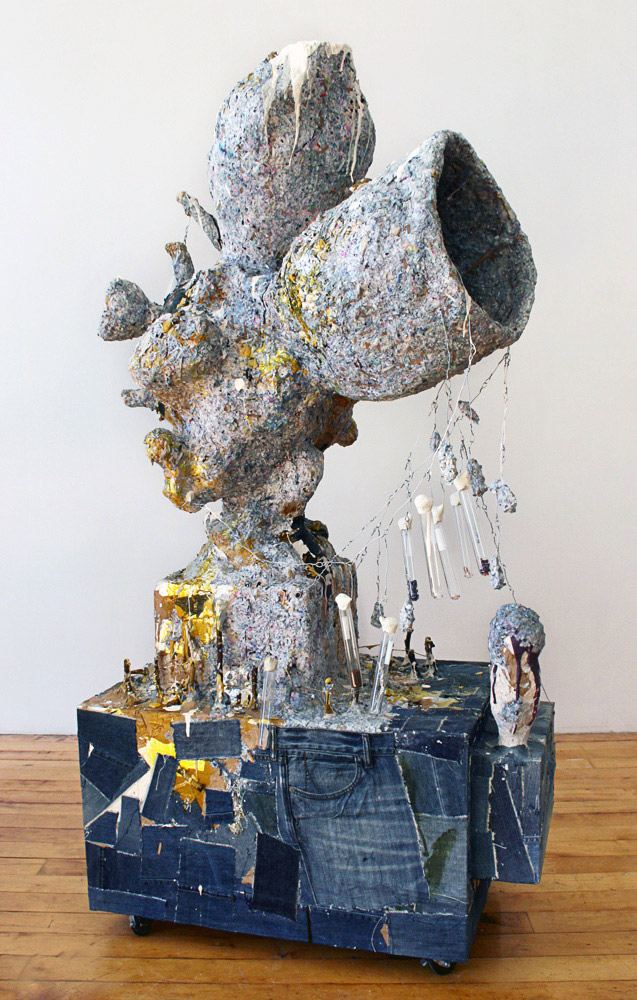
    Randy Wray, Accelerator, 2011. Papier-mâché, wood, denim, test tubes, quartz crystals, wire, coins, buttons, acrylic paint, oil paint, glitter, resin. 64 x 34 x 25 in.

    Randy Wray, Accelerator, 2011. Papier-mâché, wood, denim, test tubes, quartz crystals, wire, coins, buttons, acrylic paint, oil paint, glitter, resin. 64 x 34 x 25 in.

    KS: So all the growths and tumors dovetail nicely with your transformation theme and your working methods and everything else. What about the artists who inspire you?

    RW: I remember when I first saw Warhol’s early, hand-painted works. His use of gestural pencil or crayon marks and drippy brushwork to render graphic advertisements created such an odd dichotomy. I felt a strong connection to those works because, at the time, I was mixing an earthy homespun craftiness with a kind of Pop sensibility in my own work.

    I’ve always been drawn to self-taught or “outsider” art, from Bill Traylor’s poignant drawings to Judith Scott’s dense, layered sculptures. Of course, I relate to the inclusiveness of Rauschenberg’s art and how it blurs boundaries. I also love a variety of good painting such as the dark visions of Goya, the brave beauty of Gustave Courbet, the peculiar images of James Ensor, the dynamic scribbles of Cy Twombly, the expressive marks of Philip Guston and Alice Neel, the material explorations of Alberto Burri, Jean Dubuffet, and the great Sigmar Polke.

    In terms of contemporaries, I appreciate the way Tal R moves back and forth between painting, sculpture, collage, and installation while constantly evolving and retaining his own perspective. It’s exciting not knowing what to expect next from Kai Althoff. Sterling Ruby’s mysterious works also fascinate me, and Ruby Neri’s lush paintings and ceramics are terrific.

    KS: All that you’re feeding on gets energetically imbued into your work; no wonder it makes me feel like anything is possible.

    RW: I try to take a variety of approaches in my work, but I also operate within a specific range. So maybe it’s not that anything is possible, but rather that many things are possible and even probable.


    Randy Wray is a painter and sculptor living and working in Brooklyn, NY. He graduated from the University of North Carolina School of the Arts and received his BFA from the Maryland Institute College of Art. His awards include a Guggenheim Fellowship and a Gottlieb Grant. Residencies include Skowhegan and the Marie Walsh Sharpe Space Program. He has had numerous solo exhibitions in the US and abroad, most notably at the Weatherspoon Art Museum, Galeria Camargo Vilaça (São Paulo), White Columns, and Greenville County Art Museum. Group exhibitions include MoMA PS1, Cranbrook Art Museum, Socrates Sculpture Park, Kate MacGarry Gallery, and Kohler Arts Center.


    728x90Brooklyn Based Art Fair Partners with Chicago Tastemakers For Exhibition This Fall

    (July, New York City)—  In a bold move, Fountain Art Fair announces that it will launch a satellite exhibition this September 20-22 to coincide with EXPO Chicago 2013.  Fountain’s renowned emphasis on showcasing the most progressive programming will provide an accessible platform for artists, galleries and independent projects from Chicago and beyond. Following record sales and attendance at New York’s 69th Regiment Armory,  Fountain is thrilled to join Mana Contemporary in hosting this innovative  exhibition in their expansive facility just a few miles from EXPO’s Navy Pier. To ensure the success of the project, Chicago-based Johalla Projects will act as a supporting partner for the fair.

    Located in a landmark building at 2233 S. Throop Street, Mana Contemporary Chicago has already leased its first floor of artists’ studios and is now home to 20 established and emerging artists.  To coincide with EXPO and Fountain, Mana will open its first major exhibition space with a free public event on September 22, 2013 from 1-5 PM. The first exhibition in a 2,000-square-foot gallery will feature works by renowned painter and sculptor Ray Smith.

    Fountain’s penchant for thrilling late-night visitors with high-flying performances and dance-heavy beats will also add a distinct flavor to Chicago’s art fair weekend.  With past headliners including ADULT, Marky Ramone, No Age,  Ninjasonik and more, Fountain all but guarantees the best after-hours fair action in town.  Stay tuned for lineup announcements for Friday and Saturday night’s events, along with special programming details.

    Join us for this groundbreaking event!  Fountain selects exhibitors based on their dedication to accelerating the arts through quality visionary programming. Fountain exhibitors range from young stars and mid-career artists to established masters. Interested galleries, artist collectives and independent artists are invited to view the application online here: http://www.fountainartfair.com/application-chicago-2013.

    About Fountain Art Fair – Founded in 2006, Fountain Art Fair has received critical acclaim for its unique art fair model and genuine dedication to the artists and galleries who share in its vision and ideology. Celebrated as the first of a new influential generation of alternative fairs, Fountain is reinterpreting the concept of the art fair experience and paving a new path to the future in today’s market.


    Fountain Art Fair Chicago
    2233 S. Throop Street
    Mana Contemporary Chicago
    September 20th – 23rd
    http://www.fountainartfair.com/

    Justin Mortimer’s paintings reverberate with a fore-knowledge of Baconian flesh and torpor, and that quintessential Freudian cogency and mass that forever changed the idealistic template of the figure in painting into an expression of a post-God mortality. For both twentieth century artists, a delicious glut of adjectives are to be found, as there are when viewing Mortimer’s response to the figure; a psychological mise en scene of necrotic hues, frail bodies, victims of some amoral Goya-esque performance. But Mortimer injects a twenty-first century fetishistic tone into his voyeuristic tableaux. The viewer is ever-present as witness to a horror partly obscured as the artist shifts focus and subverts intent. He highlights our fascination with the sordid and suggestive, and in doing so projects a sense of voyeuristic guilt upon the viewer.

    Paul Black: Having won the BP portrait award in 1991—your initial response to the figure was more inclined toward capturing a ‘likeness’ of a sitters identity. The evolution of your work has seen an inclination toward an exploration of the human condition reminiscent of painters such as Francis Bacon, or even the evolution of Lucian Freuds’ response to the human regarding an awareness of fragility. Is a ‘likeness’ now being ever-more influenced by a declining flesh?

    Justin Mortimer: I was very young when I won that prize; much more a craftsman than intuitive artist. Painting anything realistically was very hard for me, so a likeness was an achievement in itself. Content was a matter of fluke. Now being twice as old as I was then, I’m less bothered with technique and far more interested in the story and psychological possibilities of the picture.

    PB: The psychological possibilities of the picture are certainly evident in your current practice; the leitmotif running through the work lends itself a very contemporary narrative—an ‘amoral landscape’ in which your figures reside. This post-moral, post-Baconian narrative reminds me of Bacon sifting through war photographs and books on dentistry in an oil stained studio; a conceit I grant you, yet you construct images from various sources including the internet. As a writer I’m interested in that romantic parallel—how do you see the early stages of your practice?

    JM: Yes I am a great sifter too. Much of what I do is thinking about and looking for the imagery that will be the catalysts for my paintings. These are mostly sourced from the second hand books I keep in the studio. They range from flower arranging manuals to techniques of orthopaedic surgery, through to all the scanned, downloaded, and snapped images I have taken. I begin by then throwing them together into digital collages on my studio PC. The collages for the largest paintings mostly start as a mashing together of figures and an environment. I am looking for those strange visual crunches, serendipitous clashes that could open up previously unconsidered psychological avenues, or could kick life back into a flagging composition. These collages are printed out and continually revised throughout the painting process so that by completion the initial idea is often a long way from the finished piece. This approach to the early stages is mostly successful, but I sometimes wonder if I am closing myself off from a more unconscious engagement with the image. Source material is crucial of course—how else would Bacon have made his paintings without photos of wrestling men or dental hygiene? I’d like to know how much time he spent on his research—how much of an archaeologist of the Internet would he have been?

    PB: That is an intriguing question! Could it be said that your unconscious engagement is in the composition of sifted images? I find the idea of Internet archaeology as a part of the process of painting fascinating; the visual ingredients of the collages, once taken out of their original context become ahistorical fragments. Reformatted they become atemporal, the nature of the images become timeless; this appears to be transferred to the final form of the painting, resulting in an ambiguity.

    JM: It is certainly that but I would also say it is there, in the necessary application of paint.

    When you have painted a certain element or area many times—subject to revisions and the experimentation of process—you eventually enter into that space where you are unaware of what you are doing and the voodoo moment of painting is reached. It is that excruciating knife-edge between self-consciousness and fugue where you almost know what you want to do, but mostly don’t. Annoyingly this is actually a boon to any good painter. You’ve got to go where it hurts. Do the work, put the hours in then be prepared to ditch it. Ditch all of it.

    The original source imagery is always going to be seductive. Look at it; there it is. Game over. The only way I can move forward and make it my own is by redaction. I also need to take the subject out of its context and jam it into a new space; WWI soldiers in a suburban garden, machines and balloons in snow, disused bunkers with surgeons, and so forth.

    My more successful work has always been when it looks as if something has or is about to happen. This openness to interpretation is interesting to me. I like to find myself unable to describe an image I have cobbled together. By re-contextualising source material you’re no longer snagged on the irritatingly literal, but released into a new ambiguous fiction.

    PB: The source images are removed from their initial context; making them timeless as de-contextualised forms placed in an atemporal space. Each interacts with the other and cancels out any singular reading regarding it’s time period, focusing the narrative onto the collective components of the painting and the interpretation of new meaning. The structure is similar to the poetic in that you are building a sentence, a paragraph, a statement, in the non temporal and abstract? As you say the most successful paintings suggest an event or the moment in-between; a frozen moment, or the most pregnant of pauses? Would you say that this is the aspect of your painting that intentionally builds unease in the viewer?

    JM: People say there is a sense of unease in the work. How intentional this is at the outset, I’m not that certain. I am always on the look out for that oddness which I talked about earlier, but at the same time to describe a scene without exhaustively describing it. Sometimes the piece is triggered by the thrill of a strange composition/alignment of content, other times the catalyst could be a found photo of a tree or a medical procedure. I have subjects that I want to make work about but I always try to avoid describing them.

    The protagonist/victim might be hidden by a door or put outside the picture plane. Maybe this unease is due to irritation with my obscuring or filtering out. There is no money shot—if you like, so the viewer is left with an unresolved visual puzzle. Perhaps a certain emptiness here can help the viewer fill the gaps emotionally.

    I imagine screen writing is similar; the less you know about the character the more you want to know—my pictures have no voice over.
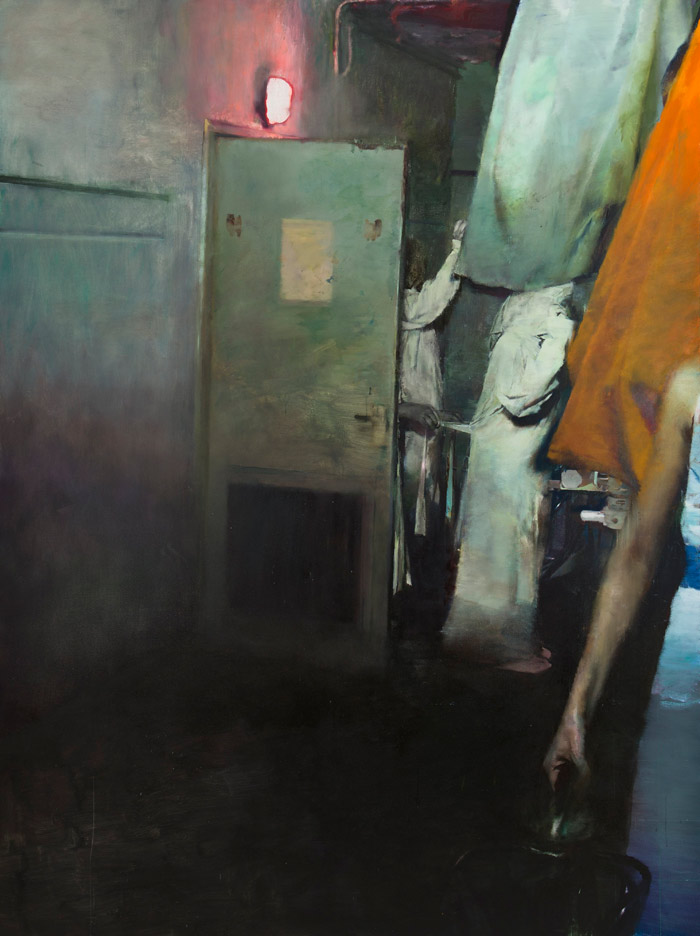
    Justin Mortimer, Chamber, 2012. Oil on canvas 240 x 180 x 3.5 cm

    PB: I don’t see it as an irritation but more as a form of obfuscation. You seem to shift focus. To obscure ordeal or indignity, you appear to glance at an event while almost being unable to process its potentially sordid horror. This results in the heightening of our concentration, as you say; we fill the emotional gaps—the dark recesses of the subconscious complete your tableaux—and in doing so you hand the viewer a projected sense of voyeuristic guilt. Do we become the voyeur’s of an amoral potential?

    JM: I like the idea of the shifted focus. It takes me a long time when making a piece to realise what it is I am actually painting. Often I find that the story only starts to emerge after working many weeks on a single piece, editing out whatever it was that took me so long and then squeezing the glimpsed figure around the side, behind or amongst what I first thought were the throw away areas of the painting. This is an interesting point in the process because I then find myself with an unassembled composition and an odd focal stress or imbalance that I use as the key to the finished piece.

    I am a figurative painter but have I got to the point where I almost can’t stand having a figure in the piece. I often wonder why. Maybe this is why objects such as balloons and plastic sacks and cabling have been appearing recently. Presumably they are a proxy body or metaphoric body for me. Whatever they are, the viewer has to straddle these things to find or more, probably not find the subject, and to fill in the gaps. At the moment I continue to make work about perverse or threatening situations, but without being too explicit. Yes, I think the voyeuristic potential here is crucial. Isn’t it (voyeurism) so much more interesting than looking? My subjects aren’t presented, you have to find them. You are not even invited—you have to intrude.

    PB: You set the viewer adrift as a wanderer in a psychological mise en scene; in some respects of their own making? Turning corners of dank corridors and gazing through glass at moments of captured immoral performances. But alluded to by an oblique and disturbed gaze; as you glance at an event while almost unable to process the sordid malaise and project that position onto the viewer; the artist has not entirely set the scene. I suppose that one of the ideas around a stolen moment of voyeurism; is being presented with a greater truth?

    JM: I believe most people bring what they want to the picture. Of course they can be guided by various visual sign posts, but for me it’s the peculiar that the viewer brings that is of interest. If there’s any aberrant behaviour to be interpreted is it not that that’s externalised by the viewers? I think that you may be right in that I present an ambiguous opaque scene or arena, that to be honest is always going to be limited by the restrictions of my imagination, and hope that the viewer will charge it with their own projected psychologies.

    PB: Goya’s Casa De Locos is replete with figures that are marginalised and rejected, which is reflected in their grotesque and pitiable behaviour.  The subjective moral certainties of his The Disasters of War—the guilt of the victim in war through the authority of the victor—are lost to a moral ambiguity. The Asylum paintings; much in the same way as the artist’s Black Paintings, were a manifestation of fear.

    Goya’s asylum figures – more than any of his others – reflect the terror of not being able to control one’s physical self or destiny; they are subject to the whim of others or of their own insanity. Would you say that your works also reflect that particular Goya-esque fear of lost control?

    JM: I would say yes. Certainly the disappointment of the failing body and the internalised locked-in terror that realization entails. The participants in whatever unfolding non-drama in my pictures are most likely a projection of that interior anxiety.

    For what it’s worth, my own personal experiences of depression and having being born with a physical anomaly have stained most subjects I tackle. I suppose it’s inevitable that a shadow of these experiences is a constant murmur throughout my work and yes, feed my obsessions with medicalised imagery, war, and loss of control.

    The early 19th century Spanish asylum was a dustbin for society. It was also a place where people came to be entertained by the lunatics twisting and juddering to their own singular torments. Asylum is the perfect visualisation for Goya, mentally and physically tortured by an unknown illness and trapped in a country being ripped apart by war. For me his asylum is a voyeuristic arena exorcising societies angst—just as the bullring purges the spectator’s dread of their own deaths.

    PB: And here we return to the exploitation of the figure. In much the same way as Goya’s juddering lunatics were in reality entertainment for the Spanish masses; we see a reflection of that idea in your works. The narrative composition of your paintings reflect the presence of a furtive third party. The existence of a work of art is determined by a viewer as part of its own equation. Within this you construct a visual narrative that exemplifies the triad between artist, work, and viewer. The image suggests the existence of a voyeuristic third party as an internal part of the narrative of the painting itself, as well as the essential presence of a viewer in the equation of artist, art object, and viewer. Would this, if intentional, give the painting a quiet self-awareness, and a slight conceptual lean?

    JM: It’s not unusual for me to suggest that a viewer is participating in the narrative. Sometimes I have even included their shadow. To passively watch, to stand aside, to let happen—this is interesting to me. There is the guilt and impotence.

    To speak of the painting as having a self-awareness suggests it inhabits its own discreet space, somehow separate, aloof even.

    A painting takes on its ‘ownness’ when the artist no longer has full control. The work has its own volition, slipping outside of the artist’s expectations into a non-habitual place. Here the unsettling crunch and crackle of unknown shapes, the bizarre push and shove of odd misalignments amount to a certain voodoo that puts a painting outside the perimeter of expectations into its own, separate dimension.

    Irena Jurek: You are an ardent collector of pop cultural ephemera. The lines between your art and collecting often blur. Did your interest in art as well as collecting develop simultaneously or did one precede the other?

    Brent Birnbaum: Certainly. I was collecting and saving things before I was making art. I just knew I was attracted to certain objects and I would save them. I wasn’t sure why or what I was going to do with them.

    IJ: You have the largest collection of Vanilla Ice memorabilia in the world. A few years ago you held a performance as Ice Ice Maybe, your incarnation of Vanilla Ice’s alter ego.  Many of your ideas seem to emerge from the objects that you collect and are drawn to.

    BB: It’s a combination of the objects I collect and the particular space I’m invited to do a show. The venue for Ice Ice Maybe was an old Tower Records and I knew 2010 was the 20-year anniversary of Ice’s To The Extreme Album. It was an alter ego but also an homage to my love of camp. My recent performances have been moving in the opposite direction involving just me, or me with one object, and addressing very different concerns than the kitsch.

    IJ: It seems that lately your work is shifting from the spectacle of pop culture to more existential themes of life and death as well as questions of meaning and purpose.

    BB: Very true. My interest has shifted. I spent a lot of time thinking about objects that are not used in an art context and objects that other artists have not used. It’s been a good run, but I’ve just become more interested in existential questions and even formal issues.

    IJ: You have an upcoming museum solo show at Casino Luxembourg, called Ride (W/) The Wind. You mentioned that the show is based on Einstein’s definition of insanity, could you talk a little more about that?

    BB: Sure, his definition is repeating the same thing over and over again, expecting different results. I combined that with another phrase, which is “wearing the world like a loose garment.” I see Einstein’s definition of insanity as a real negative force. The museum show is designed like a labyrinth. There are nine rooms and you must pass through them all once you enter, in order to exit. All of the rooms are going to look very similar, just in different colors. It’s supposed to be disorienting giving the viewer a sense of repeating the same thing over and over again.

    Then the other phrase is the positive force, wearing the world like a loose garment. Which actually goes back to your first question about collecting things. I’m at this transition, and wearing the world as a loose garment is about letting things flow through you either physically or mentally. I’ve been thinking about it a lot, after moving to the Rockaways. Before I had been living in Greenpoint for eight years where I had been able to amass really large collections of things. I went through a purge where I filled two dumpsters and threw out sixty boxes.

    IJ: So it’s almost a show about duality.

    BB: Yes, that’s a good way of putting it.

    IJ: Your idea also reminds me of the idea that all painters paint the same painting over and over again or Ad Reinhardt’s ‘black’ paintings, where each painting at first glance appears to be the same, but under further inspection reveals a work of great nuance and variation.

    BB: When you say that the show is about dualities, it is. And the title, Ride (W/) The Wind, is referencing the ups and downs of our life. We all have the highs and lows. We are always living in the dualities.

    IJ: Yeah, because nothing is ever perfect. Things are always off.

    BB: Or you feel really good about one thing and really shitty about another, and everything just flows. The nine rooms are a microcosm of people’s lives. It starts with references to childhood and it ends with references to death. It covers everything in between; in rooms two through eight, it talks about your dream job, how much money is in your bank account, your sex life, lying, cheating, stealing, and it ends referencing the afterlife and what you think happens to you when you die.

    IJ: Audience participation is really important to your work; a lot of work doesn’t consider the viewer’s experience to the same degree.

    BB: I feel like I’m more in the Tino Seghal camp. I need other people to complete my projects. My desire to do performance lately has stemmed from my curiosity of engaging with strangers and combining that with my art making practice.

    IJ: So there’s a lot of chance and improvisation that comes together in the performances. There’s this variable that you have no control over.

    BB: Yes, there’s no foreseeing what comes out of my mouth or how I react. I like that risk, this unknown territory with an art show. The participatory direction I’m moving in is more into the unknown area where I’m not as controlling with how I want the outcome to be.

    IJ: Much of your work seems to be about defining and redefining these patterns and meanings in the world. You come up with these elaborate systems and you often position one system against the next. Before you were doing these intricate, maximalist installations and collages, whereas now you’re going toward a more minimal idea. It seems like the idea of dualities not only exists in the upcoming Luxemburg show, but is also a recurring thread in your work.

    BB: Yes, I get excited by exploring new territory and new modes of working and not just for myself, I’m also excited by other artists who are pushing the boundaries of how art can be made, like Nate Hill, Ryan McNamara, and I previously mentioned Tino Seghal, of course.

    What I like about performative work is that the history is still largely unwritten and there’s more opportunity for me to explore so many more different areas and possibilities.

    Image courtesy of the artist.

    Image courtesy of the artist.

    See the world through my eyes… People always had a basic need to create things for several motivations and reasons. Things that still exist today communicate the past – messages about nations, special places, events or relationships. They are signs from the past that tell us stories, whether real, fictional, or even of spiritual encounters.

    My sculptures and works would like to tell stories from the past and present, the great cycles of mankind, or interpret the poetry of a possible future. The memories and imagination of the viewer form the actions and the content.

    thomaskoch-bildhauer.de

    A kitchen sink and cabinet dangle above the sand in a damaged beachfront home in Belle Harbor. Christina Santucci, Untitled, 2012. © Christina Santucci/TimesLedger Newspapers.

    A kitchen sink and cabinet dangle above the sand in a damaged beachfront home in Belle Harbor.
    Christina Santucci, Untitled, 2012. © Christina Santucci/TimesLedger Newspapers.

    Drawn from an open call for submissions from the public that drew over 7,000 entries, the exhibition includes 100 works by more than 90 professional photographers, community members, and bystanders who photographed the effects of the devastating storm and the subsequent recovery efforts.

    Rising Waters: Photographs of Hurricane Sandy
    August 24-September 29, 2013
    Governors Island, Building 19, Nolan Park
    New York City
    govisland.com

    News | Exhibitions