• Fluxuations

    The Fluctuations portfolio highlights artists working directly with printmaking processes, and also artists working with print concepts. The consideration of producing multiples, and the processes investigated in doing so, make Fluctuations both an exercise in coproduction and experimentation. With the help of our guest jurors Kyle Simon and Jon Irving, Fluctuations was curated to give representation to various contemporary and traditional artistic approaches, studio practices and interpretations of our theme.

    Featuring: John Redmann, Matthew Scott Gualco, Ali Reid, Pierre Chaumont, Jennifer Dayton, Matthew Wilson, Henry Gepfer, Jonathan Sherrill, Namwoo Bae, Andrew Salomone, Slavko Djuric, Heidi Lau, Owen Roberts, Jennifer Dwyer, Lisa Wicka, Anna Robinson-Sweet, Yujin Lee, Mary Pinto, and Sarah Nicole Phillips

    Fluctuations Print Exchange
    October 11 – October 20
    Opening Reception: October 11, 7-10 pm
    Recession Art
    47 Bergen St Brooklyn, NY
    recessionartshows.com

    Parody and irony entertainingly put what is narrated at a distance. Which of these two rhetorical devices does Judith Hopf employ, when she places a flock of eight sheep appearing to gaze at the entering visitors in the main gallery space? All of these sheep, whose caricature-like faces are hand-drawn, seem to have been made with the greatest possible simplicity. Their dirty gray, concrete bodies are casts of moving boxes either standing on seemingly unstable metal stilts or lying on the floor. To their left, a barren black branch protrudes from the wall about three meters over the floor; it is a bronze titled Dem Kirschbaum ähnelnder Essigbaumast (Branch of a Staghorn Sumac Resembling the Branch of a Cherry Tree). A sequence of screen prints in two groups hangs on the opposite wall. The square prints depict triangles in contrasting colors. Read from left to right, the white, yellow, orange, red, and different blue hues of the geometric forms seem to allude to the course of the day from dawn to noon. In a further room there is another group of prints continuing the sun’s orbit to the afternoon.

    The abstracted arrangement of sheep, the orbit of the sun, and the imitation of nature could be interpreted as a parody of the pastoral as a distorted, ridiculed shepherd’s scene. These idealized depictions of an idyll with grazing animals reached their peak during the baroque period. A temple was usually to be found in the background of these pictures. In this exhibition, the background would be what is outside of the gallery space, the sealed-off mansion of Volkswagen’s CEO, Martin Winterkorn. At the end of the rococo period, the temple was replaced by ruins. What also belonged to the rococo repertory was the motif of fêtes galantes, mostly depictions of couples in love.

    If one seriously read the arrangement along these lines, the missing amorous couple could refer to the friendship between the artist Judith Hopf and the gallerist Deborah Schamoni. The two made the video Hospital Bone Dance (2006), in which the controlled world of a nurse is affected and disrupted by unexpected and uncanny events.

    While the parody is an edifying play requiring knowledge of what it is modeled on, irony criticizes and mocks the prevailing conditions with the means of dissimulation and inversion. A decisive aspect of this topos is that one must not take what is shown or said literally. The flock of sheep made for an exhibition in the town of Lingen in the Emsland region of Germany, evokes both idyllic images and their unsettling disturbance through nuclear piles forming the backdrop of the pastures.

    Irony demands skepticism toward social narratives and toward oneself. At the center of Judith Hopf’s relativizing and open method lies her interest in an ongoing process of self-correction and self-relativization. It is difficult to describe where her works position themselves so as to mark both outside and inside. Daniel Pies’ description of the Sun Up / Sun Down  series may be a help here, “The order of things is consumed by the haze of shades, overlays and reflections.” This also describes Judith Hopf’s artistic practice.

    We know that Gilles Deleuze preferred humor to irony, since he suspected hierarchical thinking in the latter. In humor he found a liberating force at work for the reason that it “…has always undermined games of principles or causes in favor of the event and games of individuation or subjectivation in favor of multiplicities.” (from: Gilles Deleuze & Claire Parnet, Dialogues II [1977]).

    In her CAPTCHA series on view in the upper rooms, Judith Hopf operates with humor’s multiplicities and openness.

    CAPTCHAs are challenge-response tests that Website providers use for security purposes. These tests are usually employed to check whether the entries in Internet forms were made by humans or machines (robots). One example is a text distorted by an image filter that the user must enter in a field. Computers require pattern-recognition algorithms to process these kinds of images. A great amount of effort is needed to program the algorithms and they make high demands on the software.

    These texts are now starting points for Judith Hopf’s short poems. For example, the CAPTCHA “project polisar” is expanded by “means plenty of noise under a rug.” The distorted texts take up the largest part of the DIN A4 sheets and they are surrounded by typed stanzas. The ephemeral poems stand in strong contrast to the elaborate programs behind the CAPTCHAs, but also to the pompous marble floor of the exhibition space, which reveals the previous tenant’s luxurious interior design sins. The order and simplicity suggested by the title Sun Up / Sun Down are humorously entangled in tacit stories about the social sphere and the reception of art that are alluring due to their indeterminacy.

    Reviewed by Gürsoy Doğtaş publisher of the Artistzine Matt Magazine


    Imagine this show as candy for the eye and, for those who quiver at the sight of the surrealist distortion of bodies, queasiness in the stomach. Hiroshima-born Akikazu Iwamoto, now forty, fills his compact solo show at Stux Gallery with wildly imaginative, candy-colored paintings and drawings that involve amusing and sometimes frightening bodily transformations. The result was a surprisingly confronting, and often wicked, commentary oon our inflated inner desires.

    One small painting, The Hero, features a young girl in superwoman cape, a pair of goggles on her head, a tiny swaddled baby hung on her nose, and an enormous bomb and a stack of weight plates dragging her downward. The hope of life brought by the baby and the impending death announced by the bomb seem to joyfully coexist. The artist, who was raised just two miles away from the Hiroshima bomb site, must have seen images of human suffering since childhood. The devastating yearning for life in the post-Hiroshima world would seep into his art, as hybrid animals and distorted human bodies gleefully go about their business. This yearning, or a sort of manic joy, is perhaps less present in his recent paintings than in his earlier ones. His earlier drawings featured more animals, and color combinations were brighter and less sinister. In his recent paintings, which greatly resemble his drawings in their beige paper-like background and in the crosshatching-like brushstroke. The spontaneity and experimental energy of his earlier drawings lingers, however, the subject has grown distressingly dark and confrontational.

    Drawing from traditional East Asian paintings’ use of endlessly expansive negative space, Iwamoto’s works are built upon an empty and seemingly limitless field of beige-color. Such pictures imply an abstracted space, perhaps even a psychological landscape. The artist cites Maurice Utrillo and Giorgio Morandi as influences. To the extent that the artists invite the viewer to a certain mood and certain psychological state, Iwamoto adheres to these European masters. His body of works, however, are quite a departure from Utrillo and Morandi’s simple composition and muted subtlety of tones, in their style, and decidedly richer than the former masters in their overtly psychoanalytic demeanor.

    Here you may find themes of medical exams, animal cruelty, violence and pain. Bodies are maimed, distorted, covered, and swollen. The narrative is as enticing as it is repugnant, and viewers’ reaction to these pictures is immediate and visceral despite the lightness of the palette. A particularly striking picture, The Water 2, depicts a girl in a tiger mask, kneeling in a dog-like position licking water from a puddle. A tigress and two cubs are drinking from the same puddle. She has one end of a leash on her hand; the other links to the enormous elephant, which is sneaking up and about to crush her with its foot.

    In Iwamoto’s world, the cross-identifications between different consciousnesses and the vulnerability of the human being causes much unease in the viewer.

    The controversial French psychoanalyst, Jacques Lacan, theorizes that infants initially experience their bodies in fragments, and gain their first illusion of wholeness of the human form when they encounter a mirror. The shattered bodies in Iwamoto’s pictures hence interrupt the illusions of wholeness in our imagination, pushing back at us as if we stumbling infants looking into broken mirrors.

    The show is titled after the centerpiece, portrait of a girl, with one hand raised to her lips signally “hush”, the other taking her mask off, revealing a distorted face grappling with a candy. The “Secret Candy” might not be so secretive after all. It’s all tangibly shown on the bodies. Our bodies.

    by Yelin Qiu

    Whitecross Street in east London is just a memory stick’s throw from an area that has recently been dubbed the “silicon roundabout” for playing host to a growing coterie of tech companies. However one fine, late-summer afternoon all of that humming immaterial labor looked awfully anaemic in proximity as a crane-equipped flatbed truck unloaded 25 tons of sand onto the narrow sidewalk outside Ancient & Modern Gallery. This aspect of Raphael Hefti’s performance, Quick Fix Remix, isn’t formally announced to prospective viewers. However it’s a crucial point in the infrastructural background, a kind of knowledge cloud, that makes up the very possibility of ‘the work’; a notion which is in turn destabilized through his transparent overall presentation of the productive process.

    The process in question, or the “Quick Fix” aspect of the title, involves an ingenious portable device used to produce molten iron for the on-site repair of railroad tracks. The contraption itself, used all over the world, resembles a mini-keg of beer sitting on a small stand with an inverted cone screwed on its top acting as a smokestack. As is his distinct approach to art making, Hefti discovered the technique within the scope of his far-ranging, savant-like research into the technical processes that produce many of the basic, often taken-for-granted material substrates of contemporary existence. This interest in, and desire to disrupt, could be thought of as “subliminal materialism.” The notion subtends Hefti’s output, inserting a grain of sand into the modern mental vaseline that takes for granted the involvement of such a technical process as the welding of the train tracks as we sail across them.

    The “Remix” part of the performance is where things get moving, and potentially splattered in 1200 degree liquefied metal. Inside the narrow, boutique retail sized gallery, Hefti has directed an army of assistants to push and pile the tons of tawny sand into a small mountain that peaks just under the ceiling’s fluorescent strip lights. Occupying the space like an earthwork on Adderall, the absurd inner-city-mountain is not purely a form for consideration, but rather a technical apparatus that will be used in the main event.

    As the crowd gathered at the opening performance, forced to stand in the street due to the gallery’s repurposing, Hefti crawled up and down the mound, using lengths of wood and trowels to impress mysterious channels into the sand in the manner of an ancient alien glyph. The channels are in fact, containment paths for the flow of viscous iron that will erupt from the thermite chamber perched at the top of the slope. Donning a silver protective suit and gold-shielded helmet not unlike the kind worn by volcanologists into an erupting crater, Hefti scaled the mountain to ignite the apparatus before making a hasty retreat to a few meter’s distance, shovel in hand. With an effervescent cascade of white sparks and rollicking stream of smoke, the apparatus shot the molten steel from its chute, boiling down the zigzagging channel. The small gallery space was blindingly illuminated in stroboscopic light. Hefti traversed alongside the descending flow, coaxing the iron through the final chicane with his shovel, where it came to congeal at a cigar-shaped end glowing orange. The assembled crowd vigorously applauded both the successful cast and their own survival as witnesses.

    Raphael-Hefti_QuickFixRemix_DSC_8756_opt

    Raphael Hefti, Quick Fix Remix performance detail, 2013. Image courtesy of Ancient & Modern Gallery.

    After a few minutes rest Hefti returned with a garden-hose to accelerate the cooling process.  As he doused the now-cast iron in the sand channel, the remaining molten orange turned graphite-blue beneath a tremendous cloud of metallic scented steam. The iron still extremely hot, he grasped the long fragments with a giant pair of forceps, wrested them from the channels and placed them vertically, like great spears, in the sand near the gallery’s opened street entrance. An ad-hoc shelf made from plasterboard and crudely attached to the gallery wall was also used to display smaller pieces of casting.  The space was then left as is—striking a nearly parodic counterpoise between discrete white walls and the detritus of an industrial-scale experiment.

    Crucial to Hefti’s performance is to understand it in a lineage of attempts to reconcile the scale of urban gallery space to the demands of the artist’s paths of investigation. Just as Walter De Maria’s 1977 New York Earth Room, effectively ridiculed the niceties and constraints of the white cube as a format for the presentation of art, Hefti’s Quick Fix Remix draws us back to many important spatial and productive relations. At a moment when many small galleries find themselves endlessly on the road at a hyperbolically proliferating schedule of fairs, Hefti returns to the specific locale, using its modestly scaled but prime metropolitan location as a node for something really happening. In doing so, he performs an argument for presence that many had thought disappeared into an infinity of teenage Tumblr accounts. One suspects that despite the fact that nearly every viewer of the performance was overcome by the urge to record it on their smartphone, that upon reviewing the images and videos at some remove, a profound distance will be felt. This distance will be a reminder of the concealed ontic webs of the contemporary experience, a preemptive follow-back.

    By Paul Kneale

    ancientandmodern.org

    Everybody’s favorite thriving scene of new culture at the fringes of the city now has its own exciting film festival to match. The Bushwick Film Festival is a celebration of the work of independent filmmakers and artists, giving them the opportunity to present their work to a diverse and excitable audience. The festival works to support and encourage the Bushwick community with film screenings, as well as by building on media literacy and film education programs. This year’s list of films has been released, and here are two that we feel should not be missed.

    Una Noche
    Written & Directed by Lucy Mulloy
    Presented by Spike Lee
    October 6th, 9pm

    Two People He Never Saw
    Starring Kevin Corrigan & Nick Sandow
    Directed by Kevin Corrigan and Marcel Simoneau
    Part of the Short Film Program
    October 6th, 12:30pm

    Panel: Women in Film, October 6, 5pm
    Speakers, TBA

    Consult the Bushwick Film Festival website for official dates and times
    bushwickfilmfestival.com

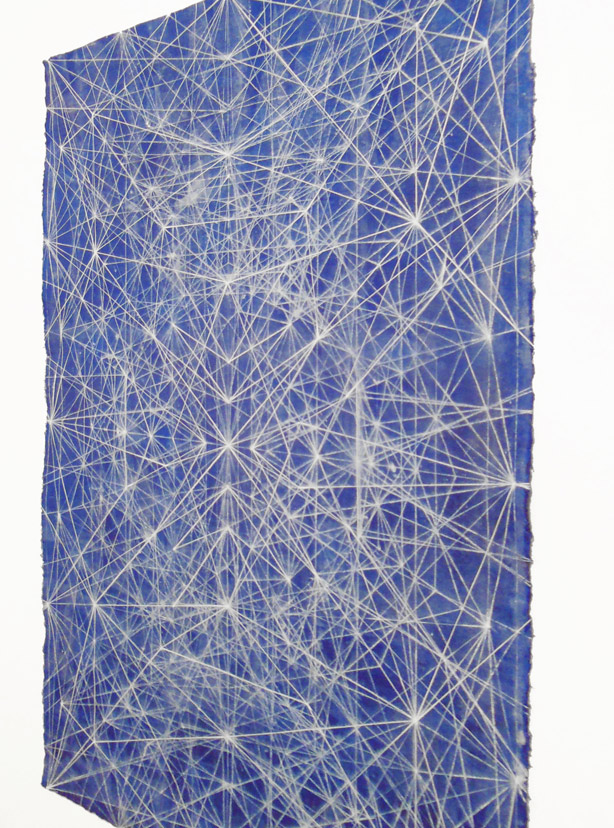
    Devin Powers, Liminal (detail) 2013. Image courtesy of the artist.

    Devin Powers, Liminal (detail) 2013. Image courtesy of the artist.

    If you are the city this Thursday evening consider stopping by Marymount Manhattan College for the opening of the new exhibition, Self-Similarity in Math, Nature & Art at Marymount Manhattan College curated by Hallie Cohen and Sam Freeman.

    Featuring : Samwell Freeman, Susan Happersett, John Hiigli, Michelle Hinebrook, Caleb Nussear, Jascha Owens, Devin Powers, John Sims, Joan Waltemath

    Self-Similarity in Math, Nature & Art
    September 29 – October 31, 2013

    Opening reception: Thursday, October 3, 6 to 8pm
    Marymount Manhattan College
    mmm.edu

    Nuit Blanche

    Scotiabank Nuit Blanche is Toronto’s annual all-night celebration of contemporary art, produced by the City of Toronto in collaboration with Toronto’s arts community. The eighth edition of Scotiabank Nuit Blanche will take place Saturday, October 5 from 6:51 p.m. until sunrise. This year’s lineup includes 112 art projects created by more than 500 local, national and international artists who will transform the streets of Toronto for a single night. Highlights at this year’s event are three curated exhibitions, including a centrepiece installation by world-renowned artist Ai Weiwei of China, curated by Ami Barak.

    Curators and curatorial themes:
    • Curator Ami Barak’s exhibition “Off to a flying start” is themed around the 100th anniversary of ready-made art now found in galleries and museums and brings these objects back to the streets.
    • Curator Patrick Macaulay’s exhibition “PARADE”, presents an unconventional parade where the audience becomes the procession.
    • Curators Ivan Jurakic and Crystal Mowry’s exhibition “Romancing the Anthropocene” acknowledges the triumph of science and human achievement but suggests a cautionary message regarding the destruction of natural habitat.

    Full details available at http://www.scotiabanknuitblanche.ca.
    Complete information on all travel packages can be found at http://www.scotiabanknuitblanche.ca/travel-packages

    The first thing that strikes you upon entering this multi-faceted show by David Renggli (b. 1974 in Zurich) at Kunst Halle Sankt Gallen is one of Renggli’s signature reverse glass paintings in black and white titled I Love You (b/w), 2013. Contrary to the usual colorfulness of the abstract color strokes, the hues in this painting have been reduced to grayscale while the massive wood frame glistens in a soft pastel pink.

    Hanging next to the monochrome painting is a seven-foot flute made out of wood cryptically titled Compositions, 2013. The larger than life flute is suspended from the ceiling with its mouthpiece hovering inches above the entry’s floor. Upon closer inspection the air holes of the flute are placed anarchically all around its slender form.

    A stark contrast to the orderliness of the first vista greets the viewer as you move into the Kunsthalle’s second and largest room. Eight neon sculptures in an otherwise dark space create a wonderful atmosphere of intensely colored light. Focusing on one of the tree-like sculptures, they are assemblages of words and geometric forms. Each one following the same rules yet differing in color and form: words like “ABER” (German: “but”) and “SORRY” are read top to bottom, split into two columns, while various geometric forms unite the word-fragments. For example the word “LIB/IDO” is backed by a tilted triangle whereas the word “NU/DE” is backed by a “hash-tag” like symbol skewed, in perspective. It remains unclear as to how the geometric figures correspond to the connected words. One might argue that the alleged meaninglessness leaves us with one choice only: reading the words as simple sounds and the utter fascination with this most basic realization about communication. Something quite wonderful actually, something seemingly so simple yet profoundly human. (I would speculate that the Show’s title Scaramouche was chosen out of similar reasoning. It is simply such a fun word to say.)

    Wandering around the room inspecting the various iterations of the neon sculptures, you discover another sculpture, Daybed Nr.1, 2013, which is almost hidden away in one corner of the space. The piece consists of a smooth concrete slab on a metal sub-frame with a rather large, almost rectangular, natural stone mounted on one end. It is reminiscent of a chaise lounge. The sculpture/bench has specifically designed holes in the concrete where swiss currency and a gemstone slice are embedded.  Interacting with the bench is quite a tactile experience as probing fingers glide over the glassy sliced gem, the smooth concrete, or the rough surface of the large stone.

    David.Renggli.3_opt

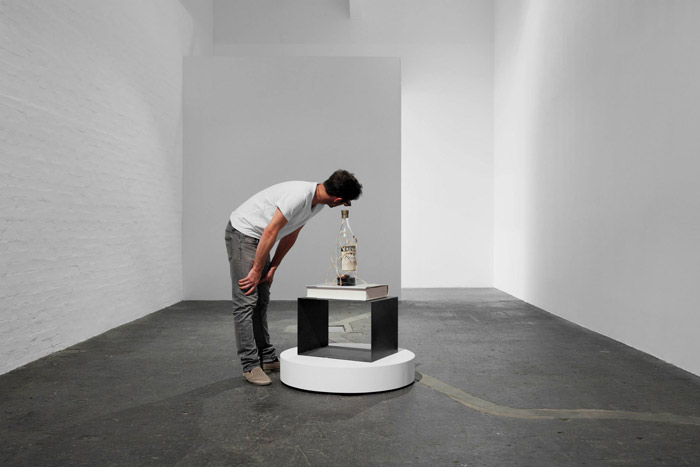
    David Renggli, Yes Maybe, You’re Right But Let Me Think About It, 2013. Mixed Media Installation. Image courtesy of Kunst Halle Sankt Gallen.

    Moving on to the next, small and elongated room, one happens upon a softly lit rectangular metal frame supporting a book with a rather large wine bottle centered on top. This work is titled Yes Maybe, You’re Right But Let Me Think About It, 2013. The bottle is filled with what looks like wine. There are wine-corks, flies, and cigarette butts suspended in the liquid. Like a mad genie in a bottle, the sound of crazed laughter escapes from the open bottleneck. The barely audible sound forces the viewer to assume a specific posture, made to bend their posture almost in half in order to listen to the recording.

    This is typical of David Renggli’s sculptural work, as seen in the last room of the exhibition where there are two more benches with a more complex arrangement of natural stones glued to the concrete slab, leaving the human frame only few choices in how to arrange itself comfortably. The artwork thus functions as a ruse to see human bodies assume certain positions.

    As you turn the corner from the palate cleansing toned-down room with the bottle you behold a truly monumental reverse glass painting I Love You Nr.3, 2012 composed mostly in reds. This is the only work that wasn’t specifically produced or revisited for this show. To the left there are two more benches parallel to each other suggesting a sort of communicative space, furthered by two robotic flutes amateurishly playing a barely recognizable duet-rendition of Led Zeppelin’s “Stairway To Heaven.”

    While the painting is purely impressive the technical feat of the flutes independently playing music almost seems endearing and funny, almost cute when they miss a note or when the robotic fingers struggle to keep up with the tempo of the music. This mixture of well considered surface finish along with subtle content references and wit, drawing the viewer in and almost forcing them to interact, physically and mentally.

    by Sebastian Schaub

    kunsthallesanktgallen.ch

    Ai Weiwei, Forever Bicycles, 2013. Sculpture Beijing, China. Photo Credit: Taipei Fine Arts Museum

    Ai Weiwei, Forever Bicycles, 2013. Sculpture. Photo Credit: Taipei Fine Arts Museum

    Scotiabank Nuit Blanche 2013 – October 5 in Toronto

    Scotiabank Nuit Blanche is Toronto’s annual all-night celebration of contemporary art, produced by the City of Toronto in collaboration with Toronto’s arts community. The eighth edition of Scotiabank Nuit Blanche will take place Saturday, October 5 from 6:51 p.m. until sunrise. This year’s lineup includes 112 art projects created by more than 500 local, national and international artists who will transform the streets of Toronto for a single night. Highlights at this year’s event are three curated exhibitions, including a centrepiece installation by world-renowned artist Ai Weiwei of China, curated by Ami Barak.

    Curators and curatorial themes
    • Curator Ami Barak’s exhibition “Off to a flying start” is themed around the 100th anniversary of ready-made art now found in galleries and museums and brings these objects back to the streets.
    • Curator Patrick Macaulay’s exhibition “PARADE”, presents an unconventional parade where the audience becomes the procession.
    • Curators Ivan Jurakic and Crystal Mowry’s exhibition “Romancing the Anthropocene” acknowledges the triumph of science and human achievement but suggests a cautionary message regarding the destruction of natural habitat.

    Full details available at http://www.scotiabanknuitblanche.ca.
    Complete information on all travel packages can be found at http://www.scotiabanknuitblanche.ca/travel-packages.

    Travel to the edges of any major European city, and you reach placid suburban hell. This is true even for ultra-civilized Copenhagen. The Louisiana Museum of Modern Art in the suburb of Humlebæk is reachable in under an hour by train, from which you see the city ebb, flow, and dissipate. Tucked inside an otherwise unassuming street, it treats us to a mock-Riviera villa with slick modernist appendages. Through the garden, luscious and perfectly kept, you are confronted by the sea, the Øresund. The gallery’s promotional material emphasizes the beauty of the location, claiming that Louisiana is able to strike a rare balance between art, architecture, and nature—but it is hardly unaffected. Could there ever be a better environment to experience the artistic career of celebrity peace activist Yoko Ono?

    Louisiana provides a minor relief to the full philistinism characterizing modern experience, but there is something not quite right about this setup. For one thing, it’s a bit too civilized. On a sunny afternoon, one can sit in an ergonomically correct chair at the Louisiana Cafe, basking in the sea air in total peace, amused by fellow visitors’ perfectly behaved children. Does this not play out in the gallery experience, too? Is it not the case that spectator and artwork, subject and object, mutually internalize the calm? If yes, does the confrontation with the art-object turn into a crude exercise in lifestyle aestheticism? A rather surprising second problem is that, when you go to Louisiana, you enter through the gift shop. The banality of shopping physically impedes our access to the artworks themselves. The gift shop is thoroughly tasteful, but the problems with this should be self-evident. What better way to mark the full domestication of Fluxus, or, by extension, conceptual art than this?

    Ono’s Half-A-Wind Show­ consummates these problems. A retrospective of her half-century in art and music, it is heavy on biographical details. It gives us a celebratory overview of her personal, political, and creative life in big bilingual panels before we enter the exhibition-proper. It puts these details in their world-historical context, which rather inflates Ono’s significance. It is unclear if we are supposed to believe that she lives up to the Romantic cult of individual genius. How would this work, exactly, when she is such an advocate of audience participation and the death of artistic authorship? It is right to think of Ono as one of the surviving participants of an era of unsurpassed creative response to social and political crisis? It is difficult for those of us born during its aftermath—the long, ongoing anti-1960s—to look at that time with the misty-eyed nostalgia of our baby-boomer predecessors.

    Half-A-Wind Show acts as a convenient sample of its failings. It commits itself to the same problems that afflict much contemporary art. It prefers to try to be overwhelmingly entertaining rather than to begin to pose interesting questions. It is not enough to say that the sheer amount of work here is at best, distracting, and at worst, muddling. The show includes one hundred or so works, from ready-mades and paintings, through films, installations, photos, drawings, and textual works. It is impossible to provide a full assessment of it all. Instead, we have to limit ourselves to pointing towards the docility of these works, their lack of any truly critical power. There are two key examples of this.
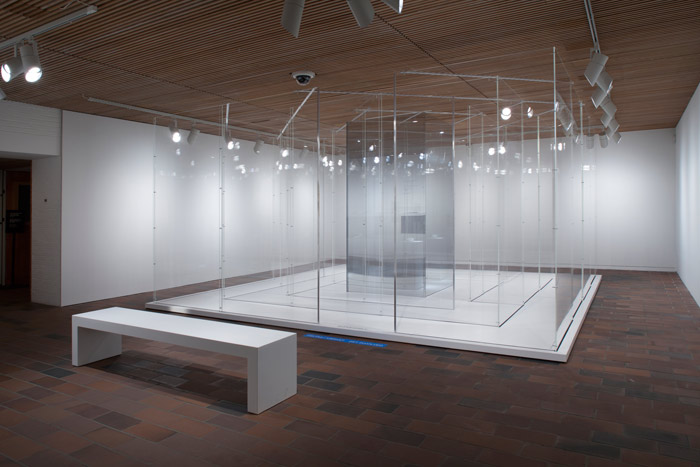
    Yoko Ono, 18 (glass chambers). Half-A-Wind Show: A Retrospective. Installation shot  Photo: Brøndum/Poul Buchard  Credit: Louisiana Museum of Modern Art

    Yoko Ono, 18 (glass chambers). Half-A-Wind Show: A Retrospective. Installation shot
    Photo: Brøndum/Poul Buchard
    Credit: Louisiana Museum of Modern Art

    First, the gallery experience itself stifles the staple Fluxus concepts of interaction, performance, and ‘intermedia’. People are often understandably nervous about physically engaging with art-objects, even if the work itself claims to invite it. In this case, however, we are not actually allowed to interact with the supposedly interactive art. 1966’s Ceiling Painting, (Yes Painting) provides us with one such example. The work itself comprises a ladder, which one is supposed to climb. At the top is what looks like a trapdoor with a magnifying glass attached. It is, in fact, a panel upon which is painted the word “YES”. The problem is that Louisiana is here acting as the steward of the art collection of Detroit’s Gilbert and Lila Silverman. This is private property. Trespassers will be frowned upon and politely asked to leave.

    Second, the art-going public still tends to treat works of art with a quasi-religious solemnity. This is precisely the sort of fluttering bourgeois anxiety that movements like Fluxus tried to challenge in the first place. The whole point of Fluxus was that it tried to make art fun. Perhaps this is why the noise from the twenty-five minute long 1970 video piece Fly is allowed to interfere with the earnest silence irreverently expected of the ready-made Apple from about 1966. Fly follows the adventures of a fly as it skirts the contours of a naked female body. It crawls through pubic hair, ascends the nipple, caresses the lips. Accompanied by a bizarre, jarring fictional buzzing sound made by the artist’s own voice, it blinds the male gaze as it goes. Apple, meanwhile, comprises a plexiglass stand with a brass plate reading “Apple”. At the top is an apple. Between them, there could be some curatorial crosstalk between nature and its manipulation, between disgust, animality, and the question of the erotic—Biblical origins of human self-knowledge.

    Of course, this could just be a coincidence. It could be a moment of flux amid the sheer superficiality of a show that refuses to question the disappearance of beauty in art, the reduction of high conceptuality and anti-representationalism to pure surface, or the apparent canonization of Ono herself. The only question it prompts is “what’s the point?” The only answer we are likely to receive is that there isn’t one. It might be best simply to enjoy the view.

    By Max Feldman

    News | Exhibitions