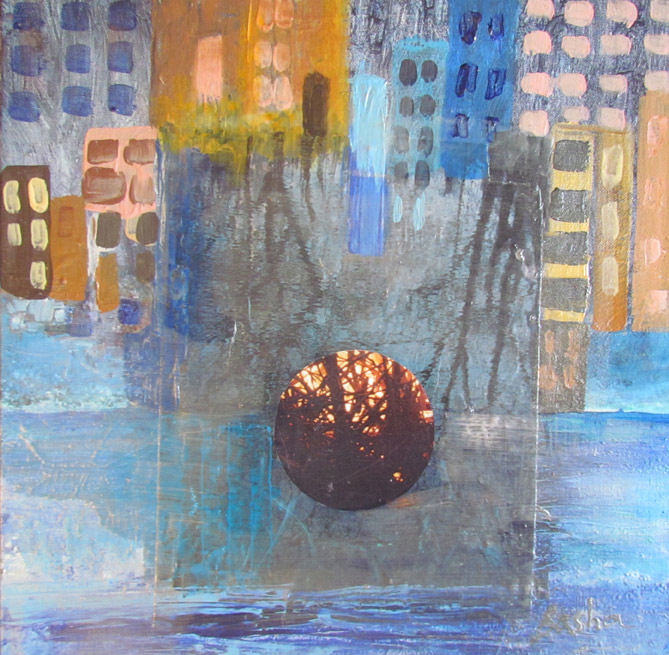
Painting links me to the world and represents the mean to communicate my emotions and feelings. It’s a silent language ignoring bounds and borders, bearing signification beyond words because true communication goes through silence. I claim lyric abstraction as a style, out of bounds and within freedom and creativity. Oil is my medium because of its sensuality, glare, and demands. I love the personal challenge it represents, requiring my surrender to painting. My inspiration often ensues from the choice of two colors, of their light plays, and the palette that is to be born. Successive layers cover canvas as instinctive consequences of spontaneous gestures and movements. Knife turns oil into a peculiar texture that invents reliefs and transparencies in recurring discovering processes.
Some meaningful statements on painting are being made in Boston this fall.
At the Institute of Contemporary Art is Expanding the Field of Painting, highlighting works from the ICA collection that challenge the orthodoxy of traditional materials, subjects, and techniques of the genre. While challenging the orthodoxy of painting’s, well, everything has been going on for generations, the selections here have spark and sex appeal—there is an especially thrilling corner of the show that faces off a typically pneumatic and glowing Lisa Yuskavage with a full length nude portrait of a very pregnant young woman by Alice Neel. The iconic Marilyn Minter Green Pink Caviar video plays in the middle. The Minter video’s swirling tongues and puffy lips look like sea creatures as they rudely cavort across a candy-smeared surface in slow motion. It is not usual to be presented with so much raw female sexual imagery that somehow maintains the figure’s subjectivity. Expanding the Field of Painting closes October 2014.
Also at the ICA is the first museum retrospective of the outspoken and influential painter Amy Sillman. It is she we have to thank in part for the current trend in juicy abstraction that flirts with figuration. But she should be revered for the way she has rigorously searched for and found forms and painting processes that can convey the paradox of being a thinking, feeling, sexual being that lives in and through a gendered body. She is one of the most authentically existential painters working right now. In the last gallery, on a small screen, is Sillman’s animation of a Lisa Robertson poem. To create the animation, Sillman made over two thousand ‘paintings’ on her i-pad. They seamlessly morph into one another as she narrates Robertson’s poem as a voice over. While surrounded in the gallery by some of Sillman’s largest, most tour-de-force paintings, this collaboration of voice and moving image just might be the key work to understanding Sillman’s concerns. While the retrospective is worth a trip to Boston (I recommend a meal at Sam’s afterword), the six minute video can also be found below. Amy Sillman: one lump or two is up till January 5th, 2014.
Leidy Churchman’s show, Lazy River, just opened at the Boston University Art Gallery. His enigmatic works point to paintings future where the traditional relationships between object and subject have been divorced. Churchman often paints figuratively, and the show is predominantly filled with small, thinly painted and yet vibrant works, whose names belie their subject: Rat, Lemon, Pizza Box, Devil. The straightforwardness of these works, their charm and feeling, leaves one straining to connect them in a narrative or other type of structure. While Churchman denies this pleasure, he may be remarking that as our relationship to imagery loses its scaffolding in this contemporary age, what remains is no less heartbreaking, and perhaps much more playful. Don’t step on the giant floor painting. It is called Pool.
Lazy River is open until October 20th, 2013.
By Emily Auchincloss
My Art is in constant motion. It is a motion. My creativity floats and expresses energy and movement. My painting is like a mirror of my Soul. The inspirations come and go, my spirit dances with colors.
Where do these images come from? I have no answer. It comes from within, but before the painting comes out of me I feel like a channel. I invite all of these miraculous things to come to me and float through me like a stream
I just remain open and let it happen.
Showcasing four artists who hail from four different countries; Belgium, The Netherlands, The United States, and France, Backslash Gallery has put together a cohesive show of artists working in similar veins but from different parts of the globe. These artists use codes and forms centring on the theme of construction and deconstruction. Populating the gallery with their favorite media, the artists create a journey where small-scale works alternate with monumental installations.
Belgian artist Xavier Theunis adopts a humor-tinged approach to the great movements in the history of art, design and architecture. His decorative obsession magnifies a perfect mastery of artistic precision, as demonstrated in his monumental collages where plane highlights volume. The artist’s play of abstract constructions, witness to his highly skilled use of colour, produces compositions as unsettling as they are enigmatic.
Dutch artist Boris Tellegen’s works on wood and paper express his interest in environmental issues. He uses engineering and the many artistic possibilities it offers in his monumental assemblages, where the aesthetic approach marries harmoniously with notions of construction and the purpose of his explorations. Each piece is put together and modelled meticulously, leaving no room for the random in the methodology favoured by this architect of chaos.
A process of deconstruction then reconstruction lies at the heart of the work produced by American artist Michael Zelehoski. Influenced by a number of historical artistic movements, particularly Analytic Cubism, the artist takes apart objects found in the street, cuts them up, following clearly defined rules, and reinvests them with a sense of the three-dimensional using a totally flat composition system. After this initial process of dismantling and artistic transformation, the object comes back to life, taking on a new and ingenious perspective while retaining the work’s planar form and causing viewers to question what they are seeing.
French artist Rero’s work, including the famous crossed out letters scattered around public spaces – such as the Centre Georges Pompidou in Paris last spring – lies on the dividing line between outside and inside. The artist’s exhibitions inevitably create a striking setting wherein the works take part in a reconstruction of the urban wastelands, particularly abandoned sites, that he draws on for unending inspiration in his quest for artistic experimentation.
Appropriately titled (de)constructions, this show will be up until the end of October. The works very much deserve a proper viewing as their materiality gains from lived experience and the interaction of light with each form. Regardless of whether you enjoy work based around abstraction, process, or material; this exhibition has something for every viewer and should not go unseen.
Trí explores the differences and interconnections of 3 artists working in Ireland today. Tom Climent, Suzy O’Mullane and Marty Kelly are all highly respected figurative artists from Ireland. For the three artists their work emanates from the figure, whether they refer to the art historical markers or whether they use the figure to illustrate ideas, moods or concepts.
Featuring: Tom Climent, Suzy O’Mullane and Marty Kelly
Trí
October 3rd – November 2nd 2013.
Opening Reception: Thursday, October 3rd, 6pm
J. Cacciola Gallery
537 West 23rd Street
Chelsea, New York City
jcacciolagallery.com
This inaugural exhibition at BRIC House will act as a celebratory “housewarming” of the new gallery, as well as an exploration of notions of home from broad vantage points. The exhibition will feature the work of 12 Brooklyn-based artists who work in varied scale and with varied artistic media, exploring the idea of “home” as a flexible, variable concept revealed in a myriad of ways, and influenced by an individual’s history and personal accumulation of places.
Curated by Elizabeth Ferrer, BRIC’s Director of Contemporary Art
Featuring: Akunyili, Sonya Blesofsky, Margaret Reid Boyer, Drew Hamilton, Katarina Jerinic & Chad Stayrook, Esperanza Mayobre, Abraham McNally, Garry Nichols, Keisha Scarville, Vargas-Suarez Universal, and Nathan Wasserbauer.
Notions of Home from the Center of the Universe
October 3-December 15, 2013
Gallery at BRIC House
647 Fulton Street
(Enter on Rockwell Place)
Brooklyn, New York City
bricartsmedia.org
In communion with nature, I paint Fuschias and Dead leaves, I go from the Sahara to the Depths of the ocean. Yet, nothing in my work takes me away from semi-precious stones: colors, veins and light evoke the original source of my painting.
“Mystery or mysticism … my work seems abstract,” only at first sight. It is in fact open to interpretation through the titles I choose, through the skies, characters or elements I paint. Even better; I bring them to life for you.
Recipes of an artist as well as of a scientist, my oil paintings have the relief and rendering of something new in the world of art with the authenticity of the material; without any addition.
In New York City at the Museum of Modern Art you are standing before“The Treachery of Images” (1929). It is a painting of a single object, a pipe, under which are the words, “Ceci n’est pas une pipe.” (This is not a pipe.) Why the denial? Of course, this may be a pipe but the painter of the work is the Belgian artist René Magritte (1898-1967). Magritte wanted, as he said, to make “everyday objects shriek out loud.” More importantly, because he was associated with the Surrealist movement, every object is surreal and therefore there is always the understanding that what is represented is not the same as what it is supposed to represent. So, of course, the picture we are looking at is not a pipe.
Magritte is one who looks but is in doubt about what he sees. He is an artist who seems to be in conflict with the very image he is working on. Consider The Lovers (1928) where the pleasure of a kiss is destroyed because the artist covers the faces of the lovers in cloth. Like others of the artist’s work, this is a very disturbing image, but he is an artist who has declared that the Surrealist movement of which he was a significant part “claims for our waking life a freedom similar to that which we have in dreams.”
By Harriet Zinnes
Flesh and Bone pits a happily married establishment figure and Royal College of Art tutor, against a self-taught sadomasochistic gambler with a fondness for alcohol and the sleek underbelly of Soho.
It is difficult not to see this exhibition as a competition of interests and the interesting; the very personalities of both artists are quite evident—one only needs to look at the photographs in the exhibition of both artists’ studios to see the yawning chasm between them. A curatorial decision that seems to play more to their differences than similarities, we are reminded that the cult of personality also comes to bare; as the viewer brings a foreknowledge of the infamy of one of these artists as well as of his art. The show brings together a gilded gutter life in Soho with the life of a fellow of the British Academy and a public figure. As one enters this exhibition, passed the photographs of Bacon’s Reece Mews studio, with its paint-strewn shambolic glamour, paired with photographs of the sedate and organised ‘school room’ of Moore—the scales of personality are already tipping in Bacon’s favour.
There are two ways in which you can view this exhibition. If prejudice is left at the door along with the misguided cult of personality, comparison of the very dichotomy of these artists can lead to the recognition of shared formal concerns; faces lost, distorted, or abstracted. Identity for both artists was at times even non-existent; as the likeness of an individual was of no importance to either man, yet the physicality of the human body, and the subsequent abstraction of form and shape is of paramount importance to both artists visions. What at first are diametrically opposed works do on occasion give way to familiar aesthetic concerns of the shape and weight of the figure.
But it is hard to balance these two artists’ works. Bacon’s feverish sacks of meat are positively fervent set against Moore’s stolid immovable incapacity; Moore is like a muted child being out-screamed by a naughty sibling.
Where Moore regains footing, however, is in his drawing. This has a dynamism that, frankly, I can never find in his sculpture; a sense of movement and even urgency that reflects at least an aspect of the supine, frail flesh all around it. Moore he reflects upon war, it is the only occasion for the artist where he is less kind to the reality of the human form, with slight echoes of Baconian angst. Moore’s tepid beauty receives more pain than is usual and becomes all the more vivid for it— both artists having been influenced in their own way by the realities of war.
For the most part, Moore’s human condition is concrete solidity; the unbreakable skeleton shrouded in bronze—here juxtaposed with Bacon’s fleeting and bloodied flesh. His painting appears both “bruiser and bruised”—and if viewed as a boxing match between these two giants of British Art, Moore’s fair play is taken advantage of at every opportunity by Bacon.
The second way of viewing this exhibition, and secret to finding its success, is in trying to imagine that Moore’s sculpture is the three-dimensional result which—in some ways at least—of which Bacon has often dreamt. This is expressed in a very sculptural style of painting, and equally expressed by a drunken Bacon, who at one time actually turned up at Moore’s door demanding lessons in sculpture. In fact, the similarities between Bacon’s sculptural figures and Moore’s curve of form are often prescient as highlighted by Richard Calvocoressi and Martin Harrison’s curatorial decisions, even made almost too obvious on occasion.
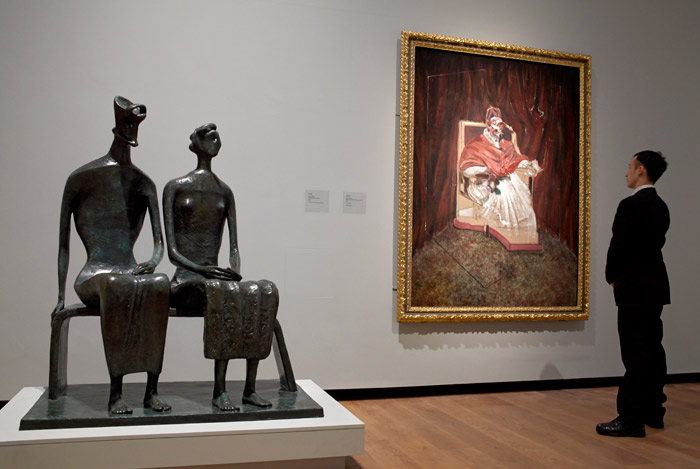
There is no denying the comparison between these two artists; Moore’s King and Queen reside as a seemingly permanent weight beside Bacon’s Pope Innocent X. A surface reading of this juxtaposition reveals certain formal similarities between the sculptural heads and the painted; yet that raw kinetic vision of Bacon again causes the once timeless, osseous matter of Moore’s work to melt away before your very eyes.
Bacon’s Lying Figure and Moore’s Reclining Figure share a striking visual collaboration; but Moore’s sculpture is a physical reality whereas Bacon’s figure is a theatrical construct placed in its own caged environment—and is all the more powerful for its decadent sanguineous fantasy. In that sense Bacon’s fictional sculptural figures behave like objects in an installation—an object within its own universe—as opposed to Moore’s sculptures that are forever separate and reside in our own.
The curatorial attempt to reference academic similarities is sometimes heavy-handed, but the juxtaposition is of significance, highlighting a core value with wildly different and antithetical results. Aside from formal and conceptual conceits which are present and of interest, when viewing this exhibition there can be no denial of power. For all the curatorial insistence of equality it seems that the psychological response to our fears will always be greater than that of our desires—as Baconian existential horror out-screams Moore’s muted immortal bones.
By Paul Black
Bacon Moore: Flesh and Bone, is on view at Ashmolean Museum, Oxford until 19 January 2014.

-
Tarsila do Amaral: Inventing Modern Art in Brazil
Tarsila do Amaral: InventingModern Art in Brazil “I want to be the painter of my country,” Tarsila do Amaral. Her signature style was ... -
ASIA WEEK MARCH 15 – 24,
15 Thu 16 Fri 17 Sat 18 Sun 19 Mon 20 Tue 21 Wed 22 Thu 23 Fri 24 Sat... -
NYC ART FAIRS MARCH 2018
The Armory Show March 8 – 11, 2018 New York, NY NYC Art Fairs March 2018 The New York City Art Fairs for March is referred to as Armor... -
17 Cuban artists: All That You Have Is Your Soul
Dear Abraham, Gallery 8 New York opens in Harlem next Thursday with an inaugural exhibition 17 Cuban artists from FACTION Art Project... -
Currents: Abortion A.I.R Gallery January 4-February 4
Abortion is our country’s Scarlet Letter, an impassioned “A” writ large on our conscience. We shame, blame and deny wome... -
CURRENTS: ABORTION
CURRENTS an exhibition in which artists respond to the theme of ABORTION. In this turbulent moment in history, abortion remains a signifier ... -
No Image
Guantanamo art in NYC makes Washington nervous
“Untitled (Alan Kurdi)” [Courtesy of Muhammad Ansi/John Jay College]... -
No Image
7th Moscow Biennale
Being late to speak at the 7th Moscow Biennale, I try the Russian car service Yandex, rather than taking the ornate Moscow subway. My driver... -
Louise Bourgeois at MOMA
The MOMA exhibit, Louise Bourgeois: An Unfolding Portrait, showcases the prints, books, and creative process of the celebrated sculptor Loui...


br> br>