

• At the Casino Luxembourg – Forum d’art contemporain, artist Christodoulos Panayiotou deciphers the history and sociology of contemporary society. This subtle and astonishing exhibition strikes a wonderful chord.

    For over ten years, the Cypriot artist Panayiotou has delved into contemporary history through that of the island where he was born, to show the different layers of a society which is trying to find itself, becoming standardized and creating its very own myths. The Casino Luxembourg presents a selection of his works of art as well as interventions to the building itself.  The exhibition presents a sensitive, intelligent, ironic view of our identities and our worlds, which sometimes don’t seem to be quite right.

    Christodoulos Panayiotou has, over the past few years, made his place in the world of modern art thanks to particularly intelligent, simple, sensitive creations which are not without irony. They center on a universal subject; the construction of identity and history in our modern societies. Originally from Cyprus, a small island in the Mediterranean squeezed between Europe, the Middle East, and Africa, Christodoulos Panayiotou has always been interested in history and its construction, in the myths and references that societies create over the years. Particularly touched by a complex and fragmented history, he uses Cyprus as a reference point to show us the cultural processes that the whole of society go through.

    As soon as you enter his exhibition, the tone is set, with no explanatory text, no titles on the walls. Works of art mix into the exhibition space and as an installed decor which becomes the work of art. The viewer starts with nothing more than the simple word, “And”. “The title of the exhibition was chosen especially to raise expectations. And sets the tone, as if there was always something left to write, define; history is not finished, everything is suspended”, explains the exhibition curator, Kevin Muhlen. During the preparations for his exhibition, Christodoulos Panayiotou delved into the venue’s history, and took inspiration from it. He made it his own, even taking away the white cubes, which were there for 20 years, so the appearance of the  “Casino bourgeois” of past times shows through. In this room, which has become Baroque again for the occasion, three pairs of shoes are lined up in their original boxes. He is interested in the history of objects here, that of the shoes. They are former women’s handbags, which have become typically masculine accessories.

    All the objects which shape our lives are close to Panayiotou’s heart. He reclaims them, and reactivates them to change the way we look at popular practices and beliefs. In this way, he has reclaimed the electricity poles from Independence Street in Limassol, placing them on a made-to-measure terracotta floor created from seawater, called The Sea. Referring to an historical anecdote from Cyprus, it reminds us of an image of the Mediterranean, the set of a terrible scene of daily shipwrecks, with only simple wooden logs afloat. As for the former ballroom on the first floor, it holds a mound of finely cut paper, which turns out to be the totality—or nearly—of Cypriot pounds which were destroyed following the appearance of the euro. The notes—which have now become scenery—take the form of vestiges from a past era, making way for standardization. For his research into the layers of culture and history, the artist is particularly attached to the media tool as a vector for these new myths, created by any document. In his trilogy, Wonder Land, Never Land, I Land, Panayiotou has rummaged around in the photographic and historical archives of his island to find out how a new identity comes to be built as influenced by European and American politics and popular culture. In this period of political, economic, and identity crises in Europe, the exhibition, And allows us to take a step backwards, to relearn how to look at history, and to attempt to better understand its mechanisms. Christodoulos Panayiotou surely had no doubt that his exhibition installation in the Grand Duchy would be exceptional. His questions truly resonate in this small country, a small island of sorts surrounded by bigger ones, where the layers of continuing history have been accumulating for a long time to blur its identity.

    By Mylène Carrière
    www.casino-luxembourg.lu

    Image courtesy of the artist.

    Image courtesy of the artist.

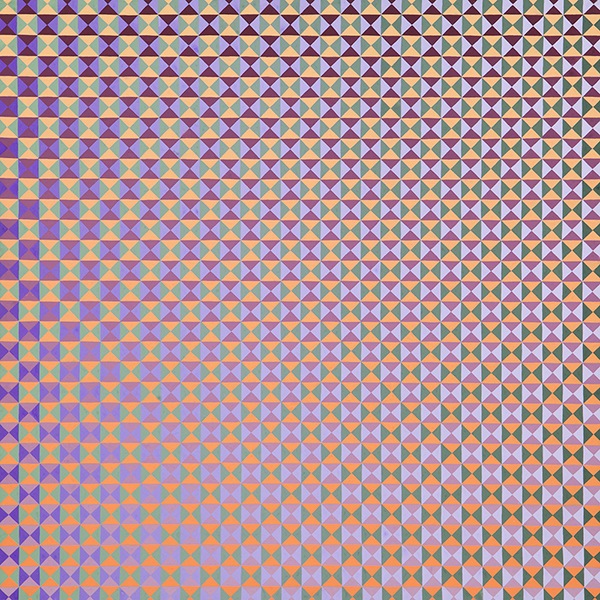
    In this series Fragments G&C, compositions are based on geometry and change, in color, value, temperature, or intensity.  These changes can be seen as the eye moves from top to bottom, bottom to top, or from side to side.  Through this process I can explore simultaneously the mysterious spaces between inside and outside, colorfield and image, figuration and abstraction, two and three-dimensional space. And because of its simplicity has immediacy, and spontaneity that is distinct.

    In this body of work I use simultaneous contrast, which is the use of two colors, painted side by side, that interact with one another and change the visual perception accordingly.   Though the shapes are not altered, patterns appear, disappear, and change in their appearance.  Fragments G&C is a series that is a new form of Color Field painting.   Which was the first major art movement initiated by a woman, Helen Frankenthaler.

    annelllivingston.com

    Image courtesy of the artist.

    Image courtesy of the artist.

    It is difficult to determine if a “fix statement” operates between this series of experiments with the image. What seems to connect them is the insistent pursuit of change; the radical transformation of their initial forms, its essence, what makes them be what they are. Part of this process and praxis of the artist, is revealed in the results of the interaction between substances like varnish, sulfonitric solution, acid and other chemical compounds. The reactions of these substances astonish for their transfiguring violence, which submits the matter, and at the same time open an incredibly wide horizon of physiognomies.”

    -Ignacio Rojas

    axuz.net


    Image courtesy of the artist.

    Image courtesy of the artist.

    I entitled all the works that have shoes as their subject the Steps of a woman. They are born from thinking of all those steps that a woman makes to carry out her tasks, to realize her dreams. I work on this theme every now and then, painting in small groups, always different even in size, but always with the same mixed technique, oil, collage, plaster, and stencil. Every time I look for the harmony of colors and shapes, the shoes are transformed into pictorial objects.

    vivianagraziani.com

    Klaus Enrique is a New York based photographer whose work echoes that of Giuseppe Arcimboldo, with some surprising twists. For one, the subjects of his portraits—made from fruits, vegetables, and yes, even raw chicken—are captured in real time, in the glorious moments before they inevitably began to decay. The photographs are stunning commentaries on the fleeting nature of life and the complex beauty of living things. Enrique’s upcoming solo show at Rebecca Hossack Gallery will showcase such artfully constructed subjects as Princess Diana, Gandhi, and even Darth Vader.

    Kinsey Robb: First of all, congratulations on your upcoming solo show at Rebecca Hossack Gallery!
    Klaus Enrique: Thank you. I am very much looking forward to the show.

    KR: Given the obvious parallels between your work and that of 16th century mannerist painter Giuseppe Arcimboldo, can you recount your first experience with Arcimboldo’s work and how it affected you?
    KE: At the time I was very excited about this “new” idea I had just come up with of making portraits entirely out of leaves, and I was online researching what other artists had done along similar lines. I immediately came across Arcimboldo’s work, and to be honest, I was really disappointed because it immediately became clear that my new idea was not new at all. As with so many things, somebody somewhere had already thought about it, and in Arcimboldo’s case, he had executed this idea incredibly well.

    KR: What led you to re-create Arcimboldo’s famous portraits? Why the focus on 16th Century mannerist painting?
    KE: After finding out that my idea was not so new after all, I kept on researching Arcimboldo’s work and the artistic tradition of depicting faces with organic objects and I realized that he had not been the first nor the last artist to use this particular technique. But because of his superb execution, Arcimboldo had become the master of this style. I still believe that photography is a perfect medium for this artistic tradition, but if I was going to go ahead with this project, I was going to have to master Arcimboldo’s work. That’s why I used his work as the starting point of my own.

    KR: At first glance, it could appear as though your work is digitally created through the use of Photoshop, but your work is far more complicated than that. Could you elaborate on your technical process?
    KE: Well, I think that to some people it might, simply because we live in a world full of digital effects. But to the trained eye it should be very obvious that these are photographs of real sculptures made out of real organic objects.

    KR: For your upcoming show at the Rebecca Hossack Gallery in NYC there will be some additional Acrimboldo-esque pieces, however the subject matter draws from pop cultural icons—Ghandi, Princess Diana, and Darth Vader. Can you comment on your decision to shift from the16th century to modern day?
    KE: As I mentioned earlier, for me this project was about creating my own images and Arcimboldo was simply the starting point. Once I felt that I had a good understanding of what made Arcimboldo’s work so great, I decided to create what I had originally envisioned, including some of these iconic images that I have been exposed to throughout my life.

    KR: For me, there is a darkness in your work. On one hand, there is an appreciation for the perfection of each branch, flower, piece of fruit etc…and yet I can’t help but think of the rot, spoil and decay that will come. The photograph allows us to capture and freeze time, but simultaneously makes us aware of it. It becomes all the more eerie when viewing your portraits of princess Diana and handy. How do you process this?
    KE: I love that you see that darkness in my work, because that is one of the conceptual layers that I want my work to convey. The word for “Still Life” in Spanish and other romance languages is literally “Dead Nature”, which I always thought was very macabre. Here you had some pretty apples and some flowers, and yet there was this inescapable fact that they were dead. Soon they would be eaten, or wilt, or rot, and they would be no more. We as humans are just like that. Just because we wake up every day we forget that one day we will not.

    These photographs were taken in one hundredth of a second to capture something that will wilt in minutes or at most hours, and at the same time make a historical reference to a painting that is more than four hundred years old by a painter who is obviously dead, but whose work is still very much alive. In a subtle way, these photographs should hint at our own finite place in time.

    Most people realize that these works have a great sense of urgency. Of a frantic rush required to get the piece done, which is in complete contrast to the deliberate, precise and delicate nature of the finished work. I think our lives should be like that.

    KR: What do we have to look forward to…any upcoming projects on the horizon?
    KE: For sure. I am trying to create a new piece every month, and I have a list of about 30 pieces that I want to make. So that is the next three years of my life, if I am still alive!

    The Reaping opens at Rebecca Hossack Gallery on Wednesday, October 16th. A reception will be held from 6-8PM at the gallery on 262 Mott Street.

    For her first exhibition with the gallery, Romanian born Anna-Bella Papp orchestrates a compositional space that reflects modernistic characteristics while evading any singular readings of her practice. Upon entering the gallery the viewer is embraced with a sense of openness, to both the works and the space. An openness that allows for a personal narrative to develop between artwork and viewer, one that perhaps exists beyond the artist’s intention. A sense of tactility resonates throughout the works as they occupy several glass tables throughout the gallery. These unfired clay tablets remind us that their development is still in motion, gradually becoming accustomed to their new surroundings. Susceptible to internal environments, these tablets remain untitled, (except one, this verse has no other night than the one that is coming, 2013), with only the material—unfired clay—defined. Such a deliberate gesture readdresses the materiality of the artworks, and implies a medium specific dialogue for the viewer to engage with. Clay as a medium does, however, have a historical reception both within craft and art. Like a metaphoric pretext, the malleable state of the clay imitates the indefinite exchange the viewer has with the work. The tablets occupy a liminal space, sharing elements of both sculpture and painting. The reliefs are displayed on glass tables, but also hung on the walls, implying a flexibility to their artistic categorization.

    This juxtaposition of delicate and stable assemblages is a prevalent motif throughout the exhibition (unfired clay to wall, unfired clay to glass table.) Reading this closeness of clay tablet and furniture as a system evokes questions of production and labor, particularly in the use of raw materials in industrial design. However, individually these near abstract tablets are cloaked by a cloudy reference—their modernist aspects, for example, are at once made present and yet seemingly hard to pinpoint. The works unintentionally reveal a fixation with modernist painting and architecture, both structurally and compositionally. In this verse has no other night than the one that is coming, Papp utilizes a framing device to set the stage for what may appear as pictorial content, such as a seascape similar to the impressionist view disclosed by Henri Matisse’s Open Window, 1921. Conversely, the works untitled, 2013, clay, 33.5 x 23.5 x 2.5 cm, and untitled, 2013, clay, 35.3 x 26.5 x 2.3 cm, seem to mark a compositional nod to minimalism.

    An architectural discussion also conveys itself unexpectedly as viewers realize that these tablet-like reliefs quickly comment on the historic moldings of the gallery’s interior. Placed next to each other on the glass tables, a diptych relationship between works may further be negotiated. Still each work in its distinctive appearance embodies its own inquisition. For example, untitled, 2013, clay, 28.5 x 22 x 2 cm holds a performative quality that provokes a sense of rhythm through various repetitious markings, whereas untitled, 2013, clay, 28.8 x 21.5 x 1.5 cm, almost bares no trace of the artist’s hand, only a silhouette of intention rests on the compliant slab. By intentionally not giving the viewer any context to the works, Papp creates a space that allows for a vast amplification of everything that isn’t there to be read and expanded upon, through the various exchanges one can have with the clay objects. Temporarily suspending all perceptions by the viewer, the work remains hazily defined until the initial encounter. The exhibition offers moments of recognition that at once serve as points of orientation and imply that each work is perhaps only a moment within a larger montage.

    By Victor Wang

    modernart.net

    Noah Becker’s first solo exhibition in New York since 1999 will open at the Lodge Gallery on November 7th, 2013 from 7 to 9pm. Many of the works were generated in the last two years out of his studio in Brooklyn. They break the seal of white noise haunting the Lower East Side, where exaltation of the new is liable to cheapen the art-viewing experience. One might classify Becker’s recent works as ‘art about art,’ incorporating nods to masters like Dirk Bouts, Pisanello, and Mary Beale. The influence of modern marvels, including Lucien Freud and Andy Warhol, contribute to the mutated output Becker deems “conceptual abstraction.” He places himself within several canons of art history immediately—a challenge to the formulas of collectibility. Becker’s aesthetic preoccupation brings to mind a feisty Chihuahua nipping at the tail of a Rottweiler that refuses to stop barking quotes from Walter Benjamin, gets all life updates from ArtFCity, and refuses to be walked above 14th Street (yes, the modern pup). Like garlic, his style emerges only after being scorched, submitting to the immediacy of his influences in an attempt to transcend them.

    The series of portraits is immediately penetrable, familiar as a vanilla-spiced candle. Neutral backgrounds heighten the artificiality of each sitter’s features. They become clowns, theater actors damned to wear stage makeup in reality like a badge of honor. Nearly all of the portraits are modeled from found images of British hair models from the 1970s. They are cooly shy and demure, with wayward eyes indicating that they had somewhere to be ten minutes ago. These neutral figures meld seamlessly with more recognizable faces—remnants of Diego Velazquez’s portrait of Philip IV in a Tim Tebow jersey, and Frank O’Hara’s doppelgänger, for example. The garb of each sitter is rendered loosely, for the most part refusing to assign an identity beyond facial expression. The portraits are like anemones on a coral reef. By way of their uniformity—their predominantly neutral backgrounds, skewed cropping, and lack of racial diversity—one can acknowledge Becker’s gestural instinct and his kill-tactics. Each character embodies a physical flirtation with decoration. Curly-cues and waterfall locks are rendered in spaghetti lines. The femmes are mysteriously seductive; the men have the pink complexion of an explosive adolescent caging his rage. Decorative elements become details, the only recognizable aspects of the sitters. They feel a bit naughty, even scandalous, in their inability to express a clear backstory. These works are indulgent. Becker claims he acquired “liberation in work that is about nothing.” Like Warhol’s Screen Tests, they rely on atmosphere rather than idea or intention.

    Becker_PhilipIV_opt

    Noah Becker, Phillip IV in the Costume of Tim Tebow, 2012. Oil on panel, 20 x 15 in.

    The newest works from 2013 battle Becker’s notion that “people are only interested in something that’s famous.” His aggressive injection of art historical talking points is transparent. The characteristic embellishment of the portraits is swapped for art-historical canoodling. Your Google search for Bronzino or Gérôme will now summon Becker despite the centuries between them. These new works are collaged images, spurned from quick, impulsive concoctions that zap Becker like a neurotic tick. In comparison to the viscosity of the floating heads, this series is more self-aware. Borrowed elements are rendered in perfect detail, allowing the visible gesture or physical indication of an idea’s extraction to go undetected. Becker’s own portrait peaks into the frame of Basquiat’s Charles the First, existing with the work in real-time or seemingly pasted onto the canvas like a window applique. The exteriors, often inflated by advertisements in a nod to reality, are bland boiled brussels sprouts. This intermingling of styles and ideals evinces perspectival confusion, no doubt. Despite the composition’s absurdities, the features of his subjects retain meticulous detail. Like looking for a Sacajawea dollar at the bottom of the piggy bank, these works allude to a treasure that won’t surface. Originality from centuries past is obscured, layered, and swaddled to produce a novel comment on worth.

    Is Becker’s offering, arguably unoriginal yet completely consuming, propaganda? By challenging the power of association, he uploads his work into conscious memory and links to legends. He holds the strings like a puppeteer and refuses to rely on simple illustration. Contemporary art’s obsession with the new has the power to short-circuit the visual experience; the trend of resorting to an untapped technique without considering the visceral reaction is irresponsible. Remember, kids, new does not imply good. Becker refers to this phenomenon as the “cultural cringe” caused by “historical paranoia” that everything has been done before. A counterpoint is the market’s adoration of aged works, of the consistent Macintosh apple that draws you return to the orchard year after year. In his refusal to invent for the sake of being new, he appropriates these older references and separates them from their original intentions of wrangling perspective, realism, truth, or physicality. The work has an innately befuddling seriousness to it, yet manages to laugh at itself without condescension. Becker fluctuates between conceptual provocation and a practice very much based in reality. He is wholly embracing the preoccupations he currently has as an artist: what makes an artwork valuable or collectible? When does contemporary begin or end? Oh, the subjectivity of it all! This fluctuation between mortal and deified, derivative and utterly bizarre, suggests a practice that will embrace alterations in hindsight as ripples arise in his reflecting pool.

    By Lynn Maliszewski

    thelodgegallery.com

    Debunking Foucaltian notions of power, post colonialism, and feminism in the most intricate fashion, Gayatri Chakravoerty Spivak left me mesmerized in a lecture she gave last month at New York University entitled, “Democracy and Representation.” I have worshipped at the academic alter of Gayatri Spivak for close to a decade and now would be able to pay my respects in person. A professor within the Media, Culture and Communications department of NYU had described professor Spivak’s lecture style to me as “talking in 3D.” This same professor had also advised me not to take notes during the lecture because of the experiential quality her talks often took. His advice proved to be incredibly helpful and after several minutes of trying to keep up with what she was discussing in my notebook, I quickly gave up and simply let Professor Spivak’s words wash over me.

    Following several long introductions, Professor Spivak finally rose from her chair to address the packed room. She donned a deep blue sari with green accents, and dark glasses that hung from a chain around her neck emphasized her close-cropped haircut. She began with some opening comments on the situation in Syria, then shifted to a discussion about the Patrice Lumamba regime that ruled the Congo until 1961, and the larger social and political implications this had within Africa and Europe. From here she moved onto talking about the ways in which democracy and representation function on a global scale and began to discuss her experiences working with rural teachers in India several years ago. Professor Spivak went onto speak for over ninety minutes circling around these various topics in a complicated way. I was astounded at both the length of time she lectured for but also the passionate way she discussed the various issues she was presenting on.

    It is Professor Spivak’s passion and extreme intellect that have formed the basis of her career.  At the age of thirty-four, she translated Derrida’s famous book Of Grammatology from French to English.  She went on to earn her PhD from Cornell University and became the first woman of color to receive the title of University Professor at Columbia University in 2007.  Her 1988 article “Can the Subaltern Speak?” is what many consider to be the foundational text of post- colonial studies. She has also been the recipient of numerous awards and honorary doctorates including the 2012 Kyoto Prize in Art and Philosophy, and this year she was awarded the Padma Bhushan award by the Republic of India for English and Literature.

    Given the political and social headiness of the lecture, one element I kept returning to was a brief comment Professor Spivak made about “training the imagination.” She said this within a larger conversation surrounding knowledge production and who “the producers of knowledge” are. Although this comment was referenced within a larger discussion about issues within education systems world-wide, it also seemed to offer a possible solution to these existing concerns. During the question and answer period following the lecture, one person asked what Professor Spivak meant by “the training of the imagination.” While she did not entirely nail down a working definition of this, it did leave a space open for a myriad of alternative possibilities to arise from.

    I saw her comment as an opportunity to expand both upon my own academic and artistic training, and also where this might be present within an educational context today. My “training” first took place at the School of the Museum of Fine Arts in Boston. I then went on to receive two Masters within the humanities: one in Gender and Cultural Studies and a second in Performance Studies. Over time, I began to notice that some of the foundational components I learned in art school, such as to think critically about the world around, and to find inspiration in the everyday, were so much apart of my writing and artistic practice that it had become almost ingrained within my psyche. Although these key ingredients were something I was both taught to do and naturally gravitated towards, there does seem to be a growing need within in academia for individuals to be taught to think creatively.

    In many ways, I think that Professor Spivak is urging us to continue to look beyond what the obvious solutions may be and to strive for more creative, effective strategies to solve issues on a macro and micro level. To train the imagination is to both develop a craft, but to also be able to integrate these skills into the quotidian. Within training the imagination, we must also un-train ourselves of habits, preconceived notions, and anxiety of the unknown. Everyone posses an imagination and can be taught to think creatively, but we also must be taught how not to feel self-conscious about this process and what may come with it.

    While there are various overlaps that occur within the humanities and the arts in terms of the kinds of education people receive, there is also a need to extend beyond these bounds. Creativity training is needed on every level of the educational spectrum. It can serve both to foster new ideas and to develop problem-solving skills that reach beyond the immediate things at hand. Training the imagination is not only about developing new techniques within the sciences, humanities, and new forms of art, it is also about teaching the next generation of artist and academics to continue to strive beyond what is currently known.

    By Anni Irish

    The full lecture can be seen here:

    Democracy and Representation, a talk by Gayatri Chakravorty Spivak from Media, Culture, Communication on Vimeo.

    A recent Facebook comment on the artistic validity of a social practice project made a snarky case that war could too be considered art, due to its impact and sublime scale. If one took up this misguided thought experiment, then an elaborating context could be the rhetoric of Italian Futurists. As they posited, the tools of war have the potential to morph from weapons to medium.  This is what Jesse Sugarmann has done for his second solo exhibition, California City, at Fourteen 30 Contemporary in Portland, Oregon.

    The title of the exhibition is taken from California’s third largest city, calculated by square miles. Its history and characteristics mirror many faded southwest towns. Real estate speculators bet on the water coming, which it has yet to do, leaving parched pavement to be reclaimed by the sands.  The vast emptiness of California City’s forty square miles have been a beacon to off-road vehicle enthusiasts, bonfire parties, and weapon testing from Edwards Air Force base.  The results of this ongoing history became the jumping off point for the works in this show: two videos and five works of napalm on acrylic, all from 2013,titled California Bloodlines.

    Sugarmann’s past works have deftly engaged with the history of the automotive industry and the legacy of quirky visual culture it has generated. In sculptures involving mini-vans, windscreens, and beaded car seat covers, he has assembled attractive visual jokes, which monumentalize these ubiquitous ready-made materials. These works notably include videos and performances of vehicles on collision courses set in motion by fork-lifts and air mattresses where Sugarmann has slowed down the moment of action into an anticlimactic theatricality, allowing one to ponder the aesthetics within the moment of a split-second car accident. In California City he both continues his work within auto industry and deviates from it.

    In the five-minute video California Bloodlines (GPS dozen) a driver attempts to navigate what remains of the streets in a California City neighborhood with the assistance of twelve GPS devices.  The many computerized voices synchronize and dissonate with one and other, advising the driver to make turns on streets like California Boulevard, a barely visible trace where sand and sage brush have taken over. A choir of “recalculating” is called out again and again as the driver aimlessly wanders.

    Where Sugarmann veers off from the car culture are a series of map-like drawings depicting tracks of land found in this too-big-to-fail town. These images are lined out in napalm on 24-inch square of acrylic and then lit on fire. The acrylic is thick enough not to warp under the heat, but the burning ooze does melt away and bubble up the plastic, leaving a brown scar upon the surface defined by the black smudges of the smoke. Napalm is a mixture of a viscous material and gasoline. Its sticky quality is what makes it so deadly and why it was chosen by the US military and the artist to be used as a mark maker. Napalm’s origins track back to the Second World War, but its almost pop-culture reputation comes from its extensive use in Vietnam, which coincides with California City’s incorporation in 1965.

    The burnt and smoky quality of the drawings leave one with a haunted feeling, while their fiery origin and abstracted nature posses an air of early 20th century modernist occult, and bring to mind the strange bed fellows of rocket scientist Jack Parsons and mystic Aleister Crowley. These references to rituals are reinforced by the ultra crisp video playing in the back room of the gallery, California Bloodlines (parts 1 and 2).

    Unfolding over thirty minutes total, the first and shorter part of the video depicts a man and woman in matching faded denim and gray T-shirt sweeping and painting with mops on a stretch of sand covered road. Within the cast space, they push around and paint the shell of an open wheeled dragster.

    The second part of the video unveils some of the production of the napalm drawings. A sheet of acrylic is hung between a frame of lumber, the napalm has already been laid out, the camera is in front of the plastic, looking through to the desert, and soon the napalm is lit. The camera captures with incredible detail the flame that emerges and quickly spreads over the drawing, leaving a demonic smoke that soon blackens the entire work. We watch it burn and bubble until the artist decides that it has done enough damage, he extinguishes the fire with splash and then washes the piece with soap and water, wiping away the smudges that he can, leaving the work as we see it in the gallery.

    In one of the final scenes of the video, the legs of the wooden structure holding the drawing are on fire and we see Sugermann wearing a respirator as he is wiping away at the drawing. The theatrics of this moment recall the 1950 Hans Namuth film of Jackson Pollock working on clear surfaces. It is a reveal of process, an elevation of stature, and a wickedly powerful image of the artist playing with fire. In it he is the artist conjurer, not in the way Marinetti wrote, “about the love of danger, about the use of energy, and recklessness as common daily practice” but rather a taming of the weapon. Sugarmann turns them around in order to create theory object rather than instruments of war.

    Mack McFarland is an artist and curator at the Pacific Northwest College of Art’s Philip Feldman Gallery + Project Space in Portland, OR.

    Image courtesy of the artist.

    Image courtesy of the artist.


    This painting is about the last days of my father’s misunderstood struggle with Alzheimer’s.  The Green Chair was his favorite place to sit when he was “aware.”  It also represents the universal place in which victims of this terrible disease find themselves.  It is their familiar place when they are capable of settling down to comfort and remembering … it was a long goodbye.

    charles-williams.html

    News | Exhibitions









