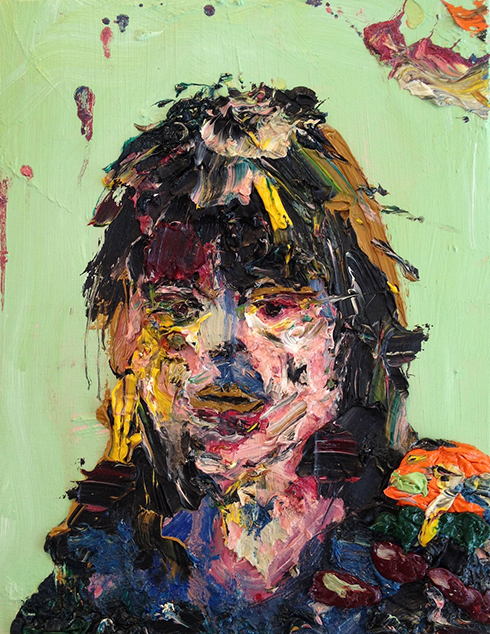
Fast drawing and movement with black line in still paintings has defined my art for 15 years. I worked for a long time as an artist before going to have schooling from the Russian Masters with portraits. I am an arts healer in abstract painting as well as in classical styles. My portraits and paintings have been said to be changing depending on the viewer’s own feeling at present. With my art, I hope to share a feeling of life energy and to connect with the heart.
Bobby Mathieson’s paintings reflect the emotional complexity shaping his relationship to these figures through a portraiture that is at once provocative, grotesque and deeply reverent.
Bobby Mathieson, Cheats and Codes
November 14 – December 14, 2013
Opening Reception, November 14th, 2013, 6:00-8:30 pm
Lyons Wier Gallery
542 West 24th Street
New York City
lyonswiergallery.com

This exhibit celebrates the career of one of the most influential living comic artists. Best known for Maus, his Pulitzer prize-winning graphic novel about his parents’ survival of the Holocaust, Art Spiegelman (b. 1948) has produced a diverse body of work over the course of five decades that has blurred the boundaries between “high” and “low” art.
Art Spiegelman’s Co-Mix: A Retrospective
Nov 8, 2013 – Mar 23, 2014
The Jewish Museum
1109 Fifth Avenue
New York City
nyc-arts.org
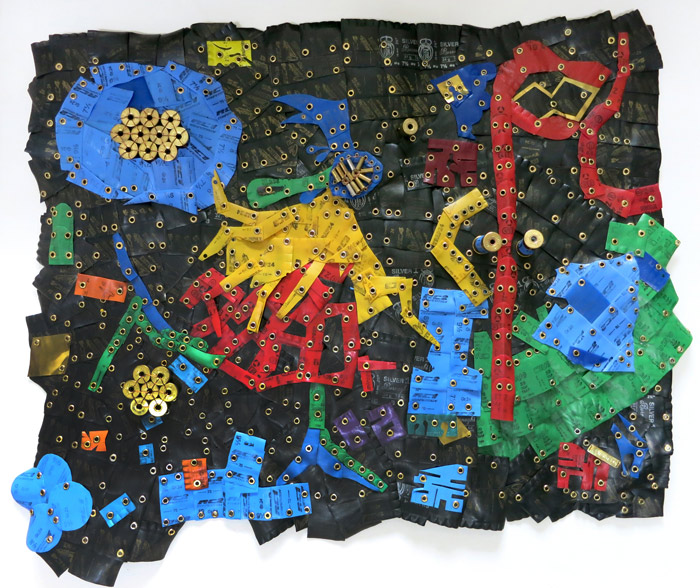
These bullet paintings take on a visceral approach to the politics of violence, focusing on the dynamics of infliction and trauma, as well as depicting traces and spaces, a mental place where empathy translates into healing.
My “ballistic” medium grew from personal traumas, experienced, converging with collective history. My work embraces influences from different cultures taking on an investigative approach to place and time, in relation to a sense of self. My works have used more than 30,000 spent shotgun and brass bullets of different calibers – wondering if any among those I have used has taken a life.
The bible has been a pillar of society since its writing centuries ago. At the same time, it is a fractured and controversial document wrought not only by the wars fought in its name, but also by conflicts over the document itself, how it should be read, translated, and distributed. There are countless versions, each touted as the authoritative word of god. To this fray, Adam Broomberg and Oliver Chanarin have added Holy Bible, their own thought-provoking edition to highlight the violence of god in the bible using images from the Archive of Modern Conflict.
Earlier this year Broomberg and Chanarin won the 2013 Deutsche Börse photography prize for their work War Primer 2, a belated sequel to Bertolt Brecht’s War Primer. The pair’s Holy Bible is also based on Brecht’s work, this time his bible, which was filled with photographs of catastrophes. From the outside, Broomberg and Chanarin’s Holy Bible appears similar to any King James Version bible, with the exception of an author attribution on the spine, but the inside is filled with 512 photographs imposed over the pages’ text. Readers are free to relate the selected images to passages of underlined text and make their own connections. The images from the Archive of Modern Conflict are varied, some looking official, many more personal: images of atomic explosions, portraits of friends holding guns, a body crushed from a long fall, a smiling girl with a Nazi-era Jewish star on her dress.
Since its inception, the photograph has been a conveyor of violence, from Bayard’s Portrait of the Photographer as a Drowned Man, to Fenton’s The Valley of the Shadow of Death, to the war journalism of today. Now that everyone has a camera, everyone is a witness, each with their own politics and perspectives. These are the sources for Holy Bible, the overwhelming volume of images contained mirroring the overwhelming volume of images produced. The history depicted by the photos is also the history of how photos of conflict have evolved. But even with the proliferation of photography as a hobby, images of conflict are controlled by the news agencies who own the images that illustrate world events in our minds. They are a currency challenged by the unofficial documentation captured in Holy Bible. Or does their being housed in a sacred text, sourced from an archive, give the depicted images an aura of authority? In its depicting images counter to the officially sanctioned representations, the text calls the trustworthiness of the images into question, challenging the notion of photography as documentation, as well as how it depicts and shapes history.
Included in the work as an epilogue is an essay by Adi Ophir entitled “Divine Violence” from his Two Essays on God and Disaster. The central tenant of the essay is that god in the bible shows his might through catastrophe. When man was few and easy to handle, god’s hand was light, but as man became more numerous, “his reaction to their wickedness turned violent.” This is seen in the tales of Noah, Babel, Sodom and Gomorrah, the ten plagues and the drowning of the pharaoh’s army. Some like Lot and Abraham were given warning, the violence a lesson to those in the story. Other times there is no warning, the story of violence is used as an educational drama for the reader. Today, one prays when the victim of unexpected events. Ophir argues that for a god who benefits from disaster, this is a way of being recognized and connected with, a way for god to reveal himself. The same is true for secular institutions that try to replace god’s functions. The bible becomes a metaphor for the modern state which reveals itself through destruction.
Broomberg and Chanarin’s use of the bible, Ophir’s essay, and the images of the Archive of Modern Conflict in the form of a Brecht-ian collage brings forward issues of authorship; what it means to be an author and what it means to appropriate. The two have been working together for over twenty years, dealing with the politics of images and how these images are made, distributed and consumed, all of which is unpacked in their update to Brecht’s bible. Both Holy Bible and Brecht’s bible center around catastrophe. Both demonstrate how images in the news need to be decoded and translated. But though images are encoded with politics and framed through perspective, events need to be witnessed and documented. Holy Bible presents a vast number of conflicts, and is long on concepts and the problemetizing of packaging. It may be short on answers, but this open-endedness only serves to make it more provocative.
By Kempton Mooney
The 51st New York Film Festival is more of a milestone than the 50th Anniversary edition. The Festival demonstrates that American filmmaking has fully transformed itself from a plastic form of storytelling in time and motion, into a form of self-indulgent self-centered vanity. This was to have been expected.
Since the mid-1990s, celebrity has been the dominant stylistic trope of the cinema. When agents achieved the status of “power elite” in Hollywood distribution circles, it was the death knell for imagination and creativity. Character-driven cinema revolves around the cult of personality. Actors have projects created to reflect their “face to the public”. Because of this egocentricity, no one ages in American Film.
Plot lines are concocted to display the attributes of the actor. More than in the 1930s, current distribution/production deals mandate marketing that sells “stars” not story.
Plot is subverted by spectacle because spectacle displays the creativity of the plastic surgeon. The conceit of character-driven cinema is that its creators no longer need a message; they simply need a “brand”. This all appeals to the self-centered sentiment of the “Me Generation” who defines life experience via twitter.
Vanity and narcissism dominated this year’s Festival wherein the messenger is far more important than any message.
Nebraska
Displayed exquisitely in black and white, the landscapes of Nebraska and the faces of its people define this work as a beautiful portrait of a somber reality, not everything ages with grace. In Nebraska that reality does not seem to trouble all the common folks that populate Alexander Payne’s pictorial elegy and contemplation on family loyalties, conscience, and “settling up.” Sense of place dominates the story and after a dutiful son painfully entertains his aging and vulnerable dad’s zany compulsion, a certain sadness and dignity emerges that makes you appreciate the simplicity of rural America.
Inside Llewyn Davis
This portrait of the uncompromising artist concocted by the Coen Brothers with a certain air of compassion, nevertheless celebrates the cult of youthful self-indulgence. Structured as a commentary of the struggles an exemplary singer/songwriter trying to establish himself and the new early 1960s musical idiom of folk. As portrayed by Oscar Isaac, Llewyn Davis embarks on a “misbegotten odyssey” toward success. Circumstances, timing, and rhythm are nicely plotted to evoke quiet desperation and it is his presentation that seems to doom him. The character is so into himself, he can’t feel the audience only his own passions and frustrations. Like so many “savants” Llewyn just misses the boat. Pioneers don’t succeed; others harvest the fruit of their labor. I would like to think the Coens are celebrating the single-mindedness and self-destructive tendencies of creativity. We might even feel, after all is lost, that this character embraces and is sustained by the artistic energy he creates in each solitary performance.
Stranger By The Lake
Swollen over as it is with ample amounts of explicit man on man sex, Alain Guiraudie’s ominous tale moves from romance and jealousy to a horror story. Developing entirely in a beachfront “cruising spot”, Stranger tries to document one man’s quest for continual pleasure while understanding his own sexuality and what drives him. A plot could not be more self-centered. Intimacy and trust are the emotional drugs that lead to a scary conclusion one that makes eloquent use, as in most of the film, of ambient sound and the loss of natural light.
La Jalousie
The lead character is a study of narcissistic selfishness. , the persona is an actor, committed more to himself than his wife or the woman with which he has an affair. Blind to the needs of anyone around him, Louis allows himself the privilege of despair when everyone runs out on him. Director Philipppe Garrel paints a picture of poetic justice. Louis is stuck with himself. Directorially, it is a celebration not a cautionary tale. While it avoids elevating self-indulgence to a virtue, this portrait is somewhat forgiving of itself.
Jimmy P. Psychotherapy of a Plains Indian
This film lacks the magic needed to explore its subject: the exploration of the interchange between patient and physician. Director Arnaud Desplechin is too respectful of his source material Reality and Dreams by Georges Devereux, who melded both the theories and practices of psychotherapy and anthropology. This directorial reverence for his countryman (actually an expat Hungarian of Jewish persuasion) does not result in thought provoking characterization or imaginative plot. It is the ego of the director that refuses to indulge his actors, Benecio Del Toro and Mathieu Amalric, who, in the hands of another, may have provided the magical mystery tour this movie was meant to be.
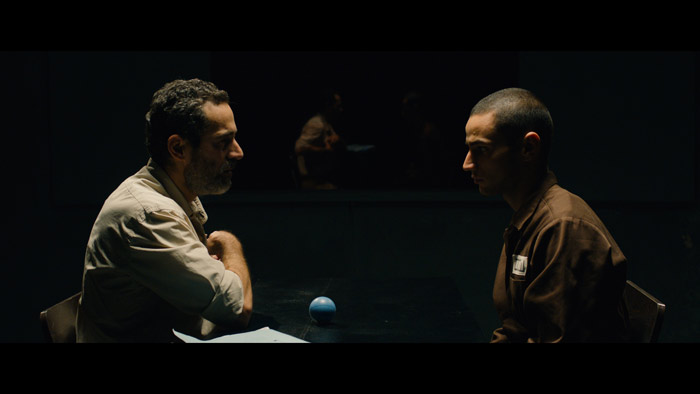
OMAR
Director Hany Abu-Assad bears the soul of Palestine in OMAR, a film that reflects the oppressive relationships between Israelis and Palestinians. The fragility and the necessity of trust drives the plot and all the characterizations and the intricacies of solidarity, as compromise propels a story that is essentially one of lost love. Propagandistic and single-minded, OMAR is, nevertheless, a sensible yet emotional story of painful choices and mutated ideals.
The Dog
The real-life exploits of the man who inspired the film Dog Day Afternoon is raucously devolved in this exquisitely satirical documentary by Allison Berg and Frank Keraudren. A subversive force of natures, John Wojtowicz Vietnam Veteran, self-proclaimed bisexual sex addict and latent stand-up comedian, enacts his own bio as a darkly humorous comedy in which he explains with irreverent passion his iconoclastic lust for life. This is a portrait of an outrageous ego that manages to survive the life of self-imposed hazards. The Dog presents what happens when an individual believes in the virtue of his debauchery.
Le Week-End
Jim Broadbent and Lindsay Duncan portray seniors on Holiday in Paris. Less about growing old than about acting old, this serio-comic episode of the implied long relationship of husband and wife details what happens to dreams deferred and ideals compromised. And as petty foibles are displayed and crotchety habits imposed, we understand that personhood always manifests a deep loyalty to self.
Bastards
A seafarer , Marco (Vincent Linden), inexplicably moves in temporarily into an apartment just vacated and strikes up a relationship with the estranged wife of an affluent businessman and their son. Sexual passion keeps them addicted to each other even though each has a vulnerable loyalty to others. Marco has not done a good job protecting his own estranged daughter from a life of exploitation, but he yearns to set it all right. It feels like an episode of NYPD Special Victims Unit.
Claire Denis cannot avoid finding a way to preserve the importance of French middle class values even when all narrative roads seem to bludgeon the bourgeois sentimentality. Bastards is ultimately more about Denis’ nimble storytelling and resolve to come to a civilized expression of the possibility of justice.
Child of God
Scott Haze acts the feral human. Some movies exist for the actor, are nothing but an excursion into the deepest cauldron of acting magic. In James Franco’s portrait of an underdeveloped hillbilly, plot improbabilities and excesses are the excuses for tour de force acting technique. Child of God is a showcase of performance art yet unlike Captain Phillips, All I Lost, and The Secret Life of Walter Mitty, the film is not a vanity project to allow established talent to flex their craft and ego.
By Tony Zaza

Be prepared to let your imagination carry you away while visiting French artist Laurent Chéhère’s first solo exhibition in the U.S. at Muriel Guépin Gallery, opening November 1. This fantastical exhibition features a series of recent photographs, many of which have never before been exhibited in a series entitled Flying Houses.
Each photograph depicts a single house weightlessly floating in the air, with only clouds and sky as the background. The photographs immediately take viewers back to their youths, as the houses seem to have arisen from a children’s book where one is suddenly caught up in an extraordinary adventure. Audiences are carried into a surrealist world full of miracles where Chéhère’s highly-detailed photographs reference historical and sometimes religious narratives. Chéhère states that the series was especially inspired by the classic French short film “The Red Balloon” by Albert Lamorisse. “The Red Balloon” was shot in Ménilmontant, the same Parisian neighborhood where Chéhère was born, and features a young boy tormented by a gang of bullies, who at the end of the film is taken for a ride over the city’s rooftops by a cluster of balloons.
Chéhère’s houses float just like Lamorisse’s Red Balloon, many of them with telephone lines still attached, emulating balloon strings. The photographs are simultaneously magical and absurd, with a touch of slapstick humor. However, despite the amusing, dreamy and playful components, a dark and eerie element also adheres to Chéhère’s work. The house, representing home, security and retreat, is alienated and becomes almost uncanny. The houses are ripped from their foundations and suspended in air, becoming elusive dreamscapes. They are taken to a different place, an unknown future, and the viewer travels with them. We become Dorothy and at first sight Oz may seem like a beautiful place full of lovely creatures and exciting adventures, but we soon learn that it is bewitched and danger is just around the corner.
Many of Chéhère’s photographs incorporate ambiguous tragic imagery. One of the houses is on fire, while several others are on the brink of falling apart or suggest a life of poverty. While looking at the structures being blown away, we automatically think about their residents and the life that is happening behind closed doors. The houses become a reflection of the people living inside them as well as the city’s architectural vitality. Chéhère offers us a different view of Paris that often unveils the beauty of something inconspicuous. The photographs serve as an homage to his city, its people, and its architecture. He takes these nameless houses and imbues them with life, just like the balloon in Lamorisse’s story. Chéhère states: “I tried to get these sad houses out of the anonymity of the street, to help them to tell their story, true or fantasized”.
Flying Houses are challenging images where multiple narratives and various socio-political issues are examined. Although the photographs seem to dwell within the realm of surrealism at first blush, they ultimately embody a severe contemporaneity and are well worth checking out. Flying Houses will be on display at Muriel Guépin Gallery on the Lower East Side from November 1st – December 1st, 2013.
By Nathalie Zwimpfer
I have been creating art all my life and can now finally live my dream to its fullest by creating art on a daily basis.
I am the owner of Warodell art studio, located in south-east Sweden on an island called Öland.
I was born in 1979 and have been working with my art professionally the last 10 years.
I work with mostly oil on linen-canvas but also in charcoal on paper.
I like to paint portraits in different styles and I always try to capture the light and contrast in my paintings.
As I child I got a lot of inspiration from my father who is an artist and I have also attended several art schools.
Im thankful that I can work with art and hopefully I can keep doing it for a long time to come.
Bursting with colors so gorgeous they could have been mixed by Matisse, Shirley Jaffe’s paintings bring a rare excitement to our senses.
The American artist moved to Paris in 1949 and has lived and worked there ever since. Her early works, with thick brush strokes of pigment and strong gestures, were in the style of Abstract Expressionism. Then, in the late 1960’s she began to paint in a very different, more controlled, way. The time spent with each canvas and the application of paint underwent a remarkable transformation.
Matte areas of carefully considered shapes began to be arranged into meticulously studied relationships. Months were spent honing and re-examining each area of distance and connection. This exhibition, of work from the 1970’s, gives us a beautiful, fulsome experience of these explorations. They are, fresh, confident, and timeless.
With barely ten flat colors, The Black Line shows us a highly complex depiction of space. Jaffe has said she is influenced by cities rather than landscape and this is clearly felt in the hard edges and partially obstructed views of various forms. The blues and whites have curves and scallops. There are two linear shapes, one red at the top, one black with ultramarine overtones, dividing the canvas almost in half. Contributing an openness and balance, these lines nearly mirror each other at the top of the frame. There is a playfulness between the various colors. The pink shape coming down from the upper right seems to be a paler version of a darker red shape in the middle. The pale blue around it quietly turns into a sea green of a similar tone.
Crossing street markings could be an inspiration for The First Diagonal. A triangle of lush rose with horizontal yellow stripes divides two areas of the canvas. Another striped area to the right breaks through the rectangular form with white and orange both heightened by trapezoids of bright cerulean. Again there is a contrast, unified by an expert eye, of sharp angles and scalloped edges.
Upside Down-New York is a joyful interpretation of the rhythms and verticality of the city. The canvas is so cleanly proportioned, it almost has the look of a triptych. The left and right areas of many of these canvases have a life of their own. They frame and add movement to a more stable center. Texture has been added with translucent green and cobalt stripes under a large red rectangle on the right, wonderfully balanced by the dynamic flowing shapes on the left.
Jaffe’s love of geometry is matched by her explorations of color. The various large and small triangles of The White Line offer a color chart of dynamic warm and cool tones. Each color is changed, either receding or approaching, by its position to another. A bold off-white diagonal line, its curves growing more intense towards the bottom of the picture plane, connects them as a river does its disparate banks.
The prevalence of semi-opaque pastel colors of mauves, grays, pale green and blue, gives Sylvia’s White a softer presence. Three different black configurations provide an anchor to the floating structures around them. Again, the activity of forms on the left and right edges echoes the equilibrium of relationships. Their position also extends the colors beyond the canvas’ edges in our mind’s eye.
Playing with the tensions between these magnificently colored forms, both curved and angled, Jaffe has invented a language of coexistence. She has brought us to a place that is refreshingly new but somehow, mysteriously, familiar.
By A. Bascove
-
Tarsila do Amaral: Inventing Modern Art in Brazil
Tarsila do Amaral: InventingModern Art in Brazil “I want to be the painter of my country,” Tarsila do Amaral. Her signature style was ... -
ASIA WEEK MARCH 15 – 24,
15 Thu 16 Fri 17 Sat 18 Sun 19 Mon 20 Tue 21 Wed 22 Thu 23 Fri 24 Sat... -
NYC ART FAIRS MARCH 2018
The Armory Show March 8 – 11, 2018 New York, NY NYC Art Fairs March 2018 The New York City Art Fairs for March is referred to as Armor... -
17 Cuban artists: All That You Have Is Your Soul
Dear Abraham, Gallery 8 New York opens in Harlem next Thursday with an inaugural exhibition 17 Cuban artists from FACTION Art Project... -
Currents: Abortion A.I.R Gallery January 4-February 4
Abortion is our country’s Scarlet Letter, an impassioned “A” writ large on our conscience. We shame, blame and deny wome... -
CURRENTS: ABORTION
CURRENTS an exhibition in which artists respond to the theme of ABORTION. In this turbulent moment in history, abortion remains a signifier ... -
No Image
Guantanamo art in NYC makes Washington nervous
“Untitled (Alan Kurdi)” [Courtesy of Muhammad Ansi/John Jay College]... -
No Image
7th Moscow Biennale
Being late to speak at the 7th Moscow Biennale, I try the Russian car service Yandex, rather than taking the ornate Moscow subway. My driver... -
Louise Bourgeois at MOMA
The MOMA exhibit, Louise Bourgeois: An Unfolding Portrait, showcases the prints, books, and creative process of the celebrated sculptor Loui...


br> br>