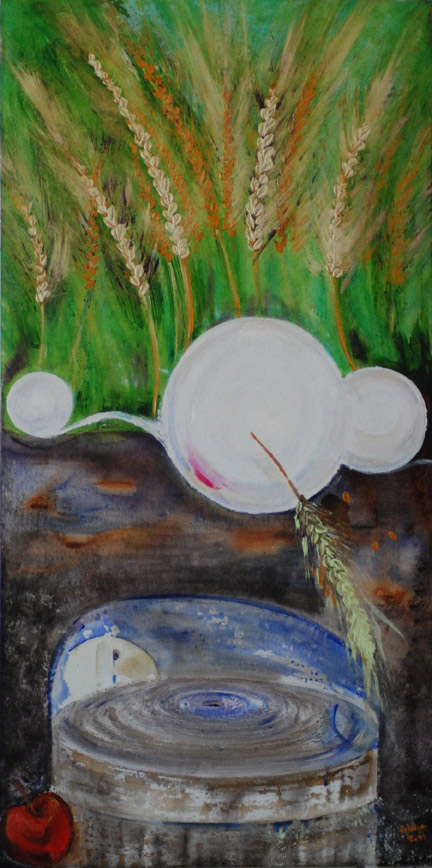
I am a Finnish visual artist. I work partly in Finland, partly in Benin, West Africa. Locating myself continuously between the Scandinavian and African cultural atmospheres reflects strongly in my pieces. Often my paintings observe the happenings, views and thoughts of everyday life. I paint and draw overlapping layers of images, colors, characters and texts. I often incorporate used and collected material which carry the marks of wear and use. The time and space blend in my memory creating new combinations and views of human experience.
For the past three years I’ve been combining street art with fine art in an attempt to unify the two. The addition of bright colors and traditional Mexican artwork helped me bring my heritage to canvas. All of my most resent subjects are from the surrounding area of the southwest. They have ranged in many races and sex. The interweaving of lines and colors bring together images of empowerment. As a Mexican American I was raised to see how the influences of combining cultures could be beneficial to ones heritage. These images emphasize the mixing pot that we’re all a part of.
One of lifetime subjects for my art is to investigate the desire of a human being as the origin of his or her own suffering. An excessive desire seems to be the major reason for the unhappiness of a human being. My first work The Flower of Evil describes the greediness stemming from the strong desire of a human being. The second work Eden in Chaos shows a chaotic situation of Adam and Eve who are suffering from their excessive pursuing of desires. This chaos seems symbolically to show painful situation of many human beings in our modern society. The third work Two Hands represents the craftiness of a human being who tries to satisfy his or her strong desire.
Featuring: Todd Bienvenu, Katherine Bradford, Jim Herbert, Arnold Mesches, Karen Schwartz
Painting Impossible
November 8 to December 22, 2013
Reception: November 8, 6:00 – 9:00 pm
Life on Mars
56 Bogart St.
Brooklyn
lifeonmarsgallery.com
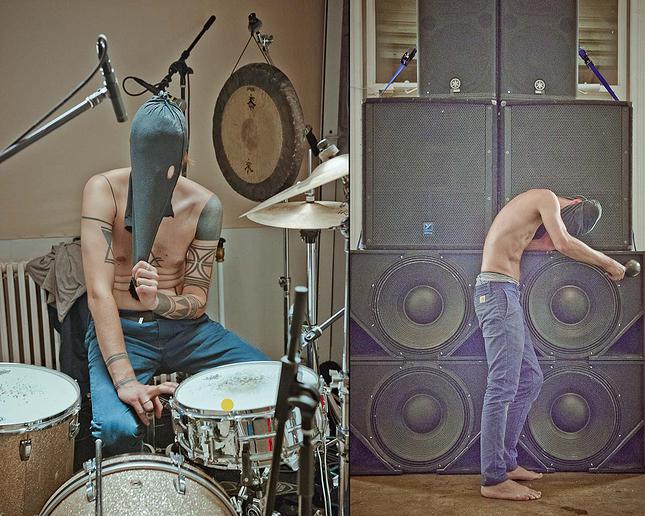
Dressed only in balaclavas and pants, Daniel Szwed and Konrad Smolenski unleash a dynamic three hour sound explosion as part of Performa 13. Fresh from representing Poland in the Venice Biennale, Smolenski sets the tone in deafening fashion with his custom electric instrument modeled after a tomahawk missile, while Szwed mounts a particularly violent assault on his drum set. Brazen and raucous as this may seem at first, the duo has quite the knack for structuring the performance around a balance between louder sonic explosions and more subdued passages of feedback and white noise. It is a series of performances that is set to evolve with each iteration of the event, culminating with a four person collaboration on Thursday evening featuring Dean Spunt of No Age. With visual elements contributed by renowned painter Radek Szlaga, Tribute to Errors and Leftovers presents one stop on your Performa circuit that is certainly not to be missed.
Tribute to Errors and Leftovers
Radek Szlaga and Konrad Smolenski
PERFORMA 13
Fridman Gallery
287 SPRING STREET
New York City
fridmangallery.com
For years now Gianni Caravaggio’s work has insistently been posing a single question: what is the essence of an image? Posing this question at the end of postmodernity means freeing oneself from any fears of comparisons with the past, shedding all neo-isms, post-isms, and trans-isms to expose oneself to an original gesture, to an initial gesture. On the whole, to make a truly radical gesture today means that the question of essence is set out in an open comparison with tradition, in the awareness of the impossibility of any return to the past and of the necessity of moving forward. In order to carry out this gesture—because it is a question of doing, of a practice—it is necessary to elevate oneself to the height of the question of art in a moment in which art seems to be disappearing in a system of general equivalence and in an attitude of n’importe quoi. It is necessary to adjust one’s gaze to the problem raised by art as a creator of images and not just simply a producer or post-producer of images. It is still starting from art, at least in my view, that we can truly comprehend the question of image. Thus, this question of the essence of the image is nothing less that the necessity of dealing with the question freshly from the beginning, from creation, that it is the question of art tout court.
In the work Gianni Caravaggio has been carrying out for over decade now, this search does not so much coincide with the attempt to arrive at a final point, as with the experience of an exposure to the nude reality of the artistic gesture, of the gesture of creating images. There is no desire to make a definitive, final statement. To the contrary, there is a need to return to the beginning, the opening of a possible scenario: an origin that is neither lost nor utopian, but always present, in the here and now, in my gesture and in your gaze. In the end, the question is not even exclusively about the attention given to essence, but the quest for the essentiality of gesture that becomes the work, an image-work. The essential gesture that discloses the dimension of the essence and exposes itself to the nudity of life, to its lack of easy ways out, to its need for answers. Art presents itself as a concrete answer, a work of art, to this fundamental question: what is image?
In all the works present in the exhibition “Five Propositions for a New World”, running until 11 November 2013 at the Kaufmann-Repetto Gallery in Milan, this gesture passes for a stripping down, for a sort of reduction of the compositional grammar of contemporaneity. In some way, that which is needed to perceive this elementary grammar of the image is a certain nudity, a capacity for removing and leaving to breathe among the folds of being the constitutive nullity from which the image emerges. Faced with the accumulational proliferation of cultural, artistic and existential products, the gesture that aims at the essence of the image clears away space and time to let “that which is” emerge, nothing more and nothing less.
The problem of the essence of the image seems to present itself not as that of an ideal world behind the material world, but as that of a material world that opens itself to the abyss which it is for itself. Like in the work on display The Mystery hidden by a Cloud, matter appears as an infinite power, as the opening of this world to itself, to its capacity for endlessly creating sense. The quest for essence coincides with the sense of wonder for this world and with the impossibility of enclosing it a single system of meaning.
At the same time, a work such as Under the Surface, the Truth of Concreteness makes me think of how the wall of the image is not broken through – for the image is not the surface of depth – but the “amniotic wall of vision” is and must be broken through; that is what must be broken through is the layer of film that traps one’s vision inside clichés, in cultural context, in semiotic readings, thus not allowing for any real tangency. In order to get the sense of the essence of the image then, it is necessary to understand clearly that every ontology of vision necessarily entails a critique of the gaze and a practice that lead to seeing—by composing it—a world.
If one therefore imparts an essence of the image, this essence points towards an open space, the confines of which remain uncertain and in which, then, there is no possibility of an axiology, of a system of prescriptive rules, not even negative ones. The road towards the Open, towards this initial opening gesture, which the essence of image shows to be pragmatic, not axiological. It is the creative practice of the image that constitutes its essence and not the other way around. It is a practice of picture acts, of performing images that, with their appearance, disclose the insaturation of a world.
By Federico Ferrari

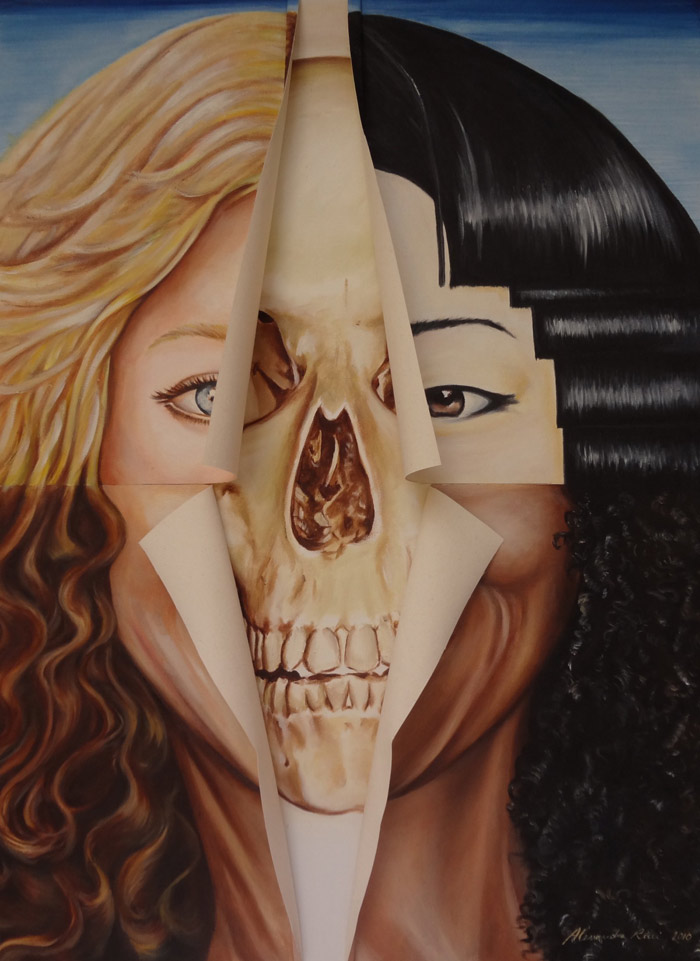
Artistic action posits a relationship with the spectator that prompts emotions and reflections through visual content.Through my art, I express concepts and emotions that are tied to my life experiences. After months of meditation, I impress my conceived images on canvas using varied and new techniques. My double canvas paintings represent explicit messages where the observer is engaged in deciphering the cuts and folds of the painting. My latest pieces illustrate the human image, especially the visage, offering an alternative to the prevailing culture of figurativism by way of visual expressions that illuminate beyond sight.alessandra-ricci.com
In his first solo exhibition at Samuel Freeman in Los Angeles, The Four People You Meet at Every Drug Deal, Jibade-Khalil Huffman brought his viewer into a world of myriad, reflecting surfaces; a coreless expanse of language and image that flitted over the face of something unutterable. Huffman showed work in a range of media including video installation, five-channel slide projection, and still photographs. It was also clear that as an accomplished writer who is the author of two books of poetry, he takes a special pleasure in words. In the video Working Title (all works 2013), Huffman austerely animates one of his poems with alternating block colors on the screen, which change with each line of the text. Blending a first person narration that weaves around a dream, a script, a film, and various characters’ pasts, with humorous aphorism (“All spiders/are related to Spiderman”) and alliterative association (“Lecture/Lecturn/Lantern/Llwelyn”) the presentation highlights the flatness of language, but also the suggestive, illusionistic power that resides right on its surface.
The conception of language as something fundamentally manipulable and playfully nonsensical, concerned more with itself than the shadow of its physical referent, also applies to Huffman’s visual sense. Google Image Search: Virginia Wolff The Sea The Waves is a photograph whose title—ostensibly a pun on the wave-like ripples of gingham fabric the work depicts—evokes the immaterial sphere of the internet, wherein terms and pictures are interchangeable, often incomprehensibly so. The photo was one of a series of close-ups, most of them of fabric, that are rendered as kinds of visual endgames, barriers to deep space. Huffman undermines the promise of a photograph as a portal into three-dimensions, instead favoring a slippery façade that falls somewhere between transmutation and abstraction. In Venice, for instance, what appears to be a deeply rose-colored reflection off a window gives way at the bottom edge of the picture to patches of grass, conflating exterior and interior, and destabilizing perspective.

Jibade-Khalil Huffman, The Forms of Love, 2013. 5-channel slide projection, sound. Approximately 450 slides, dimensions variable.
This theme was further explored—and exploded—in the ambitious three-channel video installation, Lake Overturn (a rare type of natural disaster that occurs when a lake becomes saturated with gas and erupts). Here, Huffman finds an apposite metaphor for spacelessness in the workings of Hollywood. The installation cuts between placid, seemingly commonplace shots of Los Angeles, following the route of a movie location scout played by the actress Claire Titleman, and mixes in clips from classic horror and apocalypse films like The Fog and Falling Down. Huffman rhythmically employs close-ups, fast cuts, voiceover, subtitles, and opening credits, combining Titleman’s spoken inner monologue with lines of text on the screen and names of made up movies (which are particularly great) starring both real Hollywood actors such as Cicely Tyson and Rodney Dangerfield as well as poetic constructs (“Staring: A Man I Once Knew”). The piece reaches a cacophony of collage, collapsing time and place, perpetually restarting and interrupting itself, continually obliterating landscape.
Perhaps it’s because of this complexity that the room Lake Overturn played in felt slightly over-installed: a sculptural object made of metal studs, weighted with sandbags, and hung with lovely, almost charcoal-like photographs of flowers blocked one of the projection screens. This was surely a nod by Huffman towards further obfuscation, but in this case, the videos seemed rich enough not to require it.
On the other hand, The Forms of Love, a five-channel slide projection aimed at a separate corner of the gallery’s wall was flawlessly scaled and executed. There was a luminous, prism effect of the numerous slides (a combination, among other things, of found, vintage illustrations and color and black and white photographs taken by Huffman of both rural and urban landscapes) bending on the wall’s edge, overlapping, and infusing one another. While it echoed concerns of other works in the show—with the individual slides becoming almost like words, shuffled around into different formations, lushly intertwining, or awkwardly colliding. The heaving physicality of the projectors countered the airy surface of the images in this piece, offering that, somewhere, gravity still exists.
By Kate Wolf
Art is life it is the most beautiful universal language that silently speaks aloud. If pain accumulates to generate creativity, then art heals!
-
Tarsila do Amaral: Inventing Modern Art in Brazil
Tarsila do Amaral: InventingModern Art in Brazil “I want to be the painter of my country,” Tarsila do Amaral. Her signature style was ... -
ASIA WEEK MARCH 15 – 24,
15 Thu 16 Fri 17 Sat 18 Sun 19 Mon 20 Tue 21 Wed 22 Thu 23 Fri 24 Sat... -
NYC ART FAIRS MARCH 2018
The Armory Show March 8 – 11, 2018 New York, NY NYC Art Fairs March 2018 The New York City Art Fairs for March is referred to as Armor... -
17 Cuban artists: All That You Have Is Your Soul
Dear Abraham, Gallery 8 New York opens in Harlem next Thursday with an inaugural exhibition 17 Cuban artists from FACTION Art Project... -
Currents: Abortion A.I.R Gallery January 4-February 4
Abortion is our country’s Scarlet Letter, an impassioned “A” writ large on our conscience. We shame, blame and deny wome... -
CURRENTS: ABORTION
CURRENTS an exhibition in which artists respond to the theme of ABORTION. In this turbulent moment in history, abortion remains a signifier ... -
No Image
Guantanamo art in NYC makes Washington nervous
“Untitled (Alan Kurdi)” [Courtesy of Muhammad Ansi/John Jay College]... -
No Image
7th Moscow Biennale
Being late to speak at the 7th Moscow Biennale, I try the Russian car service Yandex, rather than taking the ornate Moscow subway. My driver... -
Louise Bourgeois at MOMA
The MOMA exhibit, Louise Bourgeois: An Unfolding Portrait, showcases the prints, books, and creative process of the celebrated sculptor Loui...


br> br>