Featuring: Brian Gaman, John Monti and Jennie Nichols
Lost or Not
November 15 – December 30, 2013
Art Helix
16 Harrison Place
Bushwick, Brooklyn




Featuring: Brian Gaman, John Monti and Jennie Nichols
Lost or Not
November 15 – December 30, 2013
Art Helix
16 Harrison Place
Bushwick, Brooklyn
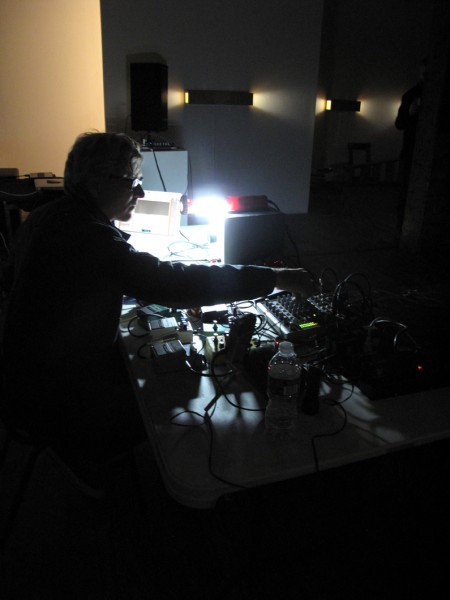
In Four Letters to Mahler, Schafer presents a room sized sculpture fabricated of aluminum struts that are host to an eight channel sound work. In this work, Schafer created a complex sonic work based on Schoenberg’s own language but existing more in a Cagean arena of voice that challenges the listener further with degrees of aural perception and intelligibility.
David Schafer
Four Letters to Mahler
November 15 – December 8, 2013
Opening reception: Friday, November 15, 7-9 P.M.
Performance: Friday, Dec 6
Studio 10
56 Bogart Street
Brooklyn
Leah Oates: What is your family background.
Paul Bridgewater: My family is ‘Merican, ‘Merican, ‘Merican!…Here a long time! (Southern accent) English, French, Black, Italian, German, Mexican and probably a lot of other things…muts!
LO: Did you always know you would be a gallerist?
PB: Me and my friends were artists. They were clueless, so I started organizing events to showcase us. Then an artist I told had little talent put a curse on me and here we are.
LO: You have been a gallerist in NYC in the hey day of the NY art scene. What are your impressions of that time and was it truly better then?
PB: They were better times in the fact that anybody could open a gallery … like the old movie’s, “My father has a barn, let’s do a play.” And actually people bought things just because they were beautiful and you wanted art to improve your house. Now they buy them because “they’re important”—or an investment. Humbug!
LO: You currently have a show open called Round Hole, Square Peg which explores aspects of the LGBT community. Please tell us more about Round Hole, Square Peg and what kind of responses is the show getting?
PB: The show is meant to explore new relationships…new ways of being comfortable in your skin. We challenged artists to redefine Queer intimacy, what it was like coming out or living in hiding or finding you were in the wrong skin. We’ve mostly gotten extraordinary support from everyone, saying it is one of the most beautiful shows they’ve seen on the subject.
We’ve also gotten a few detractors, who screamed and said they hated us.
We actually had a large bag suddenly appear right after someone said they were going to fix us and we thought it was a bomb. Luckily, it was a bag of books.
LO: Please tell us about the artists that you represent i.e. what their work is about, their media
etc., and how you discovered their work.
PB: Our official mantra is “Kooky, Kinky, Genius!” So, if it’s something that’s wildly interesting, uses the medium in a different way, shows you something you’ve never seen before, and makes you think innumerable times about what and why it is—you’re probably speaking our language.
LO: What does it take to be a successful gallerist and how do you select your artists?
PB: The first question I asked when teaching my course The Art Business…”How do you make a small fortune in the Art Business? Start with a big one.” I think I addressed my process for selecting artists in the last question.
LO: What advice would you give artists who want to approach galleries for shows?
PB: Visit galleries and find your fit. Go back and try to make yourself known to the staff. Then ask their procedure for submissions. Gone are the days of unsolicited slides.
LO: Do you think galleries look for innovation or follow trends in NYC?
PB: I can only hope galleries are looking for innovations. Following trends is much like wearing labels … great for the general public, but not what the people who are supposed to be defining culture should concern themselves with.
LO: What projects and show do you have coming up in the future at Smart Clothes Gallery?
PB: My next show SUBurban will be very exciting and is trying to show how urban planning isn’t about making cities better and how the sprawl of cities and suburbs is out of control and destroying our sense of self, individuality, and environment.
And “Not Clowning” takes a look at The Clown in all of their facets, from the simple and innocent Pierrot to the absolutely scary clown from Cindy Sherman to John Wayne Gacy.
Mariko Mori’s much-anticipated solo exhibition titled Rebirth at the Japan Society is a startling departure from the energy and defiance of her early photographic work. Her transformation from a daring thinker whose cyborgian bad girls portrayed Japanese angst to a meditative Zen like artist is not particularly enthralling.
Long inspired by Buddhist spirituality, Mori’s urge to connect humanity to nature is a noble one. Her endeavor is best communicated through the photographs, hung in the basement of Japan Society, of her earthworks inspired art from the 60’s. What comes to mind from the stark black and white images of circular stone constructions devised on the sea front is not only Mori’s strong connection with nature, but its humbling force over mankind. Yet this energy and association is wanting in her indoor sculptures.
Segregated into three sections titled “origin,” “rupture” and “rebirth,” the exhibition begins with a pre-historic Kaen-doki “flame vase,” from the Jomon period dated 3,500 – 2,500 BCE. Stone formations that were used to create places of worship from this ancient Japanese culture are the basis and foundation of her new practice. But from Transcribe 1.1, 2004, and Flatstone, 2006, circular structures created from Corian pillars and ceramic stones, one gets a sense of artificiality despite the pervading ambiance of serenity and calm. The LED lighting that illuminates the pillars changes colors according to a preprogrammed movement of the planets. However, it fails to evoke the sensations one experiences by works for example by James Turrell and Olafur Eliasson that manipulate light. Lacking in the notion of transcendence or the sublime, these indoor sculptures appear to be contrived rather than organic in their function.

Moriko Mori, Journey to Seven Light Bay, Primal Rhythm, 2011. Video with sound; 5 minutes, 14 seconds. Sound by Ken Ikeda. © Faou Foundation, New York. Courtesy of Adobe Museum of Digital Media.
The weakest link in the show is the display of eight colorful rotating disks in the section titled “rupture.” Meant to convey the transforming qualities of Buddhist philosophy, here color gradations on the Cibachrome prints change based on the viewer’s vantage point. Accompanied by Mori’s incantatory voiceover that chants, “We are nature. We are sustained by nature. We are sharing nature…” Miracle, 2001, seems more of a technical feat, and falls prey to pseudo shamanism.
Strongest at her outdoor conceptualizations, Mori’s video installation of a work in progress known as Primal Rhythm, 2011, best communicates her vision in the last section titled ‘Rebirth.” A sun pillar erected on a rock in the Miyako Island of Japan will capture the northern light and cast its shadow on a floating “moonstone” that will be placed in its path. The color of the white buoy is expected to change according to the season and the tide. Compelling for how it intends to alter our mind set and mood, images of this work not only reveal the immense power of nature but also come closest to conjuring the immersive experiences of Turrell and Eliasson.
Equally convincing are a series of mixed media works on paper that capture various cosmological formations in the sky. A quiet serenity emanates from these delicately rendered clusters of oval patterns that instill a sense of mystery about the solar system. Both aesthetic and ethereal the drawings convey Mori’s spiritual connection with the universe.
But these works not withstanding, the final piece titled White Hole, 2008-11, made up of a convex white lens that is meant to counter the degenerative power of the black hole is not new or refreshing. Installed in the ceiling of a dark room where the surface of the lens resembles the open sky, this combination of Anish Kapoor and Turrell achieves neither the awe nor sustainability of either artist.
Ultimately, even if Mariko Mori’s deeper yearnings are imparted to the viewer, the overall effect punches less in the gut and lacks the overwhelming sensation of her earlier cultural and earthbound concerns.
By Bansie Vasvani
Featuring: Santiago Carbonell, Guillermo Conte, Roberto Cortazar, Reynaldo Díaz Zesati, Ofill Echevarría, Graciela Fuentes, Claudio Gallina, Fabián Gimenez, Hugo Lugo, Antonio Luquin, Roger Mantegani, César Rangel, Daniel Alcalá, Mónica Espinosa, Moris, Ishmael Randall-Weeks, Marcela Armas, Mauro Giaconi, Mark Powell, Omar Rodriguez-Graham, Omar Barquet, Agustín González, Iván Puig, Jaime Ruíz Otis, Gilberto Esparza, José Luis Landet, and More.
Pinta, NY is an exclusive and intimate international art fair of select exhibitors invited to present the best Modern and Contemporary art from Latin America, Spain, and Portugal.
Pinta NY
82 Mercer
pinta-ny.com
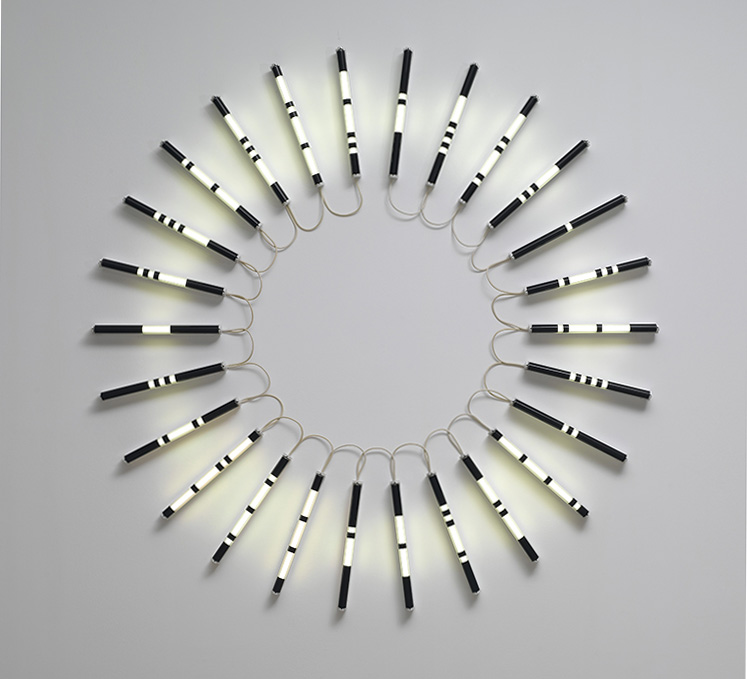
Brigitte Kowanz Morse Alphabet 1998 Fluorescent tube lamps, acrylic glass tubes, lacquer diameter 94 1/2 inches
An exhibition of new work by noted new media artists Brigitte Kowanz and Mariano Sardón. This exhibition investigates encoded language systems and their formation of a cultural dialogue through contemporary sculptural forms.
Featuring: Brigitte Kowanz & Mariano Sardón
Transmissions
November 14 – December 21, 2013
Bryce Wolkowitz Gallery
505 West 24th Street
New York City
brycewolkowitz.com
This exhibition is based around the massive Warhol painting Double Hamburger.
Featured: John Ahearn, Mike Bouchet, Peter Coffin, Anne Collier, Mark Flood, Guyton\Walker, Rachel Harrison, Alex Katz, Nate Lowman, Ari Marcopoulos, Tony Matelli, Sam Moyer, Joyce Pensato, Raymond Pettibon, Larry Rivers, Andy Warhol and Martin Wong
Double Hamburger Deluxe
November 14, 2013 – December 21, 2013
Marlborough Chelsea
545 West 25th Street
New York City
marlboroughchelsea.com
 Featuring: Flavio Merlo, Jeanne Graff, Mai Thu Perret, Emanuel Rossetti, Tobias Madison, Emanuel Rossetti, Jeanne Graff, Kerstin Brätsch, Stefan Tcherepnin, Emanuel Rossetti, Gilles Furtwängler.
Giant Ice Cream Cones
Date: August 18 – October 18, 2013
1m3
Lausanne
Switzerland
galerie1m3.com
Politics of Light, Jan Tichy’s first solo exhibition in NYC, is a moody paean to light and shadow, to the ebbs and flows of what light reveals and what darkness hides. Tichy’s installations are a fluid integration of diverse media incorporating animation, film, photography, and sculpture, all invested with the presence of mechanical light—be it a projector or a TV monitor—fulfilling light’s role of enabling vision.
Revelation through the metaphor of light reaches back to the very dawn of art. But the title, Politics of Light, selected by the artist, refers less to the divine, than to the power inherent in the political or social machinery that causes any challenge to that power—from political dissidents to the urban poor—to be removed or hidden from view. The work also questions our individual tendencies to look away from inconvenient realities.
Politics of Light is the first exhibition in a new program called NLE Presents. Unlike NLE’s tradition model of group exhibitions whose themes emerge from extensive site and community based research, NLE Presents will mainly focus on solo exhibitions that allow a greater investigation into an artist’s work. With his emphasis on site-specific installations and his investigations into spatial justice and how the built environment has deep ideological implications for social structure, Jan’s work was chosen as a powerful way to launch this series.
This exhibition also marks a collaboration between No Longer Empty and Richard Grey Gallery which adds important context to Tichy’s work by placing it directly within the public sphere—a physical extension of its inherent social concerns.
By Naomi Hersson-Ringskog
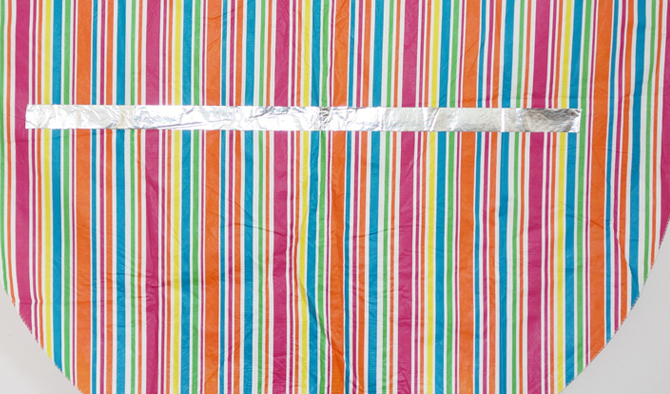
Jim Nolan, Striped Painting (detail), 2013. Table cloth, tape, pushpins, 60″ diameter
Featuring: Amanda Browder, Yo Fukui, Donna Huanca, August Krogen-Riley, Jacob Rhodes, Patrick McDonough, Jim Nolan, Brent Owens, Stacy Scibelli, Jeff Spaulding
Interwoven throughout a multipurpose and multilevel space in Dumbo, High Fiber excises an undercurrent of artmaking that incorporates textiles as process-based markers that lead to sculpture, installation and other acts of imagemaking.
HIGH FIBER
November 16th – December 28th, 2013
Opening Reception Saturday November 16, 7-10pm
Present Company
39 Bridge Street
Brooklyn, NY
present-co.com











