The Ferner-paintings, which Helmut Federle painted in 2012 and 2013, are restrained and quiet, and yet they radiate a determining power. They evade one’s view and, because of this, create an optical vortex. All of the paintings are the same size, only 50 cm high, and show only one form: a circle. The blurred borderline and slightly darker shade create just a touch of difference from the subdued sand color of the unprimed canvas that forms the total picture plane. The circle has not been painted onto the canvas, but was created by applying vegetable oil that soaked into the material and tinted it a bit darker. Though the form clearly differs from the painting’s rectangle, it nevertheless merges with it completely.
If one intended to classify in words that which is visible, just a few would suffice, and they would be the same for every painting: circle, canvas, vertical format. Yet one’s visual perceptions cannot be restricted to concepts. They expand, become unspecifiable, and penetrate one another. As a closed form, the circle hovers slightly above the center of the painting and transforms into something completely different, into an almost linear rotation, whose course again increasingly expands breadthwise, opens up and penetrates the immobile material of the flat canvas. All of these tensions and transitions among different perceptions take place in a special way in each painting. That which one looks at transforms into inner processes. The painting does not retain anything static. Its optical units circular form, circular course, background, material, picture surface cannot be perceived individually, but indeterminably oscillate into one another. They transform the small painting that is objectively hanging in front of the viewer’s eyes into a dynamic and unlimited experience. What the viewer sees expands if the viewer lets it into varying ideas and into a special rhythm based on the tensions between motion and stillness. This inner process, which every viewer perceives and carries out in his own way, is the actual painting.
For Helmut Federle, the value of an artwork lies mainly in what he calls “spirituality”: “Form always has to be spiritual, that means form with inner vegetative logic and concentration” (Federle 1989, 164). For him, the consistency of a painting is not founded in the relationships of form to form, but arises from the vegetative – one’s personal life and feeling. “My most important experiences were in the non-intellectual field, in the realm of excitation.” Hence, for Federle, the value of an artwork discloses itself when he is “analyzing its information by means of my own experience and including it in my interpretation of its value” (Federle 1989, 164). Consequently, spirituality is not communicated by the visible form, but is “behind” it; it is “felt” rather than directly visible. “Spirituality is the superior meaning of an appearance, the superior meaning behind the form. It is immaterial and it can exist in a mathematical, socially constructed composition as well as in an arbitrary one.” The supporting and essential effect of “spiritual transparency” can be deliberately admitted by the artist but can also appear even against his will (Federle 1989). It refuses any conscious planning and formal and material certainty. What matters to Federle is not an artwork’s formal “correctness” (Federle 1989), but its “vegetative recognition” by the viewer, that is, a way of experiencing the artwork that includes respective individual lives, bodies, and personal conditions. “The vegetative recognition of subject matter enables the viewer to be ideologically open to the formal appearance . . . Thus, adequate behavior is not a formal problem. More than ever, today recognizing these statements is subject to the right condition” (Federle 1989, 166).
When Federle wrote these notes in the 1980s, his paintings showed mainly geometric relationships. The formal rules of these relationships, however, were broken in a perplexing way: sometimes aggressively, sometimes by softly dissolving their boundary lines, or even by changing them into symbolic representational forms. In Federle’s work, geometry loses its reliability (Franz 1995). It is this inner-pictorial discrepancy that leads to the radical transformation of the painting into an internal fulfillment. Perception is no longer able (as, for instance, in Constructivism) to discover a conclusive formal sequence within the painting. That which the viewer sees dissolves into a sequence of heterogeneous perceptions, each of them demanding with formal emphasis a different attitude and stressing its contrasting difference in the visual context. Nevertheless, the painting encloses all these varying attitudes within its uniform surface, in which they simultaneously penetrate one another. Thus, the painting also unites the contradictory inner acts of viewing into an integrated experience.
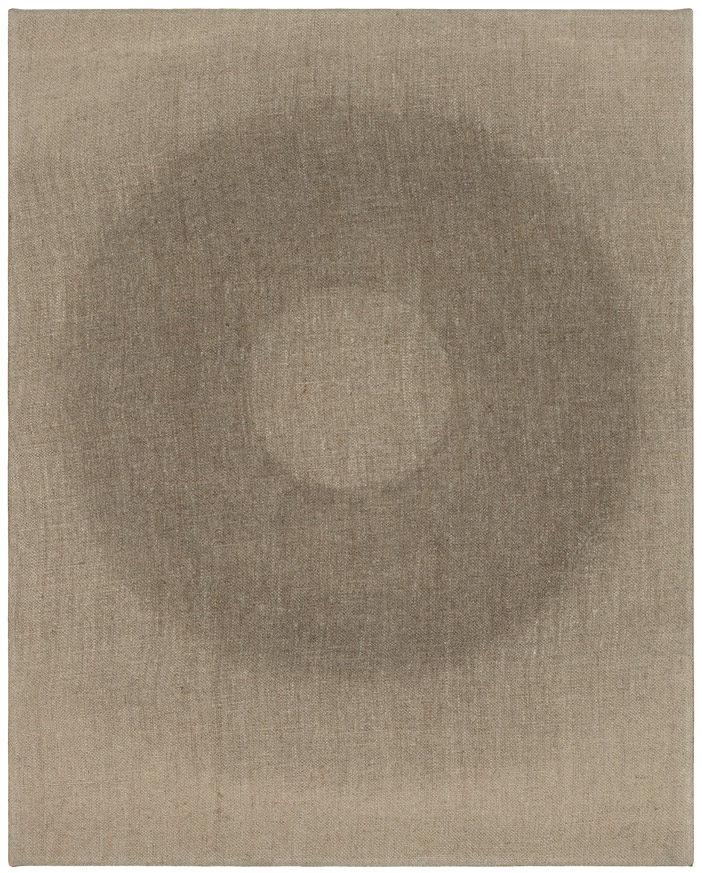
Helmut Federle, Ferner G, 2012. Vegetable oil on canvas 19 5/8 x 15 3/4 in. Image courtesy of Peter Blum Gallery.
Though it is impossible to imagine the two aspects simultaneously, the geometrical and the painterly nature, they influence each other during the repeated process of reenactment. For Federle, the juxtaposition of two colors can even lead to homogeneity of color, to a “monochrome.” Polar contrasts align themselves with a conciliatory relative middle (Franz 1997). If one imagines a single aspect in the painting and then turns one’s attention to a completely different aspect that is equally effective, the former then gains a lasting presence. It even increases against and within the other, penetrating against its resistance, and leading to a porous and always endangered unity. While this mentally executed unity is produced by the painting, and by its equally powerful and fragile-divergent symbols, the process of perceiving the unity finds no formal confirmation in the painting. It has to rely on itself ‒ as an experience of process and condition based on its own act of seeing.
Federle’s Ferner-paintings never show geometrical sharpness, and yet one’s perceptions turn out to be even more conflicting and less harmonious than with his earlier, more aggressive works. The respective circle, the only shape in the painting, penetrates and unites with a completely different form, which cannot be imagined simultaneously: the rectangle of the painting. Both lose their identity and gain an unexpected wealth in processes of imagination that simultaneously increase and neutralize their variability and even their incompatibility. The circle does not show any formal geometry but concentrates very different processes and ideas. In the following paragraphs, these aspects will be compared with the realization of circles in other artists’ works that illustrate components apparently identical in variability and incompatibility.
In none of the Ferner-paintings does the darkened circular course deviate from the perfect circle. The executed form always presents the ideal of a perfect circle. It is a holistic, elementary, and timeless idea. Though one does not see any deviation in Federle’s paintings, there is softness, a state of an approximation, in which the precise circle is only suggested. The imaginary circular line appears to be widened; it is broader (and therefore slower) or narrower (faster). It extends beyond the edge of the darker shade, forms a blurred margin to the outside or inside and sometimes connects to a second ring. In Federle’s paintings, the imagined line of a circle (in constant distance from an imagined center) does not find a firm hold. Instead, it seems to move, becomes blurred, widens to a kind of band, condenses toward the inside, and, as a breath-like suggestion, evades any precise visual control. Thus, the timeless elementary idea of the circle itself gains a process-like quality without losing its perfection. From the perfection that one automatically assigns to the pictorial circular form and that is absorbed by it without resistance, numerous perfections with increasing and decreasing visual presence differentiate themselves.
In his Lives of the Artists, Giorgio Vasari reports that the Pope sent an envoy to Tuscany in order to find out about Giotto’s skills as well as those of other painters. From the other artists, he received several drawings. Giotto, however, only drew a circle on a sheet of paper, “so true in proportion and circumference that to behold it was a marvel.” The envoy asked whether that was all, upon which Giotto replied: “’Tis enough and still too much.” The courtier was disappointed, wherefore “the Pope and many courtiers who were versed in the arts recognized how much Giotto surpassed in excellence all the other painters of his time” (Vasari 1912, 78). So Giotto’s skill consisted in the fact that the freehand form corresponded to the ideal (he had only placed his arm firmly to his side). In order to recognize the mastery, a certain expertise was needed. The envoy was only capable of stating the overall form as condition. The experts, however, were able to comprehend it as a process: a continuous change of direction that can only through utmost mastery fulfill the ideal condition.
Federle’s Ferner-paintings also lead one’s perception from the static circular form into a process – a changeable circular course, which expands breadthwise and in some works even unites several concentric parts. Here, the mark of a subjective action is hardly discernible. It disappears in the fog-like path that nevertheless gives a sense of the circle’s making – as various summations of barely noticeable courses. Moreover, the colorless oil soaking into the adjacent areas of the canvas slows that progression to a standstill. Without the artist’s having a hand in the process, the oil spreads osmotically and forms different “halos,” their respective softness lacking any sense of direction and their fading perceptibility influencing the circle’s whole appearance.
(Excerpt from the text “Inner Seeing” by Erich Franz written for the book Helmut Federle, The Ferner Paintings on the occasion of the exhibition at Peter Blum Gallery, New York from November 14, 2013 until January 11, 2014.)