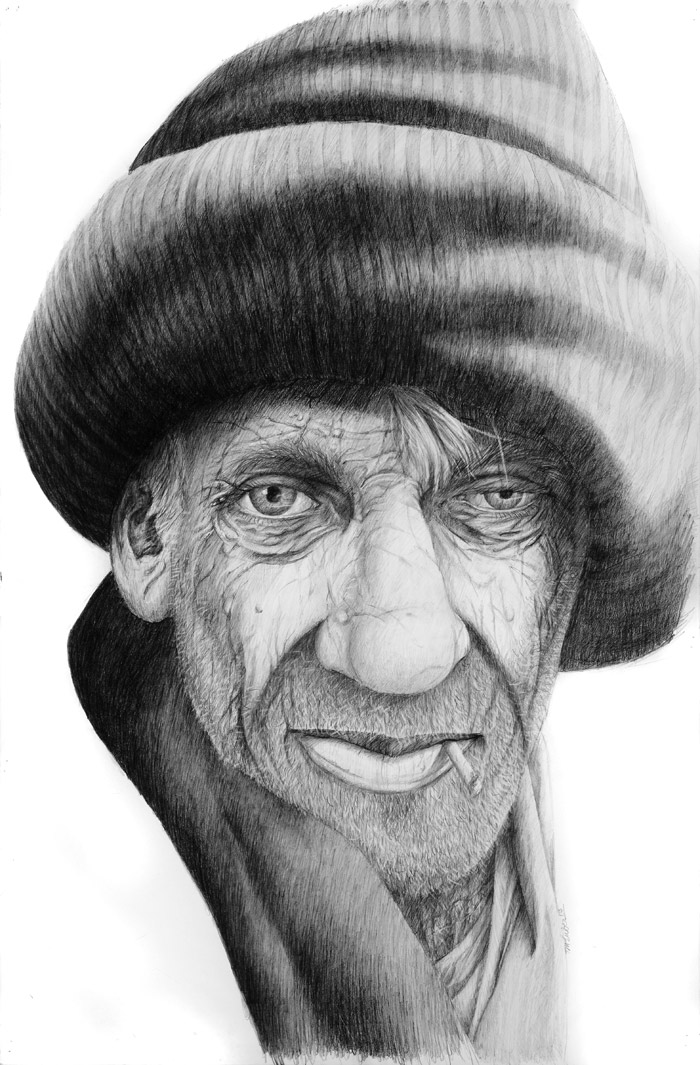
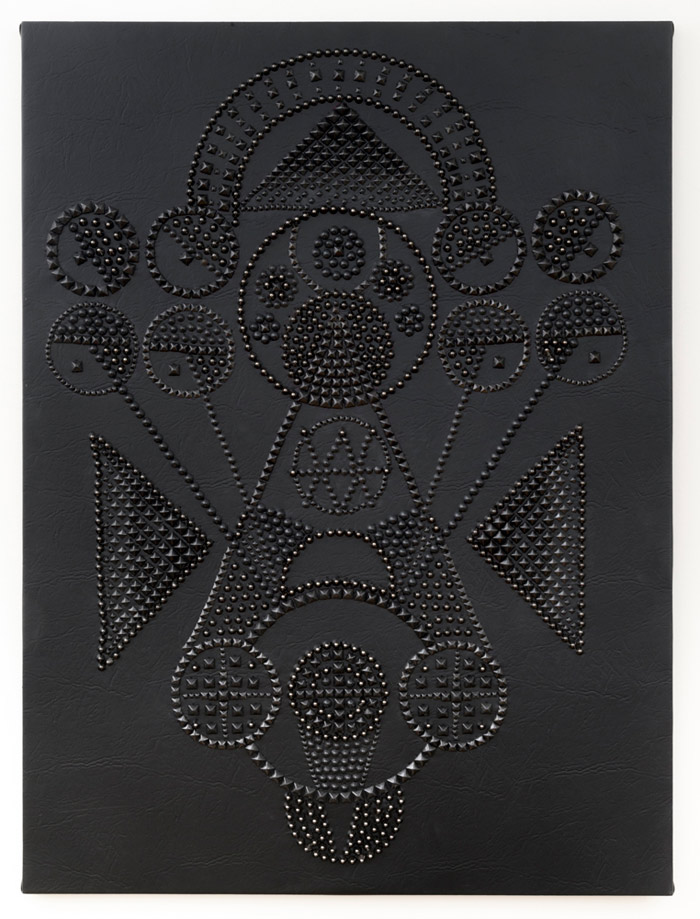
My individual realist style combines painting with drawing, juxtaposing stark black and white graphite images on paper, with opulent acrylics on canvas. My somewhat oversized canvases transport the viewer to rambunctious inner-city settings, where counter-culture characters wearing street inspired dress, and reflecting an abrasive, yet nonchalant attitude, aggressively confront and engage with the audience. Abandoned brick buildings adorned with colorful graffitti messages and imagery, evoke the underground intrigue and dangers of revolutionary artistic critiques of culture. My graffitti imagery is not only meant as mere adornment to enhance the hardcore atmosphere of the inner city compositions, but also as symbolic codes and challenges to the overbearing power structure and the politically correct world in which we live. In my new “Forgotten Faces” series, I want to remind the viewer of those whom our society has forgotten, particularly, the countless homeless veterans. My visual compositions often include messages meant to engage the viewer, and hopefully prompt them to think as well as to enjoy the artistic merit of the composition.
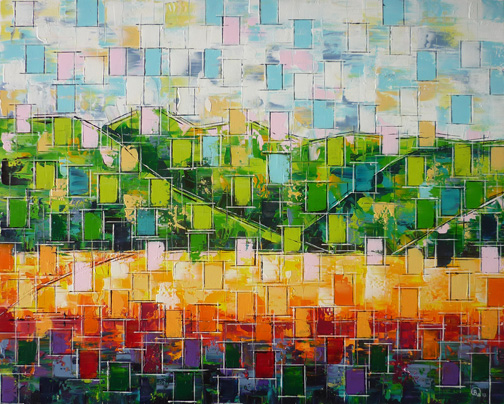
I enjoy creating digital art. Most of my digital work is created with Ultra Fractal and Mandala Maker. I use Paint Shop Pro to modify images including photographs.
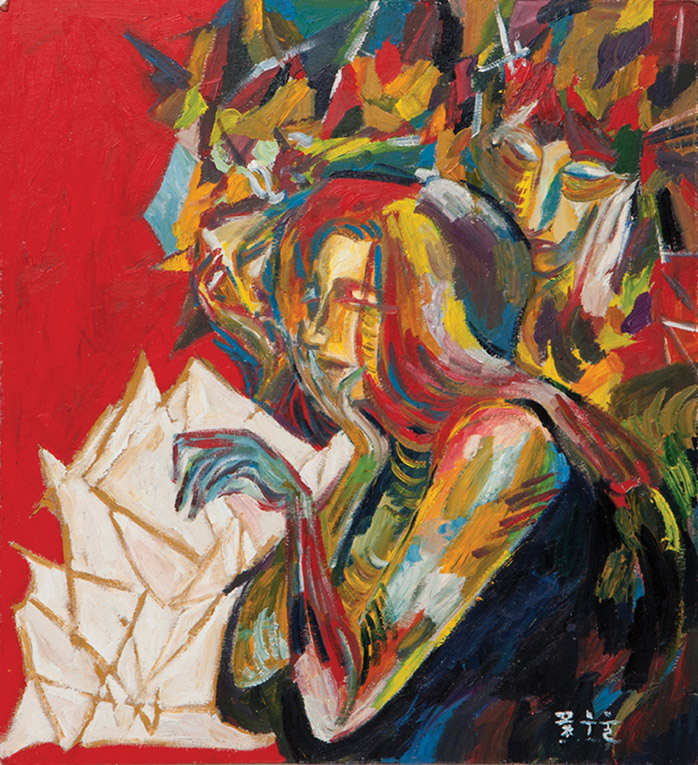
All my stories are from the chaos of imagery I’ve gained from the world, people, and from my unknown self. I paint stories in the purest form with my own visual language.
With a background in therapy and an active practice, I draw heavily on her understanding and experience of the wide range of human emotions to capture a rawness and deep understanding in her paintings. Here, I take feelings, sensations and observations of human experience, and transforms them into stunning compositions rich in color, texture, movement, and form. I want to translate emotions, psychological and complex emotions, that we have every day.
This past October, famed UK street artist Banksy spent a month in New York City, leaving behind 31 provocative works in public spaces scattered throughout the city’s five boroughs. Each new piece threw the press and public deeper into the kind of frenzy usually reserved for pop culture events like a new Harry Potter book or Miley Cyrus’s latest fashion curveball. Art news, by comparison, tends to be more austere.
Yet by the time Banksy left a small mural on the Lower East Side, featuring a stencil of galloping stallions in steampunk goggles who looked like the four horses of the apocalypse, the piece found itself quickly surrounded by barbed-wire. Its property owners apparently realized the value of the work by the sheer traffic it drew. The Post made it headline news. The Times and CNN were not far behind.
Banksy has been compared to early 20th century French conceptualist Marcel Duchamp, who once signed a porcelain toilet and claimed it “art.” Banksy gained international fame in 2002 when, in his first U.S. exhibition (in Los Angeles), he brought a live elephant, painted red, into the gallery’s main room. In a final, goodbye act to this recent NYC stay, Banksy left his moniker spelled out in silver balloons to hang from the scaffolding above an industrial building visible from the Long Island Expressway in Queens. They were quickly confiscated by NYPD after three fans attempted to lift the balloons for financial gain. NYPD initially labeled the evidence simply as “balloons,” with the intention of discarding them after the misdemeanor was processed. However, media reports quickly made it apparent that the balloons, re-labeled as “art,” could bring tremendous value at auction.
Street art has, in fact, become increasingly romanticized and highly collectible over the last decade. Many of the genre’s artists have fallen under the larger umbrella of “outsider” art by virtue of their anti-establishment sensibility, especially in graffiti circles, where the artists tend to be self-taught. Those like Banksy have come to represent hope for a more open-door policy at the institutional level for artists working outside the system.
In recent years, art critics such as Kyle Chayka of The Atlantic and Roberta Smith of The New York Times have argued forcefully that lines between folk, street, and other forms of outsider art ought be blurred in mainstream institutions, allowing art to be judged not for its formal sophistication, but rather its emotional content. Smith, in her review of a 2007 exhibition of Mexican artist Martin Ramirez at the American Folk Art Museum in Midtown Manhattan, argued that the artist’s “scroll-like drawings should render null and void the insider-outsider distinction.” Chayka wrestled with the semantics of this potential shift in a recent piece on video artist Wendy Vainity, whose amateurish YouTube videos have proven so strangely compelling that it is difficult to know where she’s been purposefully avant-garde and where she’s simply naive.
—
Fascination with artists on the outside comes largely from the special hermeneutic codes and non-textbook discourse their works embody, which often catch us off-guard. Early in the 20th century, French artist Jean Dubuffet championed art brut—works he saw being made outside the boundaries of the established art culture, such as those by insane asylum inmates and children.
Edwardian tastes in England, France, and the United States had already popularized the freakish and the macabre. Such hunger for the unconventional seems to have coincided with the first Modernists and their interest in ceremonial masks from tribal regions of Polynesia, Africa, and the West Indies. They made their way onto canvases by Pablo Picasso and photographs by Man Ray, and were shown in Downtown Manhattan shows curated by Alfred Stieglitz as early as 1915. Yet works by self-taught artists who had little or no contact with the mainstream art institutions were labeled “naive art.” These works remained on the margins of curatorial taste for many decades. Indeed, outsider art did not make a marked cross over into the free market until around the time of the first Outsider Art Fair in New York in 1993.
One of the most talked about subjects in this debate is Henry Darger, a custodial worker who lived in relative reclusion in Chicago and whose thousands of drawings and narrative writings were only discovered after his death in 1976. Darger’s first (posthumous) exhibit came quickly and his work has since been on display in every major art capital of the world. The fact that he worked in such untraditional, “non-painterly” ways—for example, he traced many of his images from comic strips and coloring books—and that his art was meant to illustrate the novels he wrote, may complicate Darger’s place among his contemporaries. Though it seems more that his exclusion has to do with his non-engagement of the art establishment while still living. For now, Darger remains largely relegated to the world of folk art.
“The ‘folk art’ label,” insists Jim Elledge, author of Henry Darger, Throwaway Boy: The Tragic Life of an Outsider Artist. “allows us to marginalize him as a naïve, uneducated country bumpkin, although Darger was none of these.” Elledge is a writing professor at Kennesaw State University in Georgia, a poet and a champion of the LGBT community in American arts. According to Elledge’s book, Darger was physically and sexually abused as a child, eventually labeled “feeble-minded” by the state and bounced around foster homes before he was unleashed as an adult to survive amidst Chicago’s Near West Side, then its very worst vice district.
“The work of Henry Darger,” notes art dealer Edward Winkleman, “is not ‘Art’ because he had no intention of ever showing it to anyone. Now I can look at Darger’s work and feel my jaw involuntarily drop. I can marvel at the vision. I can delight at the composition and especially the color. But because I know these works were the result of a masturbatory effort, they don’t meet my own definition of fine art.”
Another creative type who pulls no punches is Brooklyn-based Maya Hayuk—muralist, painter, and installation artist. Her work is rooted in the alternative and street vernacular found at art collectives like Secret Project Robot in Brooklyn and the Transformazium in Braddock, Pennsylvania, where Hayuk has lived and worked amongst a host of immersive artist types commonly labeled “outside.”
“If the term ‘outsider art’ means that the artist has radical politics or is mentally troubled,” says Hayuk in an email to me from Berlin, where her latest exhibition recently debuted, “then I’m far more interested in seeing what they might produce. Viewing art made by people who would be defined as apolitical and mentally stable sounds incredibly boring.”
Departing NYC on October 31, the aforementioned Banksy left a goodbye note on his website that read: “Save 5Pointz.” The artist here refers to the Queens warehouse structure that for two decades has housed a DIY museum of graffiti and street art, as well as classes and a legal space for aspiring artists to hone their craft in. This fall, the building’s landlords formally evicted the graffiti conglomerate with plans to replace it with a new high-rise apartment complex in the fast-growing neighborhood of Long Island City. Recently, judge Frederic Block of New York’s eastern district court ruled in favor of the landlords.
While any number of high-profile institutions, from the Metropolitan Museum of Art to the Museum of Modern Art, might have stepped in financially to save the 5Pointz Center, many have wondered out loud if once more the decision has fallen to semantics. Thus far, market demand for works by even the biggest names in street art pales in comparison to the prices realized by those established in the traditional art market. Moreover, curatorial efforts within the street art genre remain largely nonexistent in museums and art history departments. Whether this comes down to simple lack of curatorial interest, many from the street art world continue to wax conspiratorial about prejudices perceived within the larger art establishment.
“There is a lot of mistrust going around,” notes artist Antonio Serna, “People have always been suspicious about these institutions and now with WikiLeaks and Snowden, we have the proof. It’s no surprise that this has spread into the art realm with institutions that want to turn [street artists] into stars or co-opt their street language into marketing strategies.”
Serna is one of the founding members of Art + the Commons, a coalition of creative types that grew out of the Occupy Wall Street movement. Rather than hoping for integration of previously dismissed artists and art styles, Art/Commons is looking to change the entire paradigm of ownership, curation, and profitability.
I first met Serna in the spring of 2012, in the immediate aftermath of Occupy’s forced-eviction from Zuccotti Park, near Wall Street. He and a group of eight artists sat in a circle next to the central fountain in Washington Square Park in Greenwich Village. To open the floor to new topics, a majority vote was taken by a show of hands. Memos were read aloud by one person with the remainder repeating back each sentence. The central concern of Art/Commons, as with all Occupy-related groups, was how to reconfigure the financial structure of that industry. How eight people in a city of eight million planned to carry a revolution in art seemed beyond my comprehension.
To start, they got rid of the idea of a centralized space altogether; Art/Commons is today a loosely-affiliated group of community members who provide “care” for pieces in the collection. For instance, someone can borrow a given piece from the collection, knowing the work ultimately resides within the larger network of the community.
“I recently had a visitor to my studio,” recalls Serna. “She walked in and looked at my sculpture and said, ‘My students would love to touch and explore this work.’ I thought it was odd, but then she told me that she teaches art to blind students and then it all made sense. We got into this discussion about how most museums don’t allow you to handle the artwork. And so where does that leave her students?”
—
Back in Brooklyn, during the first days of November, the Mt. Carmel Church on N. 8th Street in Williamsburg hosted Comic Arts Brooklyn, an annual festival where the most experimental artists in comics and illustration meet to hawk their wares. I met artist George Cochrane on the second floor, where he was discussing the industry with Bernard Stiegler, a twenty something with a mop-top haircut and dark-rimmed glasses. Stiegler self-published The Reptile’s Mind, a strange, hallucinogenic comic about a boy raised by reptiles who, one day, is snatched from his reptilian domain by a well-meaning institution and thrown into the system against his will. Cochrane has his own psychedelicized comic book series, Long Time Gone. It is a retelling of Homer’s Odyssey and Joyce’s Ulysses set in New York City, with the artist himself in the lead role searching for a way home.
The panels of Long Time Gone were first exhibited at MASS MoCA, near Boston, in what became a sort of comic book installation. Instead of reading the finished product, viewers saw Cochrane’s process laid out page-by-page in pristine frames, where, at the very end, the bound volume itself was available for purchase in the gift shop.
“Museums have embraced comics where galleries haven’t,” he insists. “MASS MoCA curator Susan Cross’ interest in my work was all that mattered. A commercial gallery is very different. There are very few if any artists that make works on paper equivalent in value to oil on canvas. That is, there is a ceiling to the amount of money to be made selling drawings.”
To be certain, illustrators such as 19th century French iconoclast Honore Daumier and expressionist poster artist Henri Toulouse-Latrec have long been part of the fine-art establishment. More recently, comic artists like Art Spiegelman and Robert Crumb have seen museums and galleries embrace their every new work. (Crumb’s retelling of the biblical Genesis story debuted to great fanfare at this year’s Venice Biennial.) Yet if the main issue for illustrators is the financial ceiling of papered works, the dilemna seems not that different than others in the outsider art paradigm, who, while feeling the sting of being left to the margins, have also found their works increasingly in-demand at the institutional level. In fact, as much as those on the outside may argue the finer points, it seems the change they believe in is already underway.
“Since I’m busy trying to put everything into Long Time Gone,” concludes Cochrane on the steps outside Brooklyn Comic Arts, “I can’t subscribe to the usefulness of labels. I don’t really know about anybody else on this one, but labels, like a map, are only a representation of reality. Things once named can be knocked down, only to be reconfigured again. Then to get broken by the next generation of artists leading the way.”
It remains to be seen whether the cultural authorities in New York and beyond can head-off charges of elitism going forward. The sense that much has been missed already remains prescient. This week, the revolution-based murals that graced the walls of the 5Pointz Graffiti Center were painted over white. Each morning, a new tag, angry and irreverent, was found splattered over the white paint. The vitriol seems unlikely to cease anytime soon. Into this environment, New York City mayor-elect Bill de Blasio has promised “more equal” conditions for minorities and the poor. It is an ethos born of the previous decade’s disparity, expressed in the cautious optimism of a growing number of impassioned spirits, who remain in art as in life on the outside.
By Brian Chidester

Mass, plane, line, sphere, and cylinder—all of these abstractionist tropes make repeated appearance in Moved Objects, a new book of work by Georgia Hutchinson and Arini Byng which has been published by Perimeter Editions. These recognizable geometric volumes are carefully placed to point a finger out of the land of sculpture and back towards painting, all the while directing our gaze through the medium of photography.
Stylishly shot collections of pedestrian materials are set to colored puppet theatre-like environments of carefully selected backdrops. A piece if aluminum foil hangs impossibly suspended above what may once have been a solid brass see-saw, or rests casually on the top corner of an upright plane of plywood. Medium density recycled foam sits about listlessly in dumb chunks. Jaggedly fractured halves of a shaft of frosted glass lay hugging a hollow, crumpled volume of translucent black cellophane. A brightly painted crimson dowel leans in from outside the frame, mysteriously held from elsewhere as it touches down, becoming a ray of color that draws the eye through the composition.
The book appears to be the product of a very distinct and exacting vision. Hutchinson and Byng share an innate ability to design restricted environments in a way that highlights similarities and differences between objects that we may often take as mundane or unimportant. The shallow spaces are activated by a keen ability to compose relationships between the forms; amplifying a very sincere understanding of how textures, finishes, and colors relate and compliment one another.
Although Moved Objects is likely edited down to a number of images that fit together and are curated from a greater number of less successful attempts, my only regret in reading this book is that there is not more of it. I could look through at least two or three times this volume of work and never get tired of the images Byng and Hutchinson have put together. In the end, this is of course just a testament to the cunning these images encapsulate, leaving one selfishly wanting for more.
Reviewed by Matthew Hassell
Irena Jurek: When I look at your work I think about how it’s in dialogue with ancient ideas and the origins of abstraction. Kandinsky is often accredited with having invented abstraction, but it’s existed for so much longer than that.
Evie Falci: If you look at Paleolithic art, it’s filled with spirals and dot work, and in a way where it’s covering the whole surface. There is a way of articulating or illustrating the immaterial world through these forms, a way that I find very exciting.
IJ: Your work also seems to reference a pagan ideology that predates Judeo-Christianity. Niki de Saint Phalle comes to mind. All the circles remind me of the ancient idea of continuity. From an Occidental standpoint, people tend to think of life and death as separate. It’s actually more of a life-death-life cycle.
EF: It’s a wheel, definitely. Circles are the most perfect shape. It’s in way more related to a feminine depiction, but it can also be very cosmic, celestial. We can talk about what a mandala is and how it functions as a tool for journeying. I hope that these function as portals or stimuli for having that sort of experience.
IJ: They also remind me of Persian rugs. There’s this intense labor that goes into them and there’s so much complexity. At first you look at them and it seems as though the patterns are repeating and that there’s symmetry—but there’s always something a little bit off. There’s an idea in a lot of rug making, that the rug maker leaves a few flaws. Not necessarily a flaw, but…
EF: There’s an acknowledgement that a human being can’t create a perfect thing. That, that’s only done by a divine source, so they intentionally make something off or leave one part undone.
IJ: The funny thing is that nature often leaves things off, too! The idea of perfection is so elusive because the world is so deeply imperfect.
EF: Right. Well, it’s very important to me that these things look like a human being made them, that they’re not machine made, and that my individual hand is present. These are objects that need to be seen in person.
IJ: That’s important, since the visual experience is often taken for granted.
EF: It’s very important to be making objects that really need to be experienced in person, and to be making tactile things that actually exist in the real world.
IJ: There’s this overwhelming power to your work, because it commands your attention; it’s very celebratory and ritualistic.
EF: Well, that reminds of this text, Heaven and Hell, by Aldous Huxley. He basically talks about visionary experience first through mescaline and then through art. He talks a lot about precious materials like gems and gold and why human beings value those things. It’s because they’re precious and rare, but if you think back to the ancient world, these materials were the most brilliant and shiny and colorful things. They were thought of as being keys to some sort of heavenly or otherworldly realm. Rhinestones are obviously thought of as the poor man’s diamond, but because of the way they reflect light and the brilliant nature and color of the gems, it stimulates the eye in a similar way, and it’s riffing with stained glass windows.
IJ: I was actually going to say that these pieces look very much like stained glass windows. And stained glass windows were intentionally created to evoke this transcendental experience for people through the use of translucency and the way in which the light played or refracted.
EF: Exactly. Beauty is obviously important in this work and in my personal relationship to thinking about the power that beauty can have in a way that isn’t just superficial. Yet I’m taking the most superficial materials and trying to make them really serious.
IJ: It’s almost subversive to be thinking about beauty at this point, just because it’s been shunned so much. I think it has a lot to do with the fact that American culture is so largely based on both Protestantism and pragmatism. This pervasive push towards pragmatism attempts to eliminate anything that isn’t seen as the essential core.
EF: So, I’m working with rhinestones on denim and studs on leather, which is a form of embellishment. It’s decoration and you could say it’s almost superfluous in terms of the added adornment of bedazzling or studding your jacket. And maybe that’s why it’s perceived to be trashy in a way, too.
IJ: But, I think that that’s very essential to the roots of culture and civilization in general. Adornment has existed from the beginning.
EF: Of course, it’s a way of identifying you and your tribe, and what tribe you belong to—as well as what your values are and who you are as a person.
IJ: What were you trying to achieve in your current solo show at Jeff Bailey?
EF: I’ve been working with these materials for quite a long time. In this body of work I was trying to really narrow my focus, through making up these rules for myself, like limiting the palette in a very direct way, and also playing a lot with the negative space in the forms. The negative space in the forms becomes as important as each of the additive parts of the painting. They each have a mandala shape, where there’s a central point that emanates outwards, and even if it’s not symmetrical on four points, it’s reflective in its symmetry. They’re all, some more so than others, relating to traditional tapestry, rug work, or mosaic work.
IJ: This dialogue with crafts traditions also makes the work feminist, the same way that the feminists tried to remove themselves from the male tradition of painting in the seventies.
EF: Oh, yeah! Pattern is obviously very important in this work and its relationship to textiles and getting out of the heroic traditional type masculine painting.
IJ: There’s definitely a dialogue with AbEx in that the scale is bodily, and it reminds me of walking up to a Rothko. What you’re doing is similar to the way that the feminists in the past, like Lee Bontecou would subvert canvas by creating these intensely strong vacuums and voids.
EF: Oh, she’s my home girl! Love her!
IJ: And what you’re doing with the denim and the leather, I think that that’s such a conscious decision. There’s this celebration of femininity through the use of adornment and referencing these crafts traditions, and I feel that that’s really important because a lot of women are shying away from Feminism right now.
EF: Oh, well, God. How could you argue with what feminism is, and if you’re like “I’m not a feminist,” then you’re giving power to the people who have slandered that term and made it a dirty word.
IJ: The women who are rejecting feminism now, don’t seem to realize that they wouldn’t even have a platform to speak from it wasn’t for the feminists of the past who laid out the grunt work.
EF: People don’t have a memory of what it was like at an earlier time, and they take it for granted, this world that we are in now, except that there’s still such a divide. That’s why I want to make such aggressively feminine, aggressively beautiful paintings. At the same time, I don’t want to make vagina art! I don’t know—maybe these are cosmic pussies?!
IJ: There is still such a tendency in so much of the art world to downplay the importance of work that is feminine.
EF: Well, there was the pattern and decoration movement in the eighties, and this work is tied to that as well. Textiles and patterning are also associated with women’s work and feminine work. In the text, Ornament and Crime, Adolf Loos, is not specifically talking about women but you could read it this way too. He’s mostly talking about “savages” from Papua New Guinea who are involved with tattooing, piercing, and decorating their everyday objects. He claims that civilized people shouldn’t need to do that, and he fetishizes straight lines and unadorned surfaces. It’s a text that makes the case for modernism and imperialism.
IJ: Modernism has always struck me as coming out of an ascetic Puritanism.
EF: Totally, and this work is very anti that as well, being “more is more is more!”
IJ: It’s very problematic to me, the way that previous generations looked at abstraction with such unquestioning faith and idealism.
EF: That it’s a universal language that can be read by all?
IJ: Yeah, or even that’s it’s removed from the corporeal filth of actual existence.
EF: In a way, I do believe that abstraction can function that way, and maybe because these materials are so populist, that there’s already a very open point of entry for engaging with this stuff. That’s why I love outsider art and ancient art because it comes from such a place of fervent desire and an undeniable need to make, that I find lacking in a lot of work.
IJ: A lot of work almost begs permission for aligning itself with an academic dogma. So many artists still talk about demystifying art, and I feel like that may have been interesting twenty years ago, but it’s no longer relevant, because our ideas have progressed and our conception of the world has become more pluralistic and complex. I almost feel like we need to bring the magician back!
EF: Hey, I’m here!
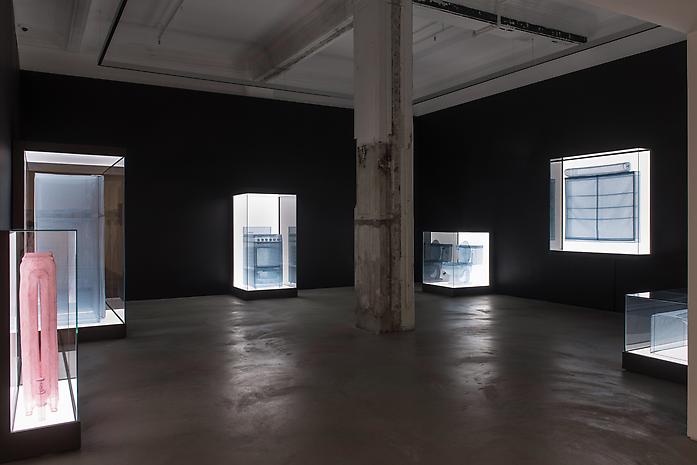
Do Ho Suh
Lehmann Maupin Gallery
November 14, 2013 – January 25, 2014
Opening Reception: November 14, 2013 6-8 pm
407 Pedder Building, 12 Pedder Street,
Central, Hong Kong
lehmannmaupin.com
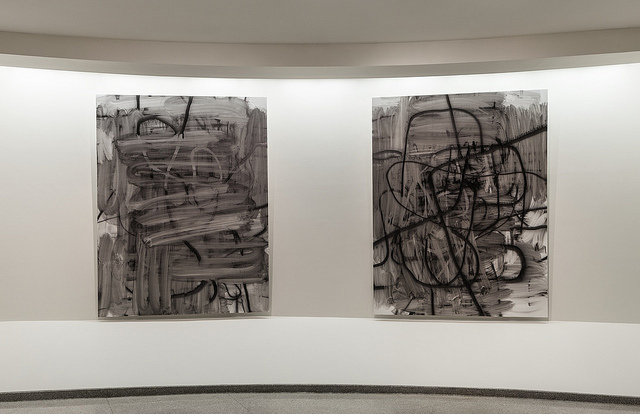
Christopher Wool
Solomon R. Guggenheim Museum
October 25, 2013 – January 22, 2014
1071 Fifth Avenue
New York City
guggenheim.org
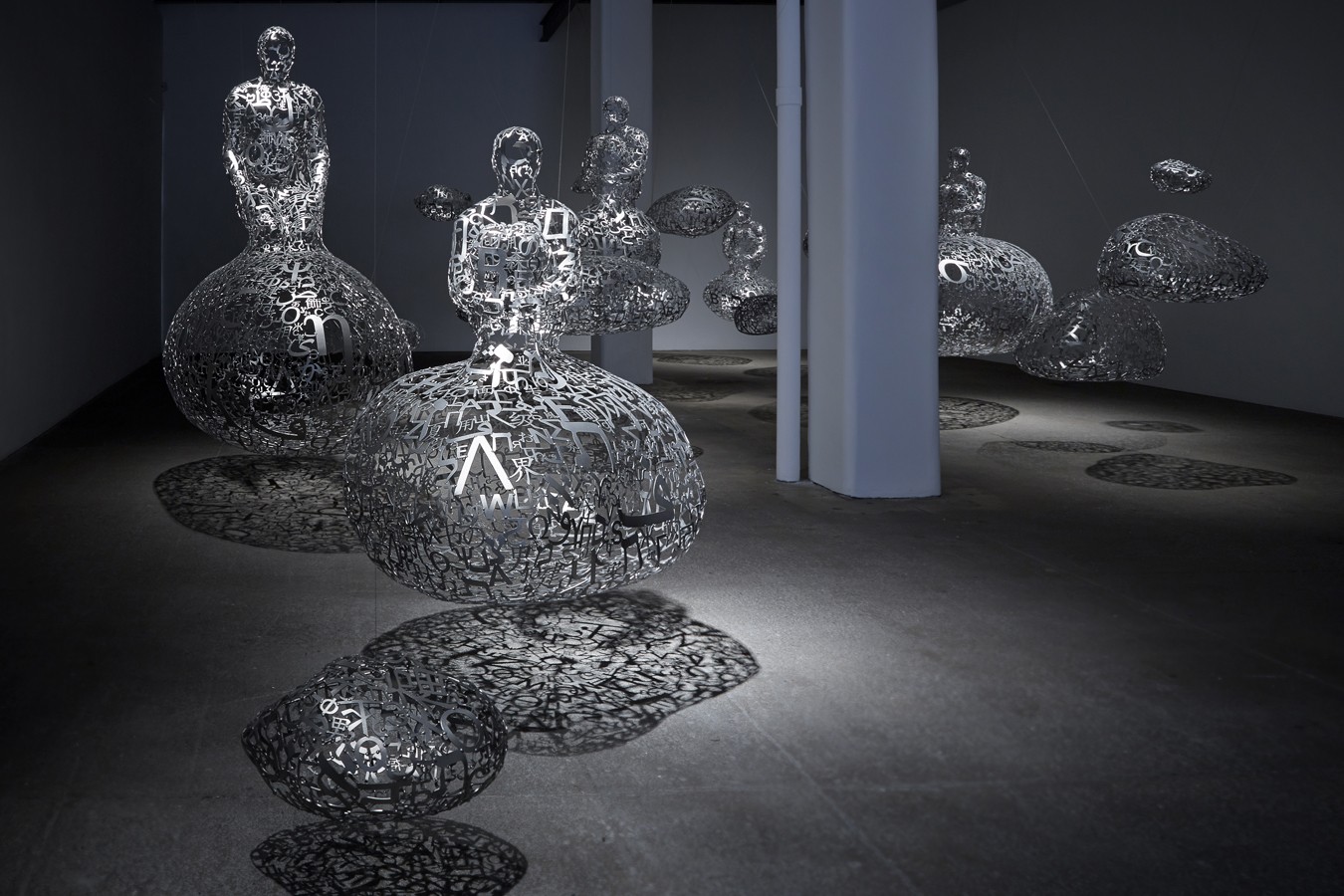
Jaume Plensa
Talking Continents
Galerie Lelong
November 1, 2013 – December 14, 2013
Opening Reception: November 1, 2013 6-8 pm
528 West 26th St.
New York City
galerielelong.com
-
Tarsila do Amaral: Inventing Modern Art in Brazil
Tarsila do Amaral: InventingModern Art in Brazil “I want to be the painter of my country,” Tarsila do Amaral. Her signature style was ... -
ASIA WEEK MARCH 15 – 24,
15 Thu 16 Fri 17 Sat 18 Sun 19 Mon 20 Tue 21 Wed 22 Thu 23 Fri 24 Sat... -
NYC ART FAIRS MARCH 2018
The Armory Show March 8 – 11, 2018 New York, NY NYC Art Fairs March 2018 The New York City Art Fairs for March is referred to as Armor... -
17 Cuban artists: All That You Have Is Your Soul
Dear Abraham, Gallery 8 New York opens in Harlem next Thursday with an inaugural exhibition 17 Cuban artists from FACTION Art Project... -
Currents: Abortion A.I.R Gallery January 4-February 4
Abortion is our country’s Scarlet Letter, an impassioned “A” writ large on our conscience. We shame, blame and deny wome... -
CURRENTS: ABORTION
CURRENTS an exhibition in which artists respond to the theme of ABORTION. In this turbulent moment in history, abortion remains a signifier ... -
No Image
Guantanamo art in NYC makes Washington nervous
“Untitled (Alan Kurdi)” [Courtesy of Muhammad Ansi/John Jay College]... -
No Image
7th Moscow Biennale
Being late to speak at the 7th Moscow Biennale, I try the Russian car service Yandex, rather than taking the ornate Moscow subway. My driver... -
Louise Bourgeois at MOMA
The MOMA exhibit, Louise Bourgeois: An Unfolding Portrait, showcases the prints, books, and creative process of the celebrated sculptor Loui...


br> br>