• The appropriately titled Curtains, Eileen Quinlan’s spare exhibition at Miguel Abreu, unsettles in ways few shows dare. The 24 black-and-white prints, all gelatin silver, communicate a spirit that is both cryptic and choleric. They dampen, these images, as in deaden. They silence. One feels in their presence as if having stepped into the afterings of a wake, casket still open, all guests gone. Something lingers.

    Part of what disquiets in this utterly hushed series is the spectering of Quinlan’s aggressive hand, which haunts in ways comparable to the cramping of a limb not long ago severed. It manifests as fitful revenant in openly hostile attacks against the negatives themselves, which are scarred with slashings and steel wool scourings and experimental broodings borne of plain artistic urge. A good dozen-plus prints in the show reflect the latter. As fly to wonton boys, killed solely for the sport, the negatives for these prints were left for hours or days in chemical baths, eroding or outright obliterating any image that might have been and erasing with it any expectation as to what a photograph should even minimally convey. To that end, these prints merely allude to photography, working as they do in the same medium. They are acting, however, in an alternate other: as medium in a kind of necromancy. They conjure rather than represent.

    Summoned prominently throughout the series is the artist’s twin sister, who appears in various states of alarm, wistful cheer, or melancholy. In Sister,we find the twin relatively pert, with a ready smile and kitten in hand. But something is off. The kitten has a glaucomic, breathless glare, as if held too tightly in her handler’s grip. The sister, for her part, is not so much showing off the kitten as using it for shield against a lens that seems a shade too intrusive. Its placement, however—the kitten’s—leaves the twin partially defaced and her remaining eye is Cyclopian and slant and communicates a presence only half there. She could be looking at us or through or nowhere at all. The shot’s dis-ease is further amplified by the intervention of the artist herself, the other half, who nearly halves the image again into chemical abstraction, then attacks what’s left with fingernail-like gashes that cut at the kitty’s already traumatized face, around the sister’s nose, across her forehead.

    I suspect a conflict. And since this show so ruthlessly prods at the imagination yet so graciously and receptively allows for an imaginative response, I propose an interpretation, however partial, one that’s fraught with sisterly cattiness. Mindful to the show’s title, something indeed feels hanging in the space between picture-taker and subject, a separation of sorts, a curtain. Might it have anything to do with the lounging male friend we see in Tulips?  Tulips is one of two prints in the exhibition that is a rephotographing of photograph. In other words, the artist pins a snapshot to a wall and shoots it again in place. The other such print, a virtual twin of the first, is Lady. The single difference being the snapshot in Tulips is swapped out for a snapshot of the sister. As they hang in the gallery, the sister in Lady looks back grimly toward the male friend in Tulips, as if in judgment or in longing. Finally, in Open City, —the last we see of the sister before the series moves entirely into abstraction—the twin looks entirely worn, as if from years of loss. In her hand is a photograph that bears the considerable weight of her gaze. What faintly bleeds through the backside of that photograph appears to show a photo within a photo, as if she too is looking at the same image we look at when viewing “Tulips.”  What is the relationship between the sister(s) and this male friend, and is it a corroding source of sibling tension?  The remaining abstractions in the series prevent any firm conclusions, which in a way duplicates the interesting and disorienting effects we experience when viewing at least half the images in the collection, i.e. it effectively obliterates our ability to see the whole.
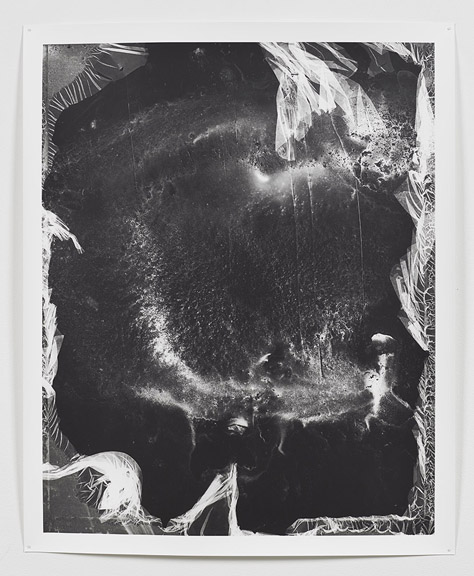
    Eileen Quinlan, Sun and Stars, 2013. Gelatin silver print. Image courtesy of Miguel Abreu Gallery.

    Eileen Quinlan, Sun and Stars, 2013. Gelatin silver print. Image courtesy of Miguel Abreu Gallery.

    Of these abstractions, one of particular interest, in part because it works nicely as a metaphor for the show, is Sun and Stars. The composition is a record of its own developmental decay, a kind of graphic birthing that comes in allowing the negative to waste away in a corrosive wash. The result here, as if through a chemical big bang, is a spacial, densely celestial realm that orbs and turns and at its outer edges frays. In it a ghostly traveler floats up from the thick, clutching to the tatters of some astral fabric as he attempts an entry into the illumined core. Though not yet through. He remains ever at the edge, in the purgatorial peripheries of a lovely, long-sought world.

    A companion print—yet another twin, though this one in way of a polarity—is Top Down. Top Down is a charged, lightning-blast of an image that would be no stranger amongst Dore’s masterful illustrations for Dante’s Divina Commedia; his “Burning Graves—The Heresiarchs” would be its perfect companion. Quinlan’s image would likewise welcome an embedded quote from that same canto Dore so splendidly illuminates:  “And now there came over the turbid waves a crash of fearful sound, at which both shores trembled: a sound as of wind, violent from conflicting heats…”  Indeed, the image crackles in white hot shards that crystalizes its upper spheres before flaming Phoenix-like into a simmering darkness. Top Down is the burning heart of Curtains, a series that otherwise roils in its own quiet storm.

    By Christopher Hassett

    The press release for Ascension describes an exhibition where “fragmentation abounds in multitudinous ‘selves’, highlighting large-scale interactions between national and, arguably, mystical realms.”

    My impression, however, in moving through the two-level group show was that the artists in the gallery’s meandering lower level were engaged in a more interesting and urgent discussion about a virulent kind of masculinity that is proving to be not just failed but fatal to the long term existence of our species.

    The spirit of this debate is embodied, literally, in the works of the Moscow collective, Tanatos Banionis, a commando band of artists/tattooists who employ Japanese warrior lore to illustrate narratives—now permanently etched into the flesh of their models—that detail a militarized movement away from the temporal self toward a more venerated, higher-Eternal Being.  Seen historically, this often obligatory journey was best achieved through selfless acts of sacrifice, for country of course, though with grave consequences to what was left smoking in the rear.

    It is those consequences that seem to be the real talking point of this exhibition.  The idea finds its thesis in Ultra Violet’s printed manifesto, “Killing is the ultimate crime…,” where mid-declarative the question is posed: “Is the membrum virile a tumescent weapon of mass destruction?”  The query could easily be a direct response to Tanatos Banionis Divine Wind, a seventeen minute video installation that weaves images of feminine submission with relentless male aggression—the latter in a maniacally ironic nod to honor, duty and lasting glory, with the interim between duty and glory being assuredly terminal.

    Tanatos Banionis, Untitled, 2013.

    Tanatos Banionis, Untitled, 2013. Digital C-print. Image courtesy of Rox Gallery

    Exemplar of the heroic arc is the Japanese kamikaze, the renowned and exceedingly feared WWII fighter pilots who time and again gave their lives for country by missiling their planes, and themselves, into enemy warships. But to what end? The Moscow collective’s five large-scale digital prints, all Untitled, suggest instead that what endures is the unconquerable Feminine, in particular an Earth that absorbs and abides until at last it snuffs the annoyance out. In other words, the membrum virile is and will continue to be a singular weapon of destruction that may very well lead us to our doom, but the Earth will journey onward nevertheless, remnants of ourselves left as mere markings on her back.

    Symbols of Earth, the women in the five prints similarly submit their backs for engravings not of their own design but for the artistic and political purpose of Tanatos Banionis. In this way they become kamikaze-like in offering forth their flesh for a greater good beyond themselves. On each are inscriptions exclusively of war—samurai, Empire commanders, supplicant infantry in rivers of blood–all sanctioned by the overseeing eye of an Imperial Sun. Meanwhile, our view of the women is always from behind. They do not sanction such action, nor should we infer complicity in their passive stance. As with Earth, theirs is an energy more untamed and lasting, and ultimately far more feral, than the gunshot will of historical man.

    This argument is supported in the negative by artists such as Jack Greer and Dave Schubert. Greer’s photographic tryptic, The Incredibles, depicts a Manson-like trio who represent a strain of masculinity gone wholly awry, an assessment that in no way excludes the central figure of a hoodied, silver-toothed woman with “GOD” thickly tattooed onto her forehead. Faint hope that these three will ever act as caretakers of their communities or the planet, though we can be sure they will take freely from both. While Schubert’s C-print blowup of Dash Snow in a tub of polaroids, cigarette at lips, eyes faded to a milky glaze, shows an equally enervate masculinity drained of any ability to nurture or protect. On the contrary, the image speaks of a type of male who offers little more of himself than documents of indulgence, and who will consume to near pathology until all else, though first himself, is gone.

    By Christopher Hassett

    Image courtesy of the artist.

    Image courtesy of the artist.

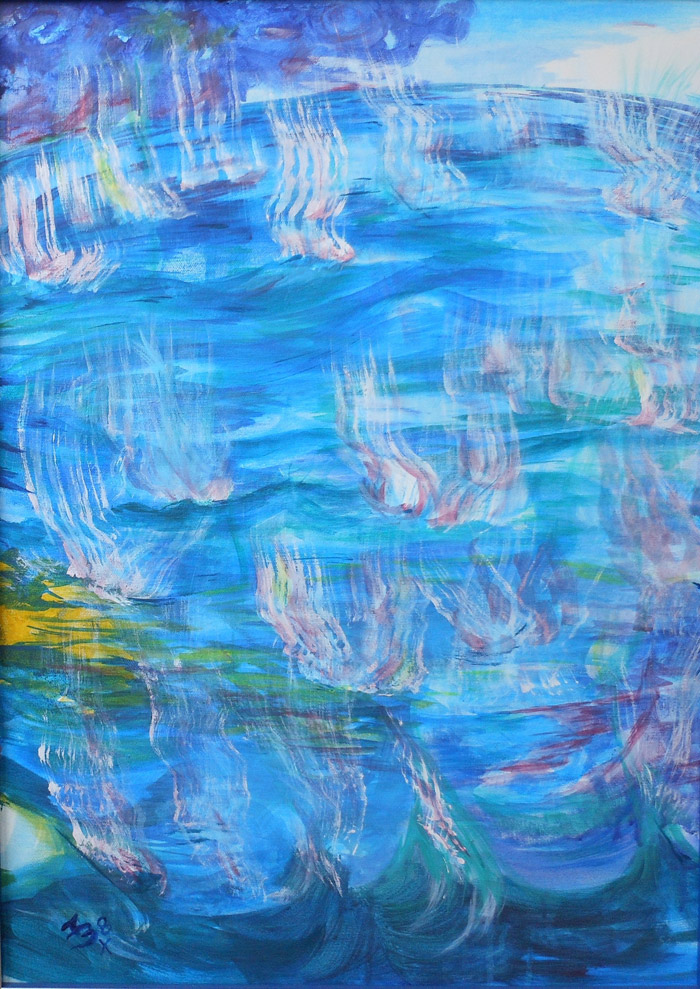
    Caught in creativity, the past 10 years mainly made me paint-study-paint, feeling like a mirror when expressing our BEING in the wonderful nature which our globe is offering, nature which is fathering my work and constantly wants to be discovered anew. Extensive travels have allowed creating on-the-spot of over 20 little travel-sketch books, some excerpts of which will be shown at the Broadway gallery vernissage in the near future. Here some thoughts which arise while viewing this work: Evaporatrion—the eternal circle of steaming is painted here: sun hits the watery surface of the oceans, makes steam rise in convergence and gives it all back to us in form of rains, snowflakes, hale prior to flowing back into the oceans.  Little me, I feel very much like the recipient making valuable use of it.

    In summary, the beauty and the width of both the ocean (my watery sea) and the desert (my sandy sea) are highly important factors of impression and expression for my work.

    traute-macom.eu

    Whether you see them as architects, sculptors, painters, or installation artists, one thing is clear: Lang/Baumann are here to bend your mind. Their large-scale installations consistently challenge the boundaries between the surreal and the commonplace, and their book, More is More, is a vivid portrayal of their best work.

    More is More is a photo collection of installation art by Sabina Lang and Daniel Baumann (who go by Lang/Baumann or L/B). In beautifully detailed photographs, More is More features a number of everyday scenes that have been irreversibly altered by L/B’s fantastical concepts; bright bars of color weave their way along the worn pavement of an old-fashioned village, the underbelly of a simple park bridge is transformed into an abstract scene, twisting white stairs to nowhere climb out of a green lawn in front of wild-looking coastal trees.

    The book also features many of their gallery displays. The average artist’s approach to a gallery show is to decorate the walls, but L/B’s approach is to visually reconstruct the entire interior of the building; decorating the walls has been done, they seek to alter the space. Such displays include rooms painted in ways that make the walls seem to warp in odd directions, rooms filled with geometrically intertwined inflatable white tubes on a goliath scale, and half straight, half spiral stairs that seem to hover in the air of their own volition.

    But it is not just the art in More is More that makes the book such a fascinating perceptual experience; the photographs and their arrangements on the page are artistic feats of their own. The photos are taken at off angles and each one is juxtaposed against a reflection of itself on the opposite page. The resulting effect is the illusion of one, symmetrical image. In some instances, the effect is downright disconcerting. When viewing the mirror images of Beautiful Wall #3, I turned my head and leaned so far to the left that I nearly toppled over, and still the image seemed to be spinning away from me. I can only imagine what it must have been like to stand in that room.

    A further enhancement of the book experience is the collection of artist’s drawings and notes in the back of the book. These drawings allow for a rare insight into the artists’ planning and creative process in the pre-production stages. The notes include details about the actual construction, as well as the reactions of the locals to having the installations in their towns. In Spiral #3, a boxy white structure that temporarily climbed the tracks of a shutdown cliff railway, the residents of the neighborhood were noted to have “embraced the work as a welcome symbol of their efforts to reinstate the funicular.”

    The photographic angles and the back-of-the-book insights can only add to the phenomenal experience that is L/B art installations. Between the golden covers of More is More, L/B have compressed goliath-scale structures and psychedelically bright-colored expanses into a one heck of a coffee table conversation starter.

    Reviewed by Jaidree Braddix

    More is More was published by Gestalten

    Image courtesy of Primary Information.

    Image courtesy of Primary Information.

    As Stefan Helmreich describes them, auditory chimeras are sonic events created by “sieving one sound through another.” This act combines the pitch and texture of one sound with the envelope (attack, decay, sustain, and release) of another. It is a sort of translation, where the material being translated acquires characteristics of the material it is being translated through. The same could be said for visualizing sound, where the visuals are informed by the sonic characteristics a listener would hear, but gain characteristics that allow them to be visually interpreted. A similar transference happens when sound is documented in a book. All of these elements of combination are found in Florian Hecker: Chimerizations, published earlier this year by Primary Information.

    In the book Chimerizations, Hecker documents five of his sound and installation pieces with a fragmented methodology reminiscent of his sound-scapes themselves. For the uninitiated, Hecker’s electroacoustic sound pieces have a raw, digital pallet. Each tone is filtered through an algorithm to distance it from its origins and give it the sterilized timbre of melting static. One of the works documented, Hinge (2012), consists of a text by the Iranian philosopher Reza Negarestani translated by multiple voices into English and Portuguese. These recordings were then siphoned through an algorithm to give them a digital quality that forces the listener to hunt for recognizable phrases. To further problematize the listening process, the audio is played over three speakers, compelling the listener to move from one to the other, through the sound field, and collect the pieces for assembly. Each difficulty to overcome makes the listener more aware of the process they use to internalize the piece, as well as conscious of how the sound behaves in space.

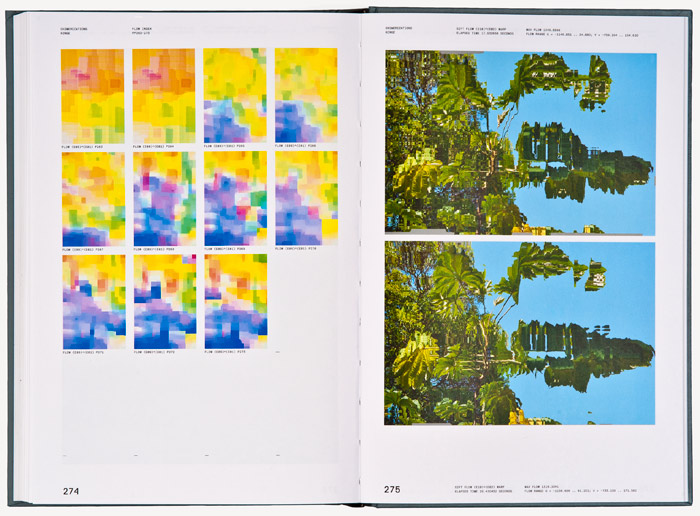
    Similarly, Hecker problematizes the documentation of his works by passing each image through a SIFT Flow Algorithm. This algorithm distorts images using temporally adjacent images and gives each picture a range of time while it also represents a snapshot in time. Here again, in the methodology, is the chimera, the contraction of two contradictory concepts. In his introductory essay to the book, Helmreich refers to Jacques Derrida’s use of the word “hinge” to describe this same idea, the holding of two contradictory concepts in the mind at the same time.

    If this seems heady, it is intended. Both Hecker’s sound pieces and documentation are ambitious and highly cerebral. His pieces take full advantage of technology to analyze perception over multiple instances using decomposition and synthesis. The audio of his pieces, their installations, and their documentations embody a minimalist aesthetic, both randomized and refined. Their distortions are sharp and create a visceral experience even if the audience may not understand the variances between the iterations of the work. The difficulty of the digestion forces the audience to think about the digestion of the work, its often acrid tones provoking the question of why one tone is different or more intense than the previous.

    The book Chimerizations is filled with multiple iterations of images depicting Hecker’s installations. It also includes a “topological hymn to the abyss” in the form a of a libretto written by Negarestani, as well as introductory essays by Helmreich and Catherine Wood. The book is a chimera itself, changing its style from one section to the next. These differentiated sections triangulate around Hecker’s concerns of timbre, pitch, space, time, and perception without emitting a single audible tone. This may be where Heckers’ skill at documentation shows the most, in his ability to so precisely mirror the aesthetics, techniques, and concepts of his sound work in such a different medium as a book.

    Reviewed by Kempton Mooney

    Image courtesy of the artist.

    Image courtesy of the artist.

    I paint from my imagination. When I was thirteen years old Sir Charles Wheeler, the past president of the Royal Academy wanted to buy my flower painting, which had won first prize in a competition in East Sussex.

    I have been an artist for many years, working in a variety of mediums – paintings, mosaic tables, walls & trays and textiles.

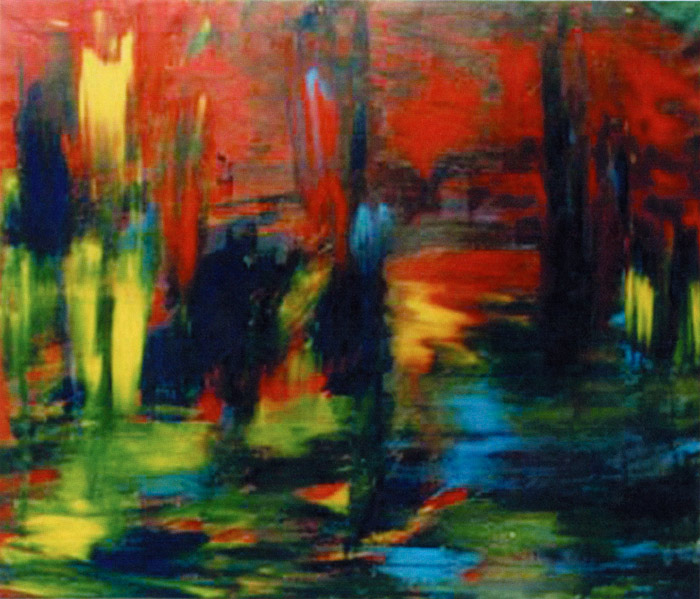
    I am a colourist, I love colour in all its variety and paint from my imagination. My paintings are organic. An image may appear on the canvas and will become something – a flower, an abstract, a figure. I don’t have a prefixed idea.

    I have been lucky in my life to have lived in very exciting colourful places – Buenos Aires, London, New York. These places have had a great influence on my paintings. My work which I have been told adds life to the environment, has been sold to businesses and homes.

    francesbildner.com

    Frank_Michiel_Thingsthatmaynotreallybethere

    Image courtesy of Galerie Bart

    Featuring: Kevin Bauer, Frank Blommestijin & Michiel van der Werf, Janneke Bolt, Dario Bongiovanni, Jonah Falke, Thijs Jager, Evelien Jaspers, Sara Koning, Nynke Koster, Naomi Souwen

    Galerie Bart
    Nieuwe Oogst ’13
    November 11 – December 14 2013
    Elandsgracht 16
    1016 TW Amsterdam
    galeriebart.nl

    08e801e05d9c8a88dd6d58f1ed7d3a77

    Image courtesy of Circle Culture Gallery

    Featuring: Maya Hayuk, Stefan Strumbel, Marco “Pho” Grassi, Teo “Moneyless” Pirisi

    POTSE 68
    Circle Culture Gallery
    November 9 2013 – January 8 2014
    Potsdamer Straße 68, 2nd courtyard
    10785 Berlin, Germany
    circleculture-gallery.com

    Image courtesy of the artist.

    Image courtesy of the artist.

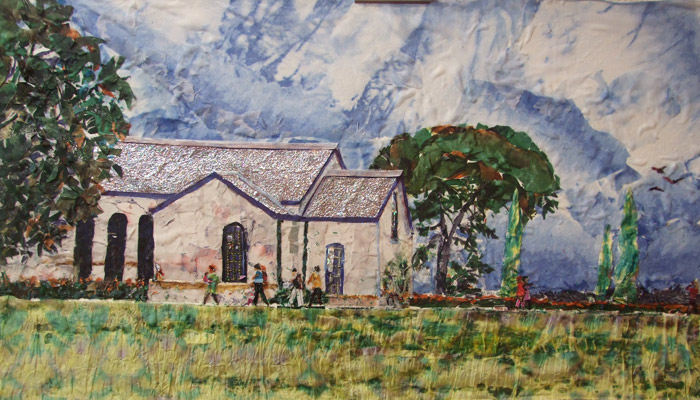
    As an artist working with many mediums, I have also developed a special interest in mixed media paintings. I enjoy incorporating multicolored material layers—silk, ribbons, beads, and various fabrics to create a three-dimensional affect for cityscapes, sky lined against rich, vibrant watercolor skies. My watercolors can take up to fourteen layers of carefully applied individual hues. I use my own photographs of my favorite city, Melbourne, to capture the different times of day and the colors that the city displays. I also have produced a number of mixed media creations of other cities for commissioned work.

    agili.com.au


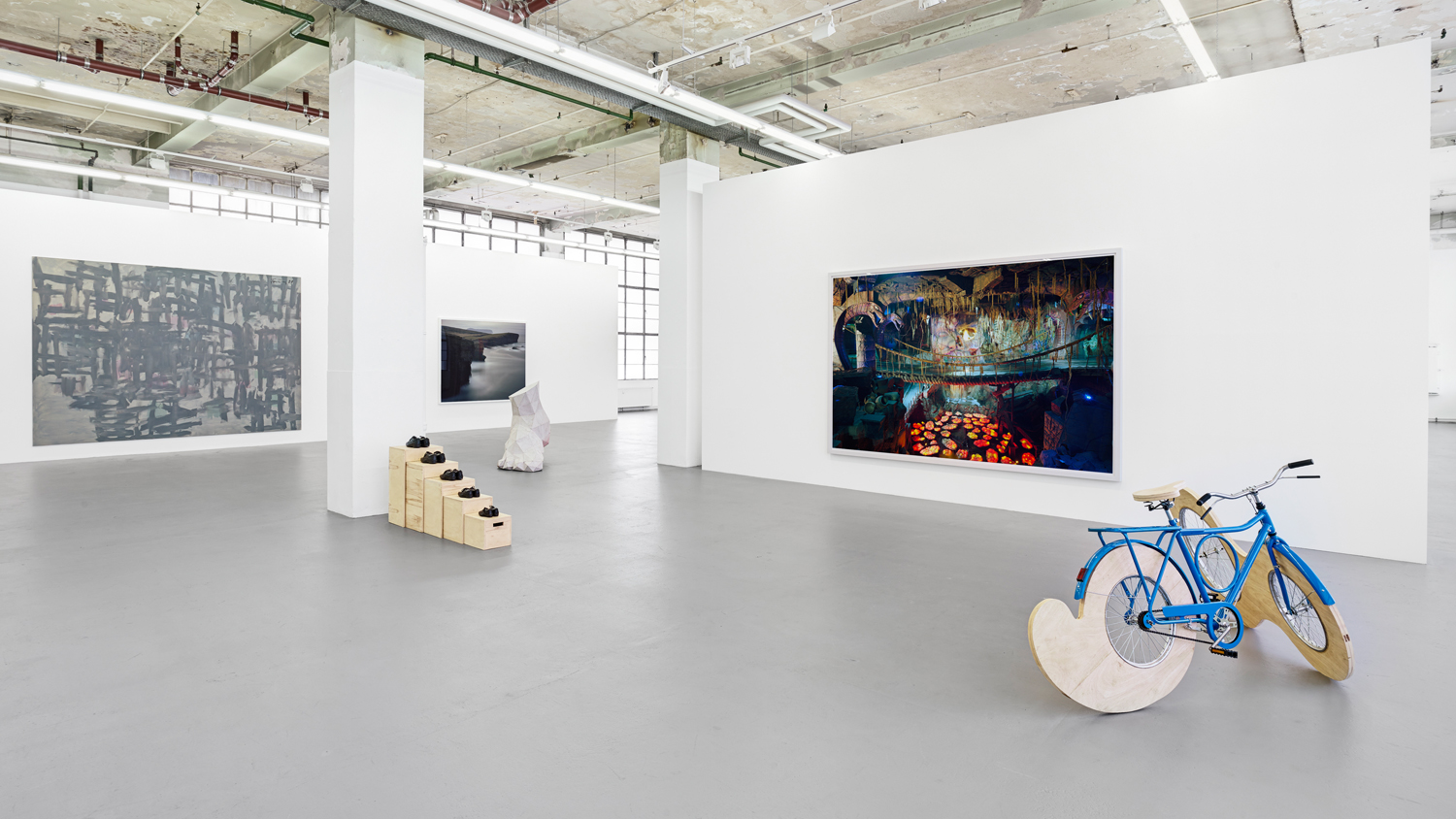
    Galerie_Max_Hetzler

    Image courtesy of Galerie Max Hetzler

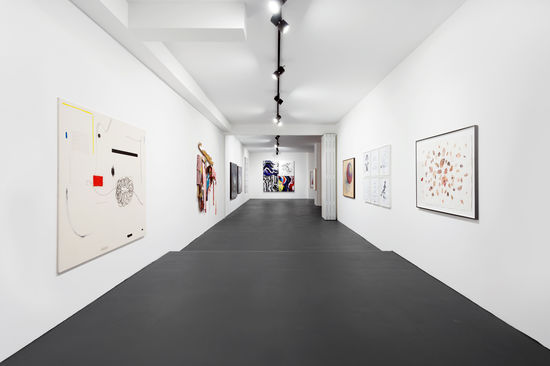
    Featuring: Darren Almond, Glenn Brown, André Butzer, Rineke Dijkstra, Günther Förg, Mona Hatoum, Jeff Koons, Vera Lutter, Marepe, Beatriz Milhazes, Ernesto Neto, Frank Nitsche, Albert Oehlen, Yves Oppenheim, Richard Phillips, Michael Raedecker, Bridget Riley, Thomas Struth, Rebecca Warren, Christopher Wool, Toby Ziegler

    Remember Everything
    Galerie Max Hetzler
    November 10 – December 21, 2013
    Oudenarder Straße 16-20
    D-13347 Berlin
    maxhetzler.com

    News | Exhibitions