• It will probably take you two, or maybe three, visits to get a real sense of Islands. To get the exhibition in its entire complexity, to try and catch each detail—whether it is visual, auditive, or olfactory. And still, it probably won’t be enough.

    Entering Islands—the show dedicated to Dieter Roth (Hanover, 1930 – Basel, 1998) and his son Björn, currently on view at Hangar Bicocca in Milan, is one of the most significant experiences you might have to get a glimpse of someone else’s life—of an artist’s life, actually. That’s partly because autobiography largely underlies Roth’s research, of course. But that also means that this groups of installations—sculptures, videos, paintings, graphics, photographs—really lead the viewer throughout an author’s daily activities, with no filter given by a theoretical superstructure. Which, obviously, exists as well. And yet, it is so well blended with the artistic production, that one can hardly distinguish art from life—in the most literal sense.

    You can get an idea of this, starting from the first “island” you come across entering the huge space of the show, the Economy bar. This is a real and fully-functioning bar that Dieter’s son and grandsons have been realizing since 2004, making it a part of each exhibition. With its cozy atmosphere (a candle-lit counter full of stuff, soft blues and country background music) – the bar tries and cut out a warm corner inside the huge space of Hangar. When you finish to sip your beer sitting at its large tables – temporarily forgetting you’re inside an exhibition venue, your eyes will be catched by The relatively new structure—which comes as the result of an intergenerational collaboration, again. This piece was especially made by the Hangar exhibition by Björn Roth with is sons, and it appears as a large walk-through installation where the viewer is invited to walk across a wooden scaffold – on which, together with old 1950s stuff, there are various broken musical instruments. Despite of their decaying condition—and rather, thanks to that—they create a new sound when activated by an electronic device.

    Nearby, The Solo Szenen (Solo scenes) is probably the most sensitive piece in the entire show: a visual diary of the last year of Dieter Roth’s life (between 1997 and 1998), this sculptural-video installation which we also saw at the last Venice Biennale, is made up with 131 monitors with daily scenes shot by the German artist himself. This huge reality show let us follow Roth’s everyday activities in his studios in Iceland and Switzerland, during his period of alcohol rehab.

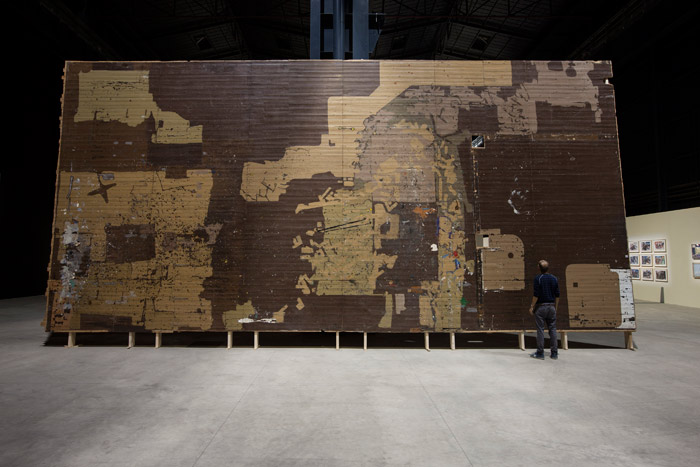
    Dieter Roth / Björn Roth The Floor I ,1973-1992 Found object; wood, paint  227 1/8 x 474 3/8 x 4 3/4 in. Installation view, Art Cologne, Cologne, Germany, 2012 Photo: Jens Kirchner Courtesy the artist and Hauser & Wirth.

    Dieter Roth / Björn Roth The Floor I,1973-1992. Found object; wood, paint. 227 1/8 x 474 3/8 x 4 3/4 in. Installation view, Art Cologne, Cologne, Germany, 2012 Photo: Jens Kirchner
    Courtesy the artist and Hauser & Wirth.

    The concept of an autobiographical diary is actually a recurrent theme in Dieter Roth’s practice—and each time it takes different shapes. It might be an accurate archive of little waste things (Flacher Abfall – Flat Waste), or simply the actual floor of his studio in Iceland (The Floor I, The Floor II). Removed from their original context and now installed as large dripping paintings, the floors look like some sort of an impressive ready made, needing nothing else but itself to tell a personal story over a period of about twenty years. But also in the 30,000 Rakyavik slides – screened simultaneously on 16 projectors placed on pedestals at the end of the exhibition path , some sort of a daily narration of the passing of time is staged. Each shot tells us about Roth’s deep relation with Iceland, where he spent large part of his life, in every season of the year.

    Another fil rouge in Roth’s research is his interest in experimenting with food as common raw materials—which the artist let live and die under the visitor’s eyes. Walking through the Hangar’s space, you will come across the artists’ Self Towers, autoportraits made up with chocolate and colored sugar, and his Coquille Gnomes—with a bittersweet sense of life and death. The experiences of the so called Mold Museum in Hamburg—comprising the New York kitchen, which has been reconstructed on the occasion of the Roths’ show at Hauser and Wirth gallery in New York, are here recollected, and return the viewer Roth’s curiosity towards real life that, once again, totally blends with art.

    Finally, the two-dimensional production by Dieter Roth also plays a key-role in the exhibition, with his huge series of graphics and paintings. The Piccadilly Project, above all—consisting of a series of 47 prints led by the idea of the serial reproducion of the same object with different colours and techniques—is a significant example of the artist’s interests in the concept of the multiple, and it also reveals his background as a graphic designer in his early years. The 55 shits for Rossana, THE DAMNED SHIT, and his mixed media paintings Material Pictures, are illustrative of this pratice, too—outlining the of figure an all-round artist that, with and throughout his son Björn’s work, reveals himself as a great director of life’s plot.

    By Barbara Meneghel

    equations_of_sight-similarity

    Image courtesy of OnStellarRays

    Featuring: Julia Bland, Nate Boyce, Ala Ebtekar, Mark Geffriaud, Laleh, Khorramian, Hajra Waheed, Lantian Xie

    Equations of Sight-Similarity
    January 12 – February 23, 2014
    OnStellarRays
    1 Rivington Street
    New York City
    onstellarrays.com

    The opening paragraph in the 1996 Nature magazine article “Circling the Inverse Square” (from which this exhibition takes it’s name) begins, “The one bit of physics that almost everyone knows is…” and continues with a fact that I did not (do not) know. Explain to me the premise that there are as many odd numbers as there are natural numbers and I become as baffled as comic foil Karl Pilkington, who famously dismissed the theory of an infinite number of monkeys eventually typing the complete works of Shakespeare with, “it wouldn’t happen”, because after all these years, “there hasn’t been one publication from a monkey”. I suspect I am not alone. For many, concepts such as infinity and nothing are understood the way a thirteen year old understands death—intellectually they know they’re going to die, but they haven’t exactly come to grips with it.

    The six artists in curator Shannon Anderson’s KWAG exhibition share an interest in elucidating the imperceptible and the inconceivable, in “creating their own language as they explore the forces of time, space and logic that affect our everyday lives.” Geometric shapes, the shape of sound, voids and infinities populate an exhibition rich with both playful and serious explorations of our methodologies for making sense of the universe.

    Joseph Albers told Elaine de Kooning in 1950 that “the concern of the artist is with the discrepancy between physical fact and psychological effect.” Jessica Eaton explores Alber’s notion (and some of the revolutionary ideas on color theory from his 1963 classic Interaction with Color) and combines them with Sol Lewitt’s exploration of the cube. In the five large format photographs in the exhibition, Eaton enacts a series of Photoshop-like manipulations, all performed in-camera. The artist documents a set of cubes that are painted white, black and grey. Using multiple exposures, the color hues in each image have been made by exposing the film to additive primaries of red, green and blue. What is most striking about the work is the unexpected painterly quality of the images, which was the result of hand-painting the cubes, leaving visible brush strokes. Eaton’s analogue approach to photography reaches beyond an academic technical exercise with results that are strikingly beautiful and expertly nuanced.

    Sound artist Marla Hlady’s work often interprets sound as a physical phenomenon. Here she presents two of her Soundball works—stainless steel rice balls containing LED lights and audio loops that the audience activate. The exhibition also includes excerpts from her series of intricate, meditative drawings, which represent sound from an expressive, poetic perspective, using delicately drawn arrows on graph paper to delineate sound as intuitive graphic score.

    Two works by Karilee Fuglem explore the relationship between the celestial body and the human body. Magnified photographs of the artist’s back are inverted as color negatives, the landscape of her skin resembling a spacescape, dotted with stars. A companion piece, Somewhere Behind My Heart, transposes these patterns of pores and moles onto an actual astral map, and plots them out on a web-like structure of hand-woven monofilament resembling an intricate but overgrown spider-web. The installation, anchored to the floor with a series of weights, disappears into the shadows, further suggesting its theoretical nature, imbuing the work as the artist says, “with an element of daydream…as part of its architecture.”

    A messier approach to mapping, somewhat at odds with the otherwise subtle, minimal and sometimes delicate accompanying pieces in the show, is Richard Sewell’s Wherelocal/circling. The site-specific work, comprised mainly of hardware store materials, such as corrugated plastic, a large tarpaulin, cable ties, etc., explores how we locate objects in the world through both intuition and logic.

    Charles Stankievech’s Gravity’s Rainbow turns Pink Floyd’s 1973 record Dark Side of the Moon into its own lightshow by projecting a thin beam across the vinyl grooves, creating an iridescent reflection reminiscent of Saturn’s rings. The soundtrack to the installation consists of the turntable stylus stuck in the run-out groove of the vinyl disc, repeating an endless white noise, not unlike the residual radiation from the Big Bang.

    Adam David Brown’s White Noise is a 30 x 40 inch frame containing multiple layers of white paper, from which the artist has cut concentric ellipses creating a layered spiraling vortex that might also read as the numeral zero.   Next to it, Eclipse invokes Joseph Beuys’ blackboards, with its patina of classroom use, except for a pristine erased black circle in the center, suggestive of a black hole. The surrounding dense layer of chalk scrawlings are equations and formulas by Isaac Newton, Stephen Hawking, and Albert Einstein.

    Einstein’s remark that, “the most incomprehensible thing about the world is that it is comprehensible” fittingly embodies the spirit of curiosity and investigative play that runs through all of the work in the show.  Bringing together works that use the human body, cultural artifacts, light, ambient sound, and everyday materials to make connections to the invisible world, Circling the Inverse Square attempts to reconcile the unknowable with the tangible.

    By David Dyment

    Best of the year lists are a dime a dozen this time of year. Who can really narrow it all down to a certain number anyway? What we decided to do was to put out an open call to our writers and ask them all to chip in five shows as part of a favorites compilation. It’s a busy time of year and many writers couldn’t quite get back to us with their selections because they were too busy between drinking boozy eggnog, fighting with the mother in law, and picking out New Years party hats. Those who were excited to contribute and could find the time put together some excellent selections from NYC to Europe and beyond. Lets say just it’s a “Now This is What We Call Art, 2013.” Read through and feel free to comment on anything out there we may have overlooked:
    oisteanu-picasso

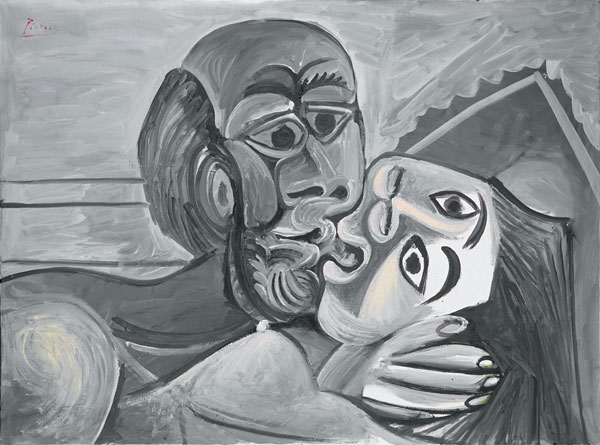
    Pablo Picasso, “The Kiss (Le baiser) Mas Notre-Dame-de-Vie, Mougins,” 1969. Oil on canvas, 97.2 × 130.2 cm. Koons Collection. Copyright 2012 Estate of Pablo Picasso/Artists Rights Society (ARS), New York. Photo: David Heald.

    Valery Oișteanu (born September 3, 1943) is a Soviet-born Romanian and American poet, art critic, essayist, photographer, and performance artist, whose style reflects the influence of Dada and Surrealism. Oișteanu is the author of more than a dozen books of poetry, a book of short fiction, and a book of essays.

    1. Picasso Black and White at the Guggenheim Museum, New York
    “Picasso Black and White” was the first ever exhibit to explore the master draftsman’s use of black-and-white tones throughout his prolific career. Comprised of 118 paintings, sculptures and works on paper, with a large number of masterpieces, as well as 38 rarely and five never-before-seen works borrowed from family and private collections. “Color weakens,” said Picasso, purging it from his art in order to highlight structure and autonomy of form.

    2. Claes Oldenburg: The Street and The Store & Mouse Museum/Ray Gun Wing at MoMA, New York
    This exhibition, organized by Achim Hochdorfer, Curator of the Ludwig Museum of Vienna and Ann Temkin, MoMa’s Chief Curator constitutes the largest-ever presentation of Oldenburg’s earliest witty and gritty expressionistic sculptures, arranged within an immersive, oversized environment. The sixth floor gallery was filled with his sculptures and in the atrium a room shaped like a Ray-Gun and another like a Mickey Mouse Head was filled with art objects made from materials such as chicken wire, plaster, burlap, papier-mâché and newspaper were finished off in enamel paint.

    3. Paul Delvaux at Blain/DiDonna Gallery,  London
    Paul Delvaux (1897-1994) a mini retrospective of a major Belgian Surrealist whose last exhibition in New York was at the Julien Levy gallery in 1947 and it culminated in scandal. Back then Delvaux’s work created quite a stir; despite good reviews, the police raided the show, and all of the artist’s pictures were confiscated and declared obscene. Delvaux’s erotic art does not offend anymore; instead it attracts an aesthetic scrutiny in the course of a drastic re-evaluation. In that exhibition twenty hypnotic oil paintings and watercolors made between the mid-thirties and the mid-sixties adorned the walls of the uptown gallery.

    4. Jindrich Styrsky Dreams at Ubu Gallery, New York
    The story of Jindrich Styrsky (1899-1942) depicts a meteoric, renaissance-like figure who in less then two decades influenced surrealist artists and poets in his native Czechoslovakia, Paris and around the world, and also inspired Ubu’s owner, Adam Boxer, to introduce the artist’s magical masterpieces in three one-man shows and six group shows over the past two decades. His outstanding and varied oeuvre includes numerous book covers and illustrations for surrealist publications in Prague. Friendly with Andre Breton, he is credited as a pioneer of surrealism in art, literature, photography and theater in Prague as well as Paris. That small exhibit was an opening of a window on his dream-like art and life.

    5. Drawing Surrealism at Morgan Library and Museum, New York
    The grand retrospective was a scholarly researched, academically presented overview of an impressive 165 works on paper by 72 artists who shared their subconscious visions. Of course, surrealism proved to be not just a fashionable, passing trend in art, but a whole attitude toward life, for some even a way of life. For others, surrealism was a spiritual activity, representing the unrepresentable, visualizing forbidden dreams, exposing repressed desires. Erotic originality, collage imagination, dreams traveling and a whole plethora of imaginary beings and places made this exhibit a trip into otherworld.

    Chantal_Akerman_Michele_Alpern

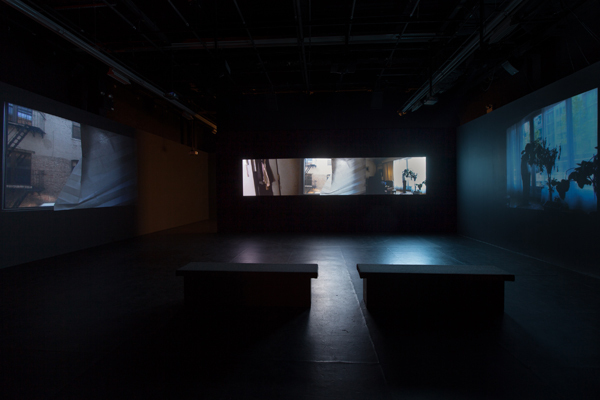
    View of “Chantal Akerman: Maniac Shadows,” 2013. Photo: Jason Mandella.

    Michele Alpern is an artist and writer.

    1. Jean-Luc Godard, The Spirit of the Forms, at the Film Society of Lincoln Center, New York
    Near-complete retrospective of a profound body of visual art spanning the last half century. Godard is unmatched in understanding cinematic form, probing the intersections of subjectivity and politics, culture and history.

    2. Chantal Akerman, Maniac Shadows, at the Kitchen, New York
    Akerman’s mixed-media video installation extends her work on the complications between self and other—specifically mother. The autobiographical piece juxtaposes interior and exterior spaces, evoking tension between confinement and vulnerability. As in her classic films, the imagery is mundane, yet presented at a remove. The piece gets at the fundamental obliqueness of identity.

    3. Dickinson/Walser at the Drawing Center, New York
    A revelatory presentation of Emily Dickinson’s poem manuscripts on scraps, predominantly envelopes, and Robert Walser’s unique “microscripts.” Dickinson’s pieces, which are mostly legible, are astoundingly experimental in their interplay between the visual, the material, and the linguistic. The exhibition opens issues of visuality and textuality, the haptic and the conceptual.

    4. Mike Kelley at PS1, Long Island City
    Kelley’s work made a huge impression on me in my early twenties—the way he used psychoanalytic, feminist, and semiotic theory along with punk aesthetics and working/middle class American vernacular culture. Seeing this retrospective, especially the second and third floors, still had the same surprisingly emotional impact. Kelley goes to the painful and abject, and it resonates.

    5. Ad Reinhardt at David Zwirner, and Richard Aldrich at Bortolami, New York
    A strange pairing of painting shows I first saw on the same day. Not only were Reinhardt’s brilliant cartoons, paintings, and photography shown in one exhibition, but an extraordinary thirteen of the “black” paintings were beautifully installed in one room. We could move among the paintings at different distances and realize how particular each ostensibly similar one is, opening awareness of the endless oscillations and revisions involved in perception.
    Aldrich’s work is increasingly about the relay of vision across pieces rather than within the bounds of an object. This show also operated across temporal interstices in memory: a second installation of mostly different work replaced the first for ten days during the run. I found the show often baffling, while evoking a challenging, and moving, sense of contingency.

    irwin-scrim-veil002_2340

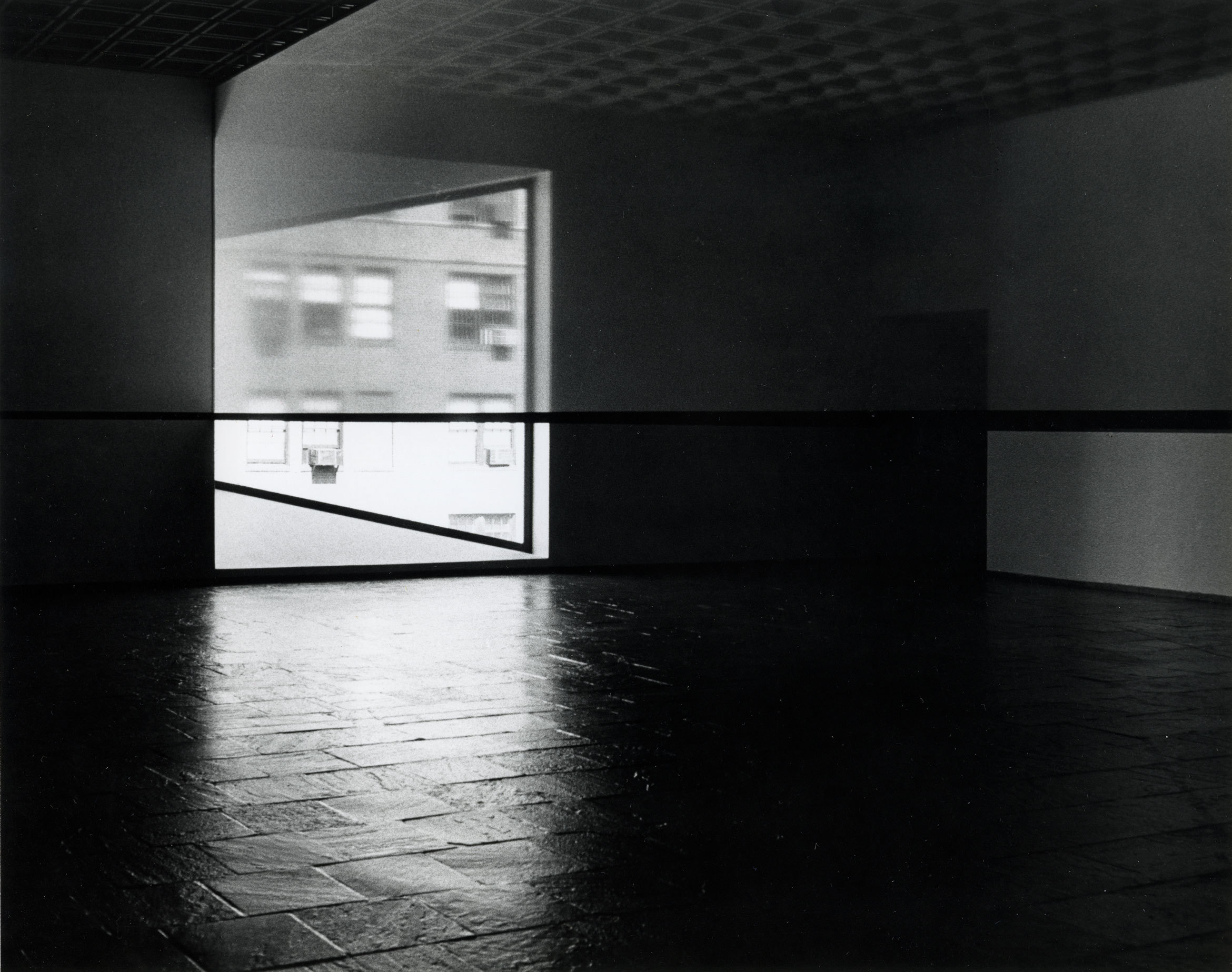
    Robert Irwin (b. 1928), Scrim veil—Black rectangle—Natural light, Whitney Museum of American Art, New York, 1977. Cloth, metal, and wood. Overall: 144 × 1368 × 49 in. Whitney Museum of American Art, New York. Photo Credit: Warren Silverman.

    Charlotte Meyer lives in Brooklyn, N.Y., graduated from Pratt Institute in 2009, and received the Joan Mitchell Foundation Award in recognition of the school. She is a Visiting Critic at R.I.S.D. is represented by Opus Projects, and is scheduled to exhibit new work at the Chelsea location in 2014.

    1. Robert Irwin: Scrim Veil -Black Rectangle -Natural Light at Whitney Museum, New York
    A reminder of Irwin’s dedication to understanding perceptual awareness of space by transforming the fourth floor of the Whitney with an intricate but barely there work, recreated after 35 years.

    2. Ad Reinhardt at David Zwirner, New York
    The black paintings fill one room with subtle details which reveal themselves with each moment you spend, smart political graphic illustrations provide a layer mostly unknown, obsessive photography slides in the hundreds.

    3. Jill Magid: Woman with Sombrero at Art in General, New York
    The investigative nature of Magid’s work paired with the skilled manifestation of sharing just enough information seduces every time.

    4. Subliming Vessel: The Drawings of Matthew Barney at Morgan Library, New York
    Intense research, developed language, constant movement, revealing process, considered materials.

    5. Dickinson/Walser: Pencil Sketches at Drawing Center, New York
    Old fashioned writing thoughts down on beautiful scraps of paper.

    bove_veraldi

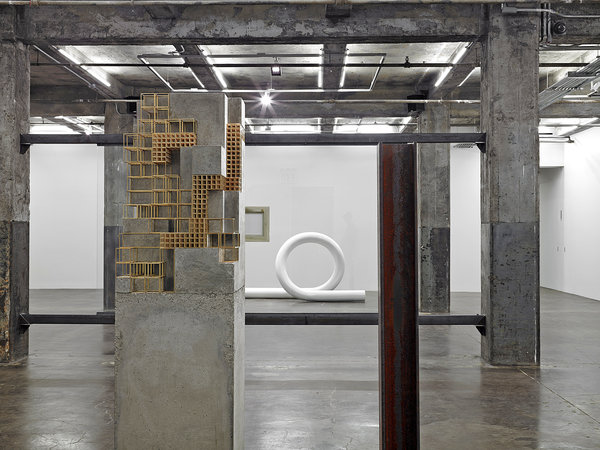
    “Peel’s Foe, not a set animal, laminates a tone of sleep” (2013), in brass and concrete, by Carol Bove at Maccarone.

    Keith J. Varadi is an artist, writer, and curator currently based in Los Angeles. He is a co-founder and member of the collective, Picture Menu.

    1. Larry Bamburg, BurlsHoovesandShells at Simone Subal Gallery, New York
    Jerry-rigged ecosystems, towers constructed from bones and gold, and artificial earth compositions made for, hands down, one of the most profoundly perplexing shows in recent memory (at one of the most consistently superb galleries in New York).

    2. Carol Bove, RA, or Why is an orange like a bell? at Maccarone, New York
    Nobody combines smart and sexy better than Ms. Bove, and this is arguably her smartest and sexiest affair yet, continuing on with her rigorously researched explorations into ascetic aesthetics.

    3. Elizabeth Jaeger, Music Stand at Eli Ping, New York
    A nude woman with a devilishly delightful look on her face, straddling a suited man with her hand caught mid-caress on his face, provided a subtle subversion of power in the intimate Lower East Side basement gallery this past summer; oh, and there was a saxophonist playing every Sunday afternoon during its run.

    4. Jamian Juliano-Villani, Me, Myself, and Jah at Rawson Projects, New York
    After creating substantial buzz at this past spring’s otherwise generally confused NADA fair in New York, this little firecracker could be seen everywhere throughout the boroughs and on the Internet, and this Brooklyn gallery made a wise move by opening the fall season with her, as she is rapidly asserting herself as a demented voice to be reckoned with.

    5. Paul McCarthy: White Snow at The Park Avenue Armory, New York
    Rarely has commentary been so abundant amidst a viewer’s navigation throughout an exhibition—comments of amusement and disgust echoed within the Upper East Side’s cavernous space—and for good reason; this modern pop-fused Bacchanalia completely transformed the public’s idea of what an art show truly can be.

    davehardy_claudiaEveBeauchesn

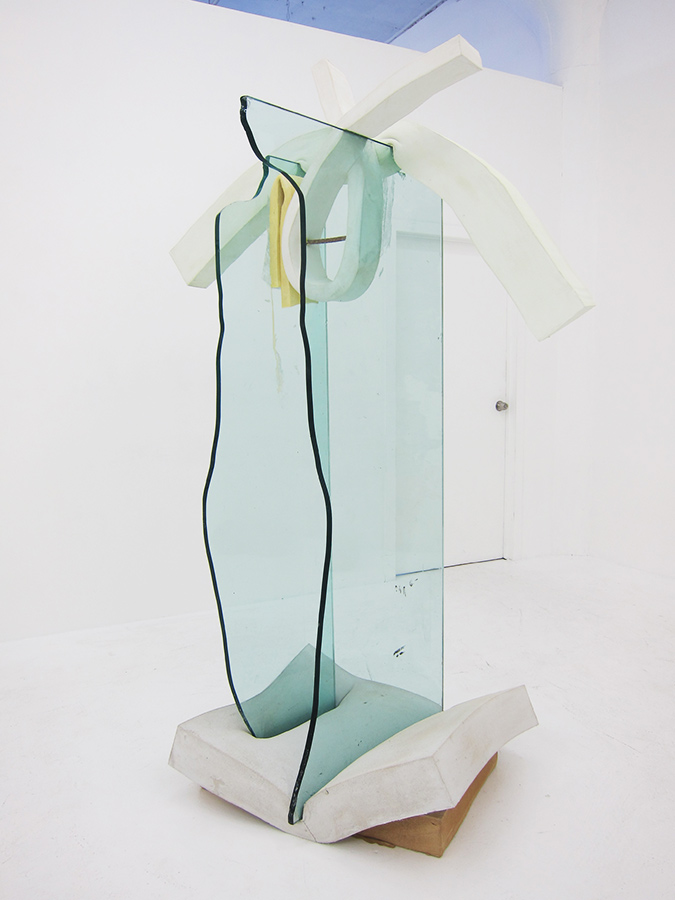
    Dave Hardy, Hunky-dory (2013), glass, cement, polyurethane foam, ink, paper, metal, pretzel,etc 86 x 57 x 33 in. Image courtesy of Regina Rex.

    Claudia Eve Beauchesne is an art historian, writer and curator. She is currently curator of programming at Formats in Montreal, Canada, and is working on a non-fiction book about the East Village art scene of the 1980s. Her writing on contemporary art, cinema and popular culture has appeared in NY Arts, Packet, Kolaj, I Love Bad Movies, and Come on Down.

    1. Generator at Audio Visual Arts (AVA), New York
    An exhaustive and well-deserved homage to Gen Ken Montgomery’s Generator, New York’s first sound art gallery which existed in the East Village and then in Chelsea from 1989 to 1992.

    2.  Dave Hardy, A House with Gates at Regina Rex, Brooklyn, NY
    Large vinyl wall hangings and precarious sculptural constructions made of discarded pliable foam, glass, cement, wood and furniture. The most innovative use of found materials this year.

    3. The Perfect Nothing Catalog at Ongoing, Brooklyn, NY
    A nomadic installation somewhere between a store, a curatorial project, a situationist intervention, and a relational aesthetic project. Uncategorizable and inconspiciously sophisticated.

    4. John Dante Bianchi: Dislocation Point at SIGNAL, Brooklyn, NY
    Large white relief panels created through a process of erosion and degradation, combined with white fiberboard sculptures that appear oxidized; almost iridescent. A fresh take on monochromatic abstraction.

    5. Shaq Attack! At BOCA Gallery, Montreal
    A conceptual online advertising campaign using Google AdSense to target a product (a customized work of art) at a single individual: Shaquille O’Neal. A smart (and funny) critique of internet-mediated marketing.

    Knudsen_pick_opt

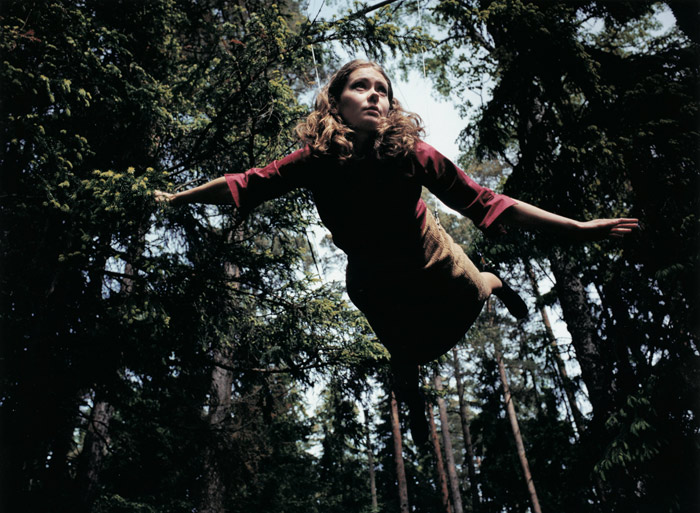
    Eija-Liisa Ahtila, still from The House, 2002. 14 min DVD installation for 3 projections with sound. Copyright Crystal Eye Ltd, Helsinki, Courtesy of Marian Goodman Gallery, New York and Paris.

    Stephen Knudsen is an artist and professor of painting at Savannah College of Art and design. He is the senior editor of ARTPULSE Magazine, a contributing writer to the Huffington Post, NY Arts Magazine, and Hyperallergic. He is the senior editor of the anthology the Art of Critique, forthcoming in 2014.

    1. Eija-Liisa Ahtila: Olentoja (Creatures) at the Davis Museum at Wellesley College, MA
    Finnish artist Eija-Liisa Ahtila has been a figure in the vanguard movement re-imagining film art into multiple screen pieces with cinematic production values. This exhibition of her key works includes House (2002), one of the best pieces in the movement. This work demonstrates that beauty and transcendence does not have to be put into the satirical air quotes of postmodernism to be critically and aesthetically relevant.

    2. Nicole Eisenman’s work in the Carnegie International Exhibition, Carnegie Museum, Pittsburgh
    The highlight of this well- conceived iteration of the Carnegie International is Nicole Eisenman’s survey of work up to 2011. She was the winner of this year’s Carnegie Prize. Included works like The Sunday Night Dinner have placed Eisenman as one of the most important 21st century painter who cast back to the roots of expressionism without evoking the weaknesses of 1980’s Neo-expressionism.

    3. Laura McPhee: River of No Return at Kemper Contemporary Museum of ART, Kansas City
    Laura McPhee is a final holdout in the line of great large format photographers using the 8 by 10 camera and pulling prints with traditional chromogenic chemistry. The show’s twenty-three mural sized ( 6 by 8 feet)chromogenic prints were photographed over several years in the ranch land and wilderness of central Idaho. An exceptional inclusion, Mattie with a Northern Red-Shafted Flicker, is a fresh and relevant iconic image that is resolute and easy to love, even without backstory.

    4. The Gallery Booth for La Central Gallery, Bogota, Columbia at Miami Beach Art Basel, Miami
    The La Central gallery dedicated all of its Art Basel space to Nicolas Consuegra’s 15 channel video installation that to my eyes was the best extended cinema piece in Art Basel ( and the satellite fairs) this year. The Water that you Touch is the Last of What has Passed and the First of that Which Comes chronicled the Magdalena river as it runs through a depressed small town outside of Bogotá. Presented as a moving ring, the river becomes a sensual emblem of rushing infinitudes and potential for a town that is in socioeconomic stagnation . See it here: http://vimeo.com/81408376

    5. Benjamin Degen’s Shadow Ripple Reflection at Susan Inglett Gallery, New York
    With Shadow ripple reflection , an uplifting exhibition of eight new paintings, Benjamin Degen showed us that he is better than ever. These works skirt dangerously close to cliché: sunshine, youthful figures lounging, reading, swimming, and setting out, and returning. But they take positive hold on the memory because they seem so unfamiliar in fanatical web-like detail in places that contrast with the simpler handling of the flesh. In the most complex passages it is as if the pigment spun from spinnerets of a spider. The work may nod toward Matisse, Bonnard, Seurat, Renoir, and Gauguin, but it is absolutely recognizable only as itself.

    image

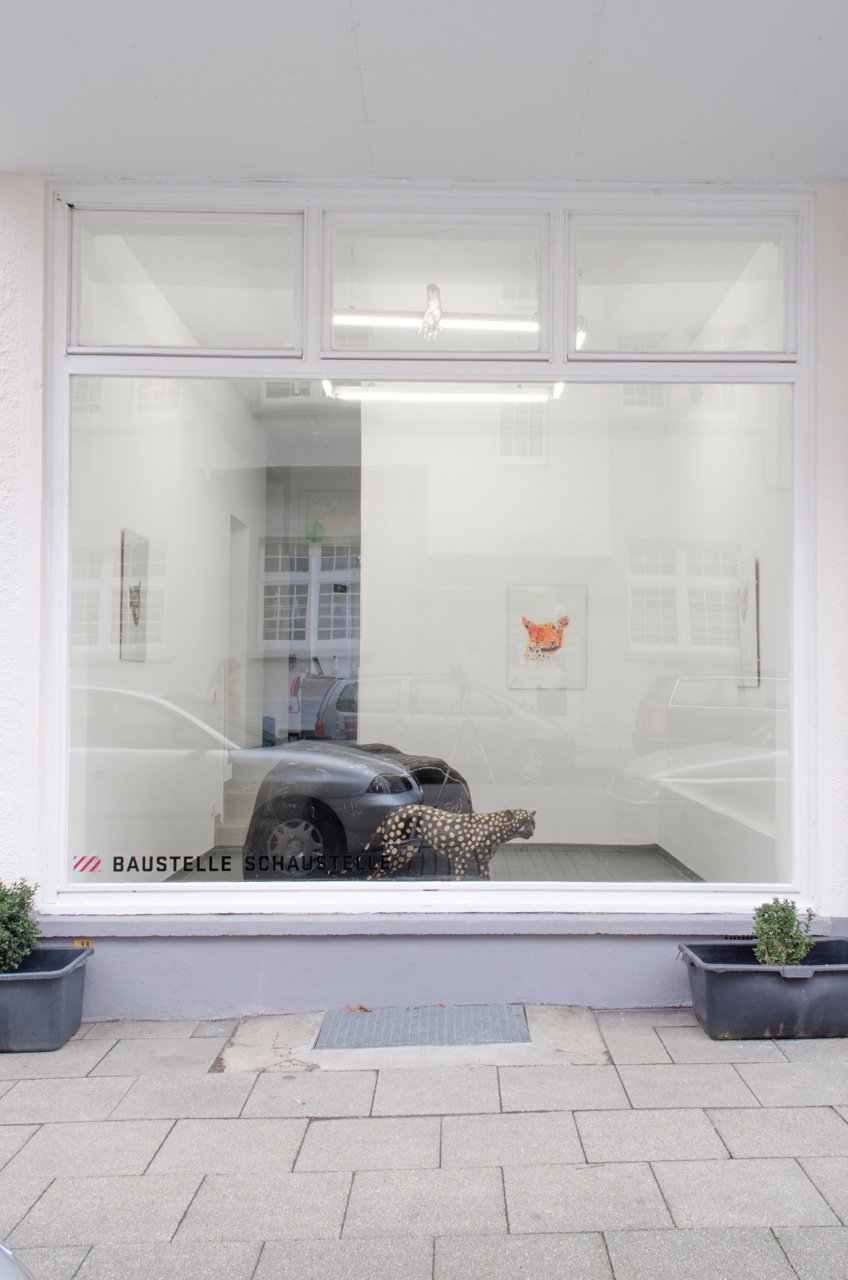
    Megan Rooney “Everything’s the same this is my dream” installation view at Baustelle Schaustelle. Image courtesy of Baustelle Schaustelle.

    Paul Kneale is an artist and writer based in London. Past work can be found here. Kneale’s upcoming shows and projects include Art Gallery of Ontario, GalleriesLafayette Paris, And/Or London. He co­runs Library+ project space and plays in the band TINA.

    1. Morag Keil, Potpourri at Cubitt Gallery, London
    Consisting of a single video that was also available online, positioning a visit to the space as nearly redundant. snippets of dialog from a celeb sex tape rehearsed in mundane settings who’s filming seemed alternately meticulous and distracted. HD/SD. Choices. A strobe light held on a moving motorcycle.  This video somehow unsettled me more than anything I’ve seen recently on /b/. The title ‘Potpourri’ recalling the proximity of media culture to scented toilets.

    2. Raymond Pettibon, Human Wave at SPACE, London
    In a year filled with vacuous formalism masquerading as network kitsch, this show of the artist’s lesser known videos was a breath of punk smog. The degraded quality of the VHS originals seemed to ridicule the current vogue for early digital crap as an after­effect. Kim and Thurston rating and smashing records. Quasi­religious ceremonies filled with howling. Perfectly installed with a collection of random office chairs as seating.

    3. Georgie Nettell at Project Native Informant, London
    A show that was aggressively indifferent to itself. Variations of serialised works, printed on canvass in colour schemes to match the galleries’ textures.  Sections of the drywall theatrically removed as if to say, ‘work is here’. Everywhere a palpable urge to go on. Nowhere any horizon to meet.

    4. Megan Rooney, Everything’s the same this is my dream at Baustelle Schaustelle, Essen
    The weirdest show I saw this year achieved an uneasy levity. A bronze cheetah borrowed from Europe’s largest brothel was both present and depicted in scores of tender watercolors. A wall text rendered in faux­ teenage girl handwriting described a moment in said club suspended between enlightenment and existential crisis. Plato’s cave redecorated.

    5. Bea Schlingellhof, Onaboat at AP News, Zurich
    The glass exterior walls of this shopping mall-­located gallery were covered by blue­washed posters emblazoned with ‘TOD’, German for death. Inside people smoked vigorously, pursued some racist books and watched a film on Jacques Cousteau. The artist produced a pointed discourse about gender and exploration that evaded localization in an object, or terra firma.

    I was once in a car crash. While foolishly attempting to cross two lanes of traffic to catch my exit, the rear end of my little two-seater got clipped by a truck, which sent me spinning nearly 360 degrees. Remarkably, my car suffered only a minor dent, but I was left with a sense of my own lightness, an awareness of my own fragility in relation to the fixity of inanimate objects. Judging by his recent show at Clifton Benevento gallery, it seems as if the artist Michael E. Smith is acutely sensitive to this issue of human weightlessness, as his sculptural installations combine manmade and organic materials in dark and humorous ways suggestive of mortality and transience.

    For his second show at this 6th floor SoHo gallery, Smith has once again removed all extraneous objects from the gallery space. Most notably, he cleared out the floor to ceiling bookshelves that cover a corner of the gallery. While the artist placed a handful of objects on the shelves, he left most of them vacant, turning the segmented shelves into a sculptural element in their own right. Located smack in the middle of the shelving unit is the center console from a Chrysler Town and Country minivan, a vaguely familiar hunk of plastic that teeters over the edge of the windowsill upon which it rests. This enigmatic object is both more and less fixed in space than it appears: safely mounted upon an invisible ball bearing device, visitors are invited to nudge the untitled sculpture so that it spins smoothly in place, playfully evoking the horrific experience of being in a car that is spinning out of control.

    This mixture of whimsy and morbidity characterizes the show as a whole. For instance, for the dual sculptures titled LBS and RBI (as in “left brain side” and “right brain side”) Smith sawed two MacBook computers in half and placed them next to one another on one of the shelves. He also sawed perfectly circular holes into the laptops’ touch pads, and filled the holes with circular chunks of human skull, (a material which can be purchased both for research and for artistic purposes, apparently).

    Ostensibly, Smith emptied out the bookshelves to prevent art history from breathing down his neck, but in actuality, I believe he did it to lend his delicate sculptures the appearance of increased weight.  Who among us, after all, can resist the zen-like vacuity of an empty gallery, that curious space which elevates its sparse contents to the status of something special, something capable of transcending the daily grind? Although Smith is certainly capitalizing upon the sanctifying power of the white cube, the thoughtful ways in which he engages with the space serve to remind us that the gallery is a lived-in place where humans act out both their most lofty ambitions and their most profane functions.

    In an untitled installation in the gallery bathroom, Smith carefully placed half a dozen metal tubes in a row on the edge of the bathtub. The multicolored tubes are in fact handsaws with the blades removed, and the saws themselves have been sawed at different points and placed in order of descending length. The fact that they are placed on the edge of the bathtub evokes the precariousness of the Chrysler console in the main room, and it also draws attention to the fact that there is a bathtub in the bathroom. We are reminded that this place was once an apartment, a place where people used to live, and a place where people still live and work to this day.

    The tension between the sacred and the profane, as well as the tension between life and its opposite, is further engaged in the sculpture Mike (all works in the show were created in 2013, and while Smith usually leaves his works untitled, he indulged in titling quite a few of them this time). Although you would never guess it just by looking at the sculpture, Mike makes reference to “Mike the Headless Chicken,” a chicken that survived for 18 months after its head was cut off in 1945  (the farmer who did the beheading kept the chicken alive by feeding it milk through an eye dropper). For the sculpture Mike, Michael Smith sawed a mannequin’s head in half and affixed a headless rooster pelt to each side of the plastic “skull”. The morbidity of this gesture is undercut by the sculpture’s placement on the floor, where it functions as a doorstop just within the entrance to the gallery.

    Bird parts appear elsewhere in the show: five chicken pelts have been coated with black rubber and affixed to a medium sized canvas that has been hung up near the ceiling in the far corner of the gallery. Two ostrich eggs sit on one of the shelves across the room; one of them has a hole in it, which makes them look a little bit like a pair of eyes staring up at the chicken painting in the corner. Clearly Smith has a knack for tying together materials and themes, such that the show functions more like a cohesive installation than a collection of discreet works. It should be noted that the relative emptiness of the gallery space, and the semantic games taking place therein, are particularly liable to annoy those who don’t take pleasure in contemporary art. That’s why I don’t buy the line about banishing art history from the gallery: clearly, you need to appreciate a good ready-made in order to enjoy this show. However, for those of you who have a taste for that sort of thing, the work of Michael E. Smith is guaranteed to leave you grinning.

    By David A. Willis

    Image courtesy of the artist.

    Image courtesy of the artist.

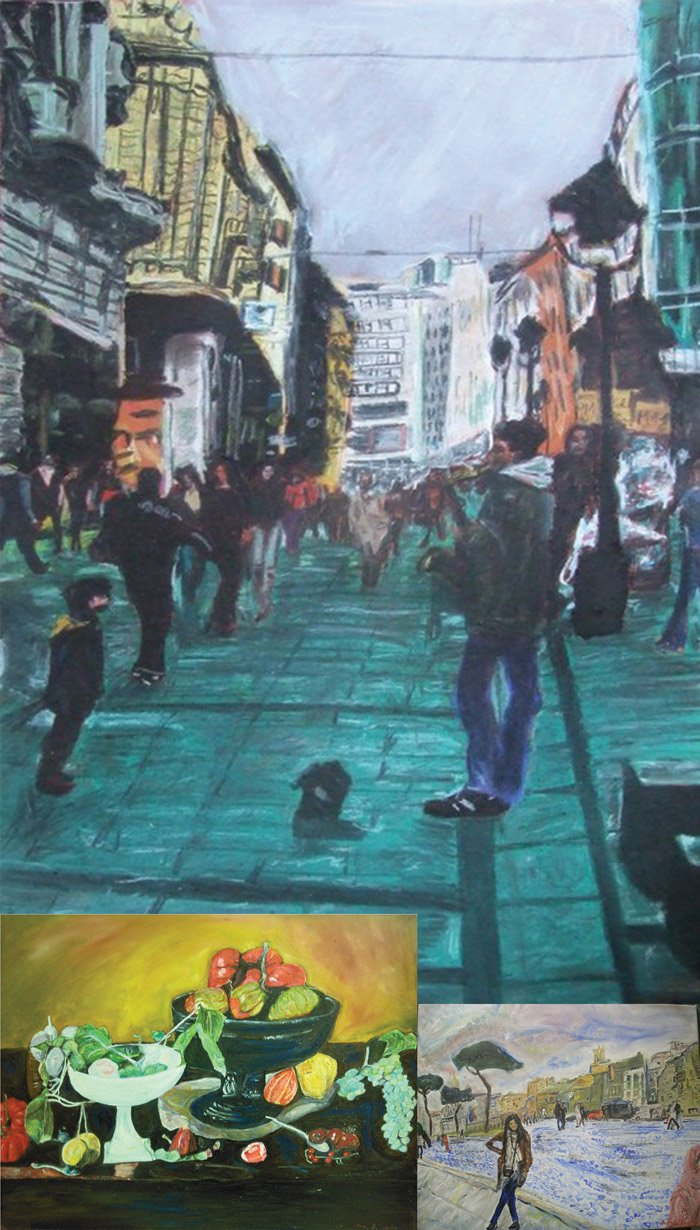
    In life, when you do art it’s hard to feel what it starts. Art becomes an inseparable part of my life. Sometimes it seems as if the brush has become part of the body. Inspiration is a giant compared to anything else, and somehow what it boils down to is that I’m looking for that giant. Detecting emotional stimulation is the goal, and opinions of the others are important also.

    My professor Dr. Sasa Filipovic attributed to my artistic expression a manifesto of modern expressionism, it is a segregation of the best from the new and the traditional.

    artbreak.com


    sur-real

    Image courtesy of Woodward Gallery

    Featuring: Jean-Michel Basquiat, Thomas Buildmore, Deborah Claxton, Sybil Gibson, Richard Hambleton, Kosbe, David Larson, Mark Mastroianni, Margaret Morrison, NoseGo, Kenji Nakayama, Dennis Oppenheim, Robert Rauschenberg, James Rosenquist, stikman, Jeremy Szopinski, Francesco Tumbiolo, Jo Ellen Van Ouwerkerk, Cristina Vergano, Kurt Vonnegut Jr. and Andy Warhol

    Sur-Real
    January 4 – February 22, 2014
    Woodward Gallery
    133 Eldridge Street
    New York City
    woodwardgallery.net

    Before-the-past-tense_low

    Image courtesy of Munch Gallery

    Featuring: Allan Bestle, Kaspar Bonnén, Rasmus Bregnhøi, Troels Carlsen, Jacob Dahlstrup, Cathrine Raben Davidsen, Christina Hamre, Jan S. Hansen, Ida Kvetny, Anika Lori, Frodo Mikkelsen, Mie Mørkebjerg, Dorte Naomi, Julie Nord, Fie Norsker, Lars Nørgård, Michael Rytz, Anne Sofie Sandal, Jakob Tolstrup, Kathrine Ærtebjerg

    Paper
    January 8 – February 2, 2014
    Munch Gallery
    245 Broome Street
    New York City
    munchgallery.com

    Volta

    VOLTA NY 2014
    An invitational solo project fair for contemporary art.
    March 6 – 9, 2014
    82MERCER
    New York City
    ny.voltashow.com

    I’ve not been to a wax museum but I can imagine the Frankenstein on display might look something like Corpus Americus, the new group exhibition at Driscoll Babcock. Then again, the better analogy might be in the source material itself, in Shelly’s nameless creature who to this day stalks the starless wilds of our imaginations. For beneath the patchwork of skins stitched loosely into an ungainly whole, there is indeed something alive at the heart of Corpus Americus.

    The animating strike is the question, “what does it mean to be an American today,” an idea that resides as much in abstract notions of America as in a chimeric Americana, in those fabled high periods of yore. America today is a country far downwind from those onetime peaks, and in the lowlands things have begun to smell a bit foul. The stench no doubt lifts from the Corpse Politicus, our national institution that’s been so supremely bungled by the very leaders we entrusted with its care.

    It should be noted, if we are to ground this exhibition in the current moment, that America is a nation assuredly polarized, and the rift is unflaggingly wrenched wide by “representatives” who insist on dividing our national oneness into a sumless, disunioned bunch. A fragmented citizenry makes for easy pickings, and in a few short decades our elected leaders have stripped the communal landscape bare, colluding with their corporate consorts in defunding or outright dismantling the social and cultural fabric that at one time wove this nation into a believable fiction. At hand now is nothing short of a masturbatory farce, and it is the Americans—the noble subjects of this show—who must suffer through the requisite, never-ending cum shot.

    The new divide manages to make everyday acts of being as much political as they are inherently personal. To be gay in America, immigrant, pregnant, jobless, uneducated, uninsured, hungry, without heat; all speak to a political beyond the personal. Further pushing our private selves into the political sphere is the fact that we as citizens are now routinely surveilled: our phone calls, emails, online searches, purchases, our point-by-point movements throughout the day. All of which makes us, whether we like it or not, political beings who possess a certain anxiety-producing potential, a truth that terrorizes our government enough to warrant an obsessive homeland reconnaissance.

    The press release for Corpus Americus acknowledges these tensions in citing Habeas Corpus as derivation for the exhibition’s title. Translating as “you shall have the body,” Habeas Corpus, the release states, “is an important, often-manipulated legal instrument safeguarding individual freedom from arbitrary state action.” The theme, then, offers a rich platform for raw, unchecked expression and, one would’ve hoped, fearless interpretations of what it means to be an American today.

    So it is curious how tepid some of the works in this exhibition are, or how unspecific they are to any experience uniquely American. From another angle, namely curatorial, I puzzle at an allowance for artwork that fails to explore the implicit tensions in the show’s title and explicitly addressed in its stated theme. Certainly some do, but easily a third of the works do not. For instance, how does Margaret Bowland’s The Tea Party, a well-crafted painting of two children lazing in their party dresses amongst fine linens and a goose, articulate a “distinctly American” experience? The goose brings me straight to Europe, but that might be my own skewed reference points. Instead, I’ll drop my focus to the lower registers of the painting where an oily-milky substance pours down from on high and splashes in at the girls’ bottoms. Are we to infer something American in this? Might there be some veiled environmental commentary about, say, how current practices in the oil and agricultural industries are dirtying or endangering our children? Perhaps, but then the girls in the painting remain perfectly untouched. More specific to the curator’s own citation of Habeas Corpus, one has to wonder how The Tea Party is anywhere in the same universe as “safeguarding individual freedom from arbitrary state action”?

    The same questions arise when looking at Simon Leigh’s Cowrie #82, a glazed stoneware representation of, well, a cowrie. The piece feels so oddly out of context in an exhibition attempting to explore meaning in being a citizen of this land that it demands your full and considered attention for no other reason but to understand its placing. What is it about a sea shell, this sea shell, that speaks to the American experience? I walked away clueless.

    Still, there are a handful of strong representations in this intimate, twelve-piece show. The standout is Doron Langberg’s On All Fours #3, a work of brute eloquence that communicates the full poundage of what it means to be an American in the first decades of the 21st Century. The painting sits just on the representational side of abstraction, an ambiguous medial that in itself speaks starkly to a now generalized American experience–that of alienation, isolation and despair, of feeling unseen, unrepresented, and permanently on the out. The figure in the painting is a muddied totality of it all and his body no longer bears the weight. He is fallen to such an extent that it implicates each one of us, while as a society we are all the more culpable for allowing such wholesale slippage to occur in our midst. Few amongst us would note this one’s plight for he is so far sunken, more of soil than flesh, a mere mound of ochres and raw umbers that hint only minimally at a presence. While the forces dragging him low seem nearly gravitational, as if from the inward collapse of some existential black hole, what keeps him there is the crushing tide of the world around him which crashes-in at his back in broad and abrupt strokes of blue. America is not one for lifting its fallen, preferring they languish for the long, slow fade; on his own, the figure in On All Fours #3 will not be standing anytime soon.

    A small delight in the exhibition is Mario Moore’s, Grisaille of Oshun.  Stylistically simple, with a palette straying little beyond the primaries, the painting is a gracefully understated study of an individual who is unmistakably American because she is so fiercely individual. Moore taps squarely into forces of womanhood that find equivalence in such natural phenomena as typhoons or earth-rending quakes. His heroine is all soldier, a panther in spirit who will tear the flesh from any fool who attempts a cross or any system that conspires to marginalize or estrange. It would be our error to believe she’s a sheltered thing come of age through shaded narrows of innocence, as might be inferred from the cover of an early issue of Jet magazine at her feet. In its early years, Jet—belying their wholesome covers—steadily chronicled the grueling, often murderous struggle for civil rights. At the same time, the magazine offered a crucial, unchallenged voice to the nation-shaking ideologies of that movement’s towering leaders. Perhaps more relevant to the heroine of Grisaille of Oshun, Jet would later give prominent coverage to feminist/Black activist warriors such as Angela Davis and Kathleen Cleaver. We’d be wiser, then, to assume the magazine at her feet is but one in a lineage of teachers in the art of war. Yet though her fist lies like a hammer at the ready, what allows her to lift into the highest representation of an American in this show is how open and easy she is, how ready to nurture and warm all who enter her care. To that end, she is as much an American archetype as a Woman for the ages.

    By Christopher Hassett


    News | Exhibitions