
Image courtesy of Feature Inc.
Todd Chilton
January 11 – February 16 2014
Feature Inc.
131 Allen Street
New York City
featureinc.com




Image courtesy of Feature Inc.
Todd Chilton
January 11 – February 16 2014
Feature Inc.
131 Allen Street
New York City
featureinc.com
Russell Tyler’s Solo show at DCKT in the LES returns back in the direction of bad painting but stops midway at a comfortable apex. He has come a long way since I first saw his work at Freight and Volume in 2010. I remember clearly thinking about Kim Dorland when I saw Tyler’s paintings at that time. Now a whole four years later, the work has chilled out. In the last year he has been making thickly painted geometric gradient paintings. In contrast with recent work I’ve seen at Brian Morris and Denny Gallery, the paintings at DCKT are refreshingly more “off” and harder to look at—yes, this is good.
The five largest paintings on the South wall of the gallery do read like screens as explained in the press release, “influenced by crude digital landscapes of outdated 8-bit graphics”. The thick paint and occasional drips echo the grittiness of early Technicolor animation. The gradients are reminiscent of early computer generated advertisements and early arcade game backgrounds. But I also think about old Japanese prints or the rainbow rolls of 1960’s/70’s rock posters.
The reductive compositions do remain graph-like but are not so considered. They avoid a lean towards early modernists like Kandinsky or Mondrian, No Golden Ratios make an appearance here. The paintings hover somewhere between graphic color charts and actual thought-out pictures. I do not imagine Russell in his studio staring at this work thoughtfully, or calculating color theory, conceptual, or even emotional content. This attitude matches Russell’s sincere, yet not pretentious personality. He’s no Albers and no Picasso—and I’m glad.
Despite what it says in the DCKT press release about his influence of the screen and early Sci-Fi films, he makes the paintings for themselves—they reference themselves, and I think more about how they relate to his older body of work than any conceptual framework or nod to pop or art history. These are paintings made by a painter who knows how to make a bad painting. And he probably knows how to make a good painting too (I’m talking about formulas). This new work is neither trying too hard or too little. A middle ground rarely tread upon these days. I feel like most shows I see are either heavy-handed new casualist or over-produced craft fairs/flea markets. But Tyler’s new paintings are at a mature point, curbed back from the cusp of beautiful, while not sunken into a shit-show of muddiness.
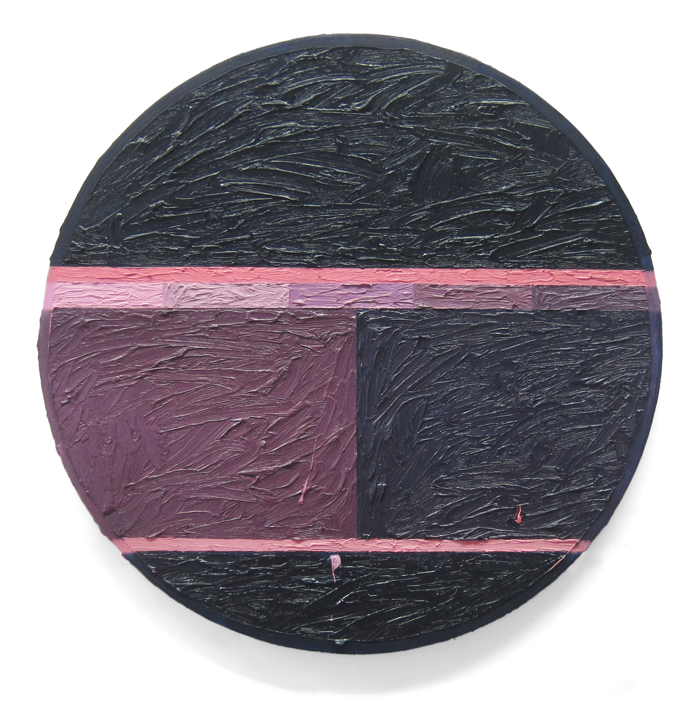
Russell Tyler, EVA-POD, 2013. Oil on wood panel. 26 in. diameter. Image courtesy of the artist.
Most of the time when you see an artist’s body of work or even more than one painting together you began to see relationships and hear conversations between the works. That is hard to do with Tyler’s paintings—maybe because the imagery is simple and similar, but also because the designs are soft and ambiguous. They are open-ended, acting like backdrops, jumping off points or fading dreamscapes. He makes the paintings bright yet muted, geometric yet sloppy. This seeming confliction allows one to read each painting individually, even when they are in a large group and in close proximity to each other. The paintings need to be seen in person—like a Brice Marden or a Julie Torres.
The paint is thick, and vivid, and lush—probably not yet dry. The works smell like oil paint but I still see and read them like graphic, flat compositions. All these other elements are there but don’t get in the way of the literal or implied image. Tyler still retains the remnants of his older style of messy, bad painting. All the paintings at DCKT except the tondo works have double line borders made by squeezing paint directly out of the tube. He does not use this technique as a statement of immediacy. The painted borders act like modernist frames.
Since the entire surface is thick paint brushed on like cake frosting, we see the final image as a field. When one mutation multiplies and becomes dominant, then it becomes the norm. Russell Tyler fills his paintings with flatness.
By Mark Sengbusch
With The Painter and the Deliveryman Rosalind Nashashibi offers a play on motifs, causality and narrative. Arriving at Objectif Exhibitions in Antwerp, the visitor is greeted by the emptiness of the ground floor gallery, a spacious white-walled and concrete-floored contemporary art space with large windows overlooking a small courtyard. The two 16mm films that give the exhibition its title are projected on loop in HD video in the basement, where they alternate next to one another in a clever and simple right angle set-up.
It must have been pure coincidence that I saw The Painter first, followed by The Deliveryman (both 2013). As causality remains an a priori faculty of our mind (for those who care, there is some Kant to be consulted here), and as video can be seen as the medium par excellence to play with causality (Fischli/Weiss’ iconic Der Lauf der Dinge being perhaps the best example of this), it seems only right to assume the arbitrary order in which the viewer finds the videos is deliberately left to play out with each visitor anew.
The Painter shows us a woman absorbed in the rather brutal process of applying paint on a large stretched canvas using an oversized mop, her brush strokes swooshing like relentless waves hitting the shore. Using a cleaning device, the painter ironically smudges and stains nearly every surface she encounters, including her own clothing. Both canvases end up as gray-white-beige non-paintings, the kind of which relatives we are ashamed of would say: “my 6-year old daughter makes better art that this.” And behold, a jump cut offers us the sight of a child’s drawing hanging on the painter’s studio wall: a horse carrying a little girl on its back and leaving behind a trail of manure.
The painter, Renée Levi, is a real-life artist, and Nashashibi’s invasion of her studio evokes those documentaries on the life and work of artists made in the mid-twentieth century, when it was still okay to think of the artist as a solitary genius. Or when it was miraculous to see Picasso draw a charcoal dove on a piece of white paper in The Mystery of Picasso (1956, Henri-Georges Clouzot). The idea that we could learn about art through close observation of the way it is made seems rather naïve amid today’s post-studio practices. Yet Nashashibi pointed her camera at this very classic trajectory where art takes place: on the axis between production and reception.
The Deliveryman shows a package being delivered at Objectif Exhibitions, upstairs, in the office. The package delivered could be one of the paintings, unstretched and folded for transport, although nothing indicates The Painter was shot prior to The Deliveryman. And besides, the enigmatic package is never opened, and as the title points out, the focus lies on the DHL deliveryman, not the delivered goods. Or is it? With the formalities of handing over the package out of the way, the deliveryman finds himself in need of relief, and delivers a generous quantity of liquid discharge in a corner of the courtyard. In a striking Jeff Wall-esque tableau we see on the one side the aforementioned art administrator—played by Objectif Exhibitions director Chris Fitzpatrick—sitting at his desk, while on the other side of the shot, divided by a wall and conveniently blinded windows, the deliveryman is having a long and clandestine wee. Nashashibi ends this little tranche de vie with a well-framed close up of the wetted bricks and pavement, silent and ephemeral witnesses of the conducted misdemeanor.
In the most simple yet poignant way, having climbed the stairs back up to the ground floor, the visitor is confronted with the almost exact same view as the tableau just described. Although the audience has passed through this space before, upon return they are faced with the set of one of the videos just seen. And indeed, that guy who signed the DHL form is sitting at that same desk. Is this a performance? Surely many visitors are tempted to investigate the courtyard for traces of the deliveryman’s urinal transgression.
Is Nashashibi taking the piss out of us? Isn’t it all on the verge of not meaning anything at all? Or is it all too much of a self-indulgent portrait of the art world, scatology from studio to exhibition hall? The open-endedness saves it. The making of the paintings, the delivery of both package and pee: it all passes through human hands. The same goes for the child’s drawing and the signature of the arts administrator on the DHL form. The indexicality of these acts points towards the other end of the camera, where a non-fictional artist and curator plotted these two videos featuring their own alter egos. Although both videos would work in other settings as well, as a duo they surmount their own inherent narrative and visual quality by their ingenious installation. This smart and playful contemplation on the tension between sites of production and presentation is present twice, simultaneously enforcing and short-circuiting itself: it is felt in the pairing of The Painter and The Deliveryman, as well as in the spatial experience so subtly imposed on each visitor.
By Samuel Saelemakers
1. Larry Bamburg, BurlsHoovesandShells at Simone Subal Gallery, New York
Jerry-rigged ecosystems, towers constructed from bones and gold, and artificial earth compositions made for, hands down, one of the most profoundly perplexing shows in recent memory (at one of the most consistently superb galleries in New York).
2. Carol Bove, RA, or Why is an orange like a bell? at Maccarone, New York
Nobody combines smart and sexy better than Ms. Bove, and this is arguably her smartest and sexiest affair yet, continuing on with her rigorously researched explorations into ascetic aesthetics.
3. Elizabeth Jaeger, Music Stand at Eli Ping, New York
A nude woman with a devilishly delightful look on her face, straddling a suited man with her hand caught mid-caress on his face, provided a subtle subversion of power in the intimate Lower East Side basement gallery this past summer; oh, and there was a saxophonist playing every Sunday afternoon during its run.
4. Jamian Juliano-Villani, Me, Myself, and Jah at Rawson Projects, New York
After creating substantial buzz at this past spring’s otherwise generally confused NADA fair in New York, this little firecracker could be seen everywhere throughout the boroughs and on the Internet, and this Brooklyn gallery made a wise move by opening the fall season with her, as she is rapidly asserting herself as a demented voice to be reckoned with.
5. Paul McCarthy: White Snow at The Park Avenue Armory, New York
Rarely has commentary been so abundant amidst a viewer’s navigation throughout an exhibition—comments of amusement and disgust echoed within the Upper East Side’s cavernous space—and for good reason; this modern pop-fused Bacchanalia completely transformed the public’s idea of what an art show truly can be.
See top 5’s from other NY Arts contributors here.
Coil is Performance Space 122’s annual winter performance festival showing remarkable contemporary performance from local, national and global artists. Full of textured, contemplative, grounded, rigorous, and always very live performance.
Featuring:
Reid Farrington
Tyson Vs. Ali World Premiere
Theater 3-Legged Dog Production
Commissioned By Ps122, Co-Presented With 3-Legged Dog
January 3 – 25 (Extended)
Mac Wellman
Muazzez New York Premiere
Theater Co-Presented With The Chocolate Factory
January 7 – 17
Heather Kravas
A Quartet New York Premiere
Dance Commissioned By Ps122
Co-Presented With The Kitchen
January 8 – 13
An Evening With William Shatner
Asterisk New York Premiere
Theater, New Media Co-Presented With New Ohio Theatre
January 9 – 12
Tina Satter
House Of Dance Theater Commissioned By Ps122
Co-Presented With New York City Players & American Realness
January 9 – 13
Catch ! Catch 60: Catch Takes The Decade
10th Anniversary Multi-Disciplinary
Theater, Dance, Performance Co-Presented With The Invisible Dog Art Center
Performance Space 122
150 First Avenue
New York City
ps122.org
Marina Abramovic, Yugoslavian performance artist famous for her long durational works once said, “The only last thing an artist can control—his own funeral.” She in fact wrote her last will and testament in which she wants three coffins to be buried in three different countries, and her memorial ceremony to be a celebration of life and death combined.
Marina’s desire to rehearse her own funeral was not unexpected. However, it probably took some guts from Abramovic, whose performances deal with real time and space to give full control of re-envisioning her life to Robert Wilson, whose works are famously abstract. When about a month ago I asked Marina about her work with Mr. Wilson, she told me about her initial shock when Wilson announced she will be playing the role of her own mother…
Entering the 55000-square-foot Drill Hall of the Park Avenue Armory, to view the production of “Life and Death of Marina Abramovic,” the audience first faced a massive construction that later revealed itself to be a specially installed stage. On each seat there was a newspaper announcing that “Artist Marina Abramovic dies at 67.” On stage there were three white angular coffins and three bodies each with masks all resembling Marina.
Where do you begin when making a piece of biographical theater? Robert Wilson certainly didn’t follow any chronological order in the life of his subject. He bombarded the audience with visually surreal, fragmentally structured scenes that were rather reminiscent of paintings. Meanwhile Willem Dafoe, the narrator, was chaotically pronouncing the dates and facts from Marina’s life, bursting, giggling, whispering, and rolling his sounds. Dafoe was like a mad scientist dissecting and examining all the emotional and painful stories that make up the artist Marina Abramovic. “The story of the washing machine,” “The ashtray,” “The story of the shoe polish,” “The story of the Russian roulette”—all the absurdist suffering and black Slavic humor becomes so tragic in this staging that you almost have to laugh.
Directed and designed by Robert Wilson, the whole piece was like a puzzle of abstract visual and sound elements with, of course, endless light cues. Traditional Serbian music by Svetlana Spajic was interwoven with the emotional performance of Antony from Antony and the Johnsons, who wrote several compositions for the production. Excerpts of original works of Amanda Koogan’s “Yellow” and “Medea” as well as Kira O’Reilley’s “Stair falling” were also organically incorporated into what turned out to be something of a quasi-opera. It seemed that each character, each element in the visionary staging of Robert Wilson, spoke its own personal story yet being a metaphor to the life of Abramovic. Marina’s acting, on the other hand, was awkward, but beautifully so. She seemed to be in constant need of “reality” in order to feel in sync with everything on stage, and yet she was the furthest from it. In the end, all the pieces came together.
In the closing scene, Wilson brought us back to the funeral. While Antony was singing “Volcano of snow”—an overall transcending experience—Marina Abramovic was elevated on the ropes suggesting ascension of the spirit…
What were you thinking about, Marina, levitating above us?
By Masha Froliak
Leah Oates: You are one of the creators and founders of Curate NYC. How did the idea for Curate NYC take shape and how do you envision Curate NYC growing in the future?
Danny Simmons Jr.: Curate NYC took shape when Brian Tate my partner and fellow founder of Curate NYC saw a request for proposals from the Economic Development Corporation. We were in the car on a comic book run and he brought the notice to my attention. We pulled over and began bouncing ideas off each other until we decided on a direction to take in our response. Over the next week or so we continued to refine the idea until we felt it was ready for submission.
As for where this is going we have several ideas that we are kicking around. A few of them include expanding Curate NYC to other states and other national and international cities. We aim to curate the world (laughs). Other ideas include deeper penetration into particular areas of the city involving nontraditional art spaces such as stores and restaurants. The goal is always to include more artists and art professionals and create greater economic opportunity and exposure for artists.
LO: Please speak about your life in the arts and why you think art is important.
DSJ: My life is fully emerged and integrated in the arts as I’m a working painter and writer, a collector, a curator, a gallery owner, have an arts foundation that serves adult artists and employees artists to work with children in NYC schools and the two galleries I run. I sit and have sat on many arts and culture boards of directors and have served as chairman of New York States Art Council. The arts are my life and one which is supremely satisfying.
The importance of the arts in everyone’s and especially children’s lives is incalculable. It feeds the spirit and fuels the imagination, it brings people together and promotes diversity, commonality and dialogue. Creating and viewing art in any form is soul satisfying. It is also a great source of economic activity for local and national economies providing thousands of jobs and billions in tax revenue for New York City alone.
LO: Do you think there is a difference or connection between making art and curating?
DSJ: Not all artists are curators or curators are artists. In order for an artist to be a curator one has to detach from a bias for work similar to ones own and understand the merits of styles and content of other artistic visions. Thats not always an easy task. The connection is an overall love for art. Both curators and practicing artists must bring a love for the arts when doing either.
LO: How where artist selected for Curate NYC?
DS: Curate NYC is an open call to join in the project which means any artist with a NYC studio or home address is eligable to participate. All an artist has to do is provide proof of NYC residence and upload an image of their work and biographical information and bang your apart of curatenyc.
LO: Curate NYC organized exhibitions in all five boroughs. How are the various art scenes in boroughs the same and/or different?
DSJ: I find that each borough has a different artistic identity as far as density of exhibition spaces and artists. The public is more accustomed to finding art in Manhattan than the other boroughs but as artists expand living throughout the city so do the amount of venues that show their work and the nature of the other businesses that support artists increase ie art stores coffee shops clubs music venues etc.
LO: What kind of advice would you give artists who want to show their work in NYC galleries, museums etc.
DSJ: My advice to artists is mingle and go to shows to meet other artists. Join CurateNYC and go to galleries to talk about your work. Get out there and let folks know what your doing.
The New York art scene is very varied and lively with many interesting shows and events going on but it can also be commercial and market driven. What are your thoughts on the art scene in NYC?
The art scene in NYC is the liveliest in the world but there are other markets that are very important. Africa, Asia, Europe and other cities in the USA. The art market is fast becoming a global one. CurateNYC recognizes this trend and has engaged curators from around the globe to help market NYC artists.
LO: Who are your favorite artists and why?
DSJ: My favorite artists today are too varied to mention but from modern art history…Paul Klee, Cy Twombly, Norman Lewis, Wifredo Lam, Romare Bearden , Jean Michel Basguait , Andy Warhol, Ed Clark , Picasso, and the list goes on and on and on.
LO: To wrap up please share any upcoming shows and/or projects or shows.
DSJ: I have a newbook of poetry and painting coming spring 2014 as well as several exhibits around the country. An exhibition on abstraction I’m curating in three NYC galleries. I will be at Art Basel Miami and I have many day to day art activites and of course CuratenNYC 2014 and its new surprises.
On a cold and busy post-holiday season night in which we turn around looking for a friendly face, or for a sign of humanity in this high-techno dehumanized big-city flow…I’m closing my eyes and opening my ears to Gabriela Arnon’s sounds coming from her third, newly released album “Pyramid Lake”.
This extraordinary singer, songwriter and a pianist who grew up in Manhattan under the auspices of the Off-Off-Off Broadway Theatre scene of the 1970s had studied classical music and jazz before she became a world globe-trotter and toured the Americas with salsa giants such as Willie Colon and Ruben Blades only to continue her exploration of sound with Christoph Mueller (of Gotan Project) in Paris. She not only formed with him a nomadic trip-hop-art-rock band (Ten Mother Tongues) which resulted in their CD “The Listening Tree” but also decided to stay in Europe, endowing the local sound with her acoustic , American experience, rich in warm, personal musings. Soon after,she formed her trio with a songwriter/singer HT Roberts and a percussionist Niels Delvaux (with De Maeseneer on saxes and Bart Maris on trumpet) , an unusual experience which combines acoustic and organic sounds, as exemplified on her second album “Trouble With Park Avenue”.
Her third, wildly contemplative cum romantic work, “Pyramid Lake” summarizes, in a way, all her previous experience and yet its freshness and “innocence regained” in the most spiritual sense of that expression attest to a new turning in Arnon’s career. What to say about someone who has successfully collaborated on various levels with the artists such as Paul Aston, Karel Beer, La Bergère, Sal Bernardi, Ruben Blades, Chochana Boukhobza, Thierry Bouyer, Soledad Bravo, Rodolph Burger, Roberto Cacciapaglia, Ronnie Caryl, Matthias Clark, Philippe Cohen-Solal, BJ Cole, Willie Colon, Djelly Moussa Condé, Lemmy Constantine, Brian Cullman, Niels Delvaux, Janice De Rosa, Diblo Dibala, Fima Ephron, The Five O’Clock Jazz group, Stephane Furic, Peter Giron, John Greaves, Stéphane Guéry, Theo Hakola, Gijs Hollebosch, Marten Ingle, Nick Jury, John Lester, Tony Leone, Gary Lukas, Luis Marquez, Fiona McBain, Danny Montgomery, Christoph H. Mueller, Stéphane Missri, Tiberio Nascimiento, Glen Patscha, Renaud Gabriel Pion, Vic Pitts, Laurence Revey, HT Roberts, Barry Rogers, Roland Romanelli, Julie Saury, Tonton Didou, Nibs Van Der Spuy, Arne Van Dongen, Jasmine Vegas, Geraint Watkins, Ben Werbolowski, George Wolfhaardt, Gabriel Yacoub, Catherine Zeeta-Jones..? Useless to keep on counting all the precious encounters in a life of an accomplished musician…
However, it’s worth noticing that all Arnon’s different sounds resulting from these eclectic and highly professional experiences with other artists magically fuse into the melancholic staccato of her “Pyramid Lake”. Gabriela is an ecological fighter who would like to preserve the Earth intact (hear her Persephone’s Field or The Seed) and she sings our worries for the disappearing water quite loud. She is also a Calypso queen who dances her salsa vocally in “Queen of the May”, or an African shamanic healer-woman who drones away our destiny in “Maiden, Mother, Crone”.
The expressionist strain in Arnon’s musical upbringing will bring us eventually to a profound sigh and yearning for the infinite in her last track, no.11, entitled “Far Beyond Our Little Gallaxy”. In that privileged space, reserved for very few contemporary artists /composers who have had a long career and who create that particular musical experience which makes us think that “all the rest is noise”, dwells the creative effort of “Pyramid Lake”. It is fresh, and easy, but it moves us- to think: about the world as an inner but also a committed and outer experience, difficult to pass by. Yes, Gabriela Arnon is on the path of Baez and Zara Leander .. and her claim to fame is yet to be made in the years to come.
By Nina Zivancevic

Image courtesy of the artist
Art is not a choice; it has always been an obsession for me. I have always had to find an outlet by painting in some form or another, whether large scale abstractions , portraits or a combination of the two. I turned to portraiture when my children were small, realizing I could not meet commercial art deadlines or focus on creating large paintings. I still like to infuse realistic imagery with abstract shapes that just evolve.

Image courtesy of the artist.
In the early 2000’s, after receiving a BFA in Drawing from ACAD, Jeff Tallon lived throughout Canada, Europe and Asia. These experiences inform the global yet local nature of his work and question nationalism, truth, identity, commerce, consumerism and communication.
Since 2009, Tallon has been synthesizing painting and technology. Some of his paintings include QR Codes, which allow viewers to capture content using a hand-held device.
Tallon’s initial interactive paintings sent text messages to participants creating a sense of faux-intimacy. Subsequently, the breadth of his work has grown to unite photography, oil paint, text, audio/video and the Internet.











