• yason-banal-bankers-banquette

    Featuring: Alfredo and Isabel Aquilizan, Yason Banal, Gaston Damag, Roberto Feleo, Riel Hilario, Kat Medina, Lilibeth Cuenca Rasmussen, John Frank Sabado, Mark Salvatus

    Group 5: Powers That Be
    January 10 – February 16, 2014
    The Drawing Room
    Blk 5 Lock Road
    Singapore
    drawingroomgallery.com

    Stephen Knudsen is an artist and professor of painting at Savannah College of Art and Design. He is the senior editor of ARTPULSE Magazine, a contributing writer to the Huffington Post, NY Arts Magazine, and Hyperallergic. He is the senior editor of the anthology the Art of Critique, forthcoming in 2014. Here are his selections from 2013:

    1. Eija-Liisa Ahtila: Olentoja (Creatures) at the Davis Museum at Wellesley College, MA
    Finnish artist Eija-Liisa Ahtila has been a figure in the vanguard movement re-imagining film art into multiple screen pieces with cinematic production values. This exhibition of her key works includes House (2002), one of the best pieces in the movement. This work demonstrates that beauty and transcendence does not have to be put into the satirical air quotes of postmodernism to be critically and aesthetically relevant.

    2. Nicole Eisenman’s work in the Carnegie International Exhibition, Carnegie Museum, Pittsburgh
    The highlight of this well- conceived iteration of the Carnegie International is Nicole Eisenman’s survey of work up to 2011. She was the winner of this year’s Carnegie Prize. Included works like The Sunday Night Dinner have placed Eisenman as one of the most important 21st century painter who cast back to the roots of expressionism without evoking the weaknesses of 1980’s Neo-expressionism.

    3. Laura McPhee: River of No Return at Kemper Contemporary Museum of ART, Kansas City
    Laura McPhee is a final holdout in the line of great large format photographers using the 8 by 10 camera and pulling prints with traditional chromogenic chemistry. The show’s twenty-three mural sized ( 6 by 8 feet)chromogenic prints were photographed over several years in the ranch land and wilderness of central Idaho. An exceptional inclusion, Mattie with a Northern Red-Shafted Flicker, is a fresh and relevant iconic image that is resolute and easy to love, even without backstory.

    4. The Gallery Booth for La Central Gallery, Bogota, Columbia at Miami Beach Art Basel, Miami
    The La Central gallery dedicated all of its Art Basel space to Nicolas Consuegra’s 15 channel video installation that to my eyes was the best extended cinema piece in Art Basel ( and the satellite fairs) this year. The Water that you Touch is the Last of What has Passed and the First of that Which Comes chronicled the Magdalena river as it runs through a depressed small town outside of Bogotá. Presented as a moving ring, the river becomes a sensual emblem of rushing infinitudes and potential for a town that is in socioeconomic stagnation . See it here: http://vimeo.com/81408376

    5. Benjamin Degen’s Shadow Ripple Reflection at Susan Inglett Gallery, New York
    With Shadow ripple reflection , an uplifting exhibition of eight new paintings, Benjamin Degen showed us that he is better than ever. These works skirt dangerously close to cliché: sunshine, youthful figures lounging, reading, swimming, and setting out, and returning. But they take positive hold on the memory because they seem so unfamiliar in fanatical web-like detail in places that contrast with the simpler handling of the flesh. In the most complex passages it is as if the pigment spun from spinnerets of a spider. The work may nod toward Matisse, Bonnard, Seurat, Renoir, and Gauguin, but it is absolutely recognizable only as itself.

    See top 5’s from other NY Arts contributors here.

    How persistent is the wish to somehow find a human face in whatever kind of art—to see a real presence there that invites us to know its secrets and enjoy its troubles?

    How powerful is that illusion of a real presence, when a ramshackle and effaced effigy, an ugly or beautiful scarecrow clothed and stuffed with snips of film, contradictory statistics, detritus of consumer goods, notations from books read and transactions made, can be mistaken for a double of the artist?

    Within a week of my first viewing of John O’Connor’s October 2013 exhibition at Pierogi Gallery, “The Machine and the Ghost”, I saw a special screening of Jean-Luc Godard’s rarely shown 1994 self-portrait film JLG/JLG.  The coincidence of the two triggered a recognition.  In both works, I saw an aggregation of parts that seemingly taps the yearning for contact with something intimate, an actual person.  In each case I found works that, seen clearly, leave that hallucination undone.

    In JLG/JLG Godard’s figure and words materialize and disappear throughout the film. Images are overlaid with a shifting litany of onscreen texts and voiceover. JLG/JLG moves both toward and aside from the actual Godard via displacement, redirection, substitution—a simultaneous presentation and disintegration of the presence of the author and subject tracing paths around autobiography. There is a sequence concerning a blind film editor.  As the editor snips and rejoins sections of film according to the cryptic verbal instruction she is given by Godard, who is off screen, we witness a formal reordering of recorded data (captured images of the subject, of time, light, space, i.e., film). One system of sequence and incident is rearranged by being conjoined with another system. That other system is an arcane or maybe arbitrary numerical order injected from outside the frame, a re-encoding of the data, a shuffling of evidentiary exhibits.

    In “The Ghost and the Machine”, as with his previous exhibitions, John O’Connor’s works track and re-organize information and events.  Pieces of evidence are delayed, mingled, organized, toyed with, compared, made graphically visible, made invisible as codes.

    There is an additional, emergent sense of a persona in “Ghost and the Machine” that seems new.  I have observed people asking O’Connor if he is the Psychopath described in Portrait of a Psychopath, if his drug and binge cycle narrative Butterfly is a true story, if his “Dear John” exchange of emails with “Beyonce” in Love Letters (Diptych) is real. Use of the first person in such text-based works and the deployment of photos of himself for his sunspot series create the illusion of a reveal, an unmasking of the personal.

    In a series of identically-scaled photographs titled by their dates, patches that resemble huge lesions or birthmarks blossom across O’Connor’s face, extreme and shocking.  He seems vulnerable and tenuous, maybe desperately ill.  But the marks are only photographic records of the sun’s activity, superimposed on the face, following a logical calendar-like system.  The personal image is divorced from intimacy in order to be fully engaged in the violent play of objective content.  Everything is factual, but the implications we might read are not true.
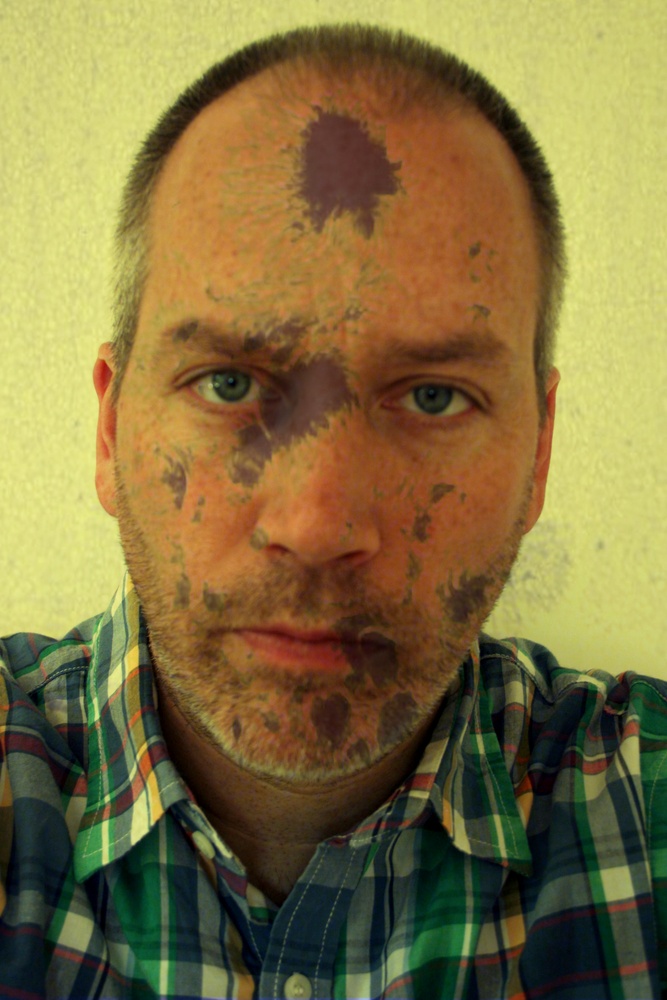
     

    JohnO'Connor, Self Portrait with Sun Spot, May 2, 2013. Inkjet print, Ed. of 3, 17 x 14 in.

    JohnO’Connor, Self Portrait with Sun Spots, May 2, 2013. Inkjet print, Ed. of 3, 17 x 14 in.

    The artist has also certainly deployed phantoms in these works, in the form of chatbots, which converse in exchanges transcribed in text-based drawings.  Among these, and hovering over them, a phantom rises up in the guise of John O’Connor himself, just as for a long time now the knots of graphic information in his data-driven works have sometimes tended to suggest figurative apparitions, as in Kooky Yoga, 2005.  Before this exhibition, though, the personages or chimeras evoked did not particularly become him, nor did they usually tend to give rise to something existing off the paper, wanting to occupy real space. Interestingly this new development coincides with O’Connor’s very convincing deployment of fully three dimensional works, embodied as, in one example, a helical loop, made of epoxy, writhing in roughly the shape of an infinity sign, a snake of words, choking on its own tail (Strange Loop, 2012).

    O’Connor seems quite alert to registering what are self-evidently problems of this historical moment (as is Godard in his later films), the same conditions noticed and tracked by science, in the media, by political structures, by the culture.  The spectrum of difficulties observed really pertains to O’Connor as an individual only in the sense that it is conditioned on the chance location in time (history), space (geography), culture, and genetic inheritance that the artist as observer happens to occupy.  We all now exist in an information reality that includes access to a radically expanded quantity of data points (facts but also an expanded field of lies and tricks). The works perhaps act out an attempt to deal with this with objectivity and a desire for a factual grasp, where confessions of personal emotional responsiveness and angst are not really the point, but are factors among many. They are disturbing and complicating factors, as they shade and distort a picture that’s already permanently unstable.  The point seems to be, at least partly, to locate accurately that constantly moving hairline juncture of banality and crisis: the present.

    By Ken Weathersby

    Image courtesy of the artist.

    Image courtesy of the artist.

    As an artist, I perceive reality in its purity: forms, colors, sounds, and the subtle nuances of emotions and dreams.

    My art explores themes such as exile, which is central for me. Exile means living outside one’s original homeland, being outside. It signifies absence, or rather non-presence; isolation, separation, distance. We are all exiles: each of us has many different identities. We are all the result of a journey.

    Humanity is at the heart of my work. As human beings we are not isolated but connected and influenced by the world, as is my work. My painting tells the story: my struggles, my journeys, my dreams, and my immense belief in our humanity.

    anissaberkanirohmer.com

    Image courtesy of the artist.

    Image courtesy of the artist.

    My art works is a plastic effort of a colorist representation of the space-time continuum. I try not to copy the reality of the object, but the rather objectification of its live appearance; it’s artistically-embodied formalization. This is related to the thing as well as to the space around it, which is apprehended by me objectively and colorfully.  From an aesthetic viewpoint in general, my approach to fine art can be determined as opposing naturalism as well as minimalism.

    vladimerasatiani.ge

    Stella_Frank_PF3005_K144_email1

    Image courtesy of Peter Freeman Inc.

    Frank Stella
    January 9 – February 22, 2014
    Peter Freeman, Inc.
    140 Grand Street
    New York City
    peterfreemaninc.com

    DODGE_Gallery_078126_550

    Image courtesy of DODGE Gallery

    Ted Gahl
    January 11 – February 23, 2014
    DODGE Gallery
    15 Rivington Street
    New York City
    dodge-gallery.com

    “We are sore-eyed scopophiliac oxymorons … disenfranchised aristocrats, under siege from our feudal heritage … our bread is buttered on both sides …” this was stenciled on the gallery wall as the artists introduction to the world over twenty years ago—fledglings from the nest of Gilbert & George, having once been their art technicians—yet arriving as the true enfants terribles of the then Brit Art scene; meting out schlock shock and conceptual irreverence. Yet the Chapman brothers have never lost the attention to detail of obsessively committed artisans—a quality rarely shared by their peers.

    Come And See is another of the artists’ exhibitions to be filled with insalubrious gore and crude hyper-reality. This is the classic art dialectic of vanitas; birth, death, sex, horror … and of course McDonald’s.

    Yet the artists attention to detail is never more obvious than in their miniaturised apocalyptic landscapes; the minutia of degradation and destruction, iconoclastic works of vitrine-encased dioramas; Hieronymus Bosch-style miniature Hell-scapes, in which zombie-Nazis fight for superiority with multiple Ronald McDonalds and his burger-headed fiends. The surreal nightmare of tiny violence is only offset by an extraordinary level of detail. This is a comedy-horror juxtaposed with the crucifixion of Mathias Grunewald, crafted from a toy box of intentional puerility.

    From the hand-painted bronzes of organ-infused devices on plinths, to the copulating taxidermied animals complete with contorted facial expressions —and a video piece called The Organ Grinder’s Monkey—or more accurately a series of video sketches with actors; Rhys Ifans as the artist, David Thewlis as the hapless alcoholic art tutor, and Samantha Morton as Mrs. Chapman giving birth to an adult Jake. Humour is as important in this exhibition as irreverence and gore—and all presided over by Ku Klux Klan clad mannequins wearing rainbow socks and Jesus creepers.

    As a young student diligently made notes while watching David Thewlis voicing an animated cockroach aspiring to live in the studio of a ‘real artist’—namely Rhys Ifans—and I belly-laughed with the gusto that the ‘Brothers Grimm’ demanded—I felt that she was missing the point.

    But hidden amongst the two-dimensional pieces is a more serious conversation in waiting; a reference to the artists ‘surfaced’ works created from the bought and appropriated Disasters of War Series by Goya, drawn over with the ghoulish and questionable iconography of Ronald MacDonald. This was a reference to the changing values of iconography from religious to capitalist, a Duchampian dialogue about authorship in art, and the committing of art-historical sacrilege in the defacement of ‘high-art’ to, ironically, create ‘high-art’.

    The Goya prints were simultaneously devalued and revalued in a dialectic about values—to change the location of a value [of profit]. The final intentional irony of the work being that the numbers of the original Disasters of War prints had decreased, increasing their value.

    The value of the prints bought and ‘added to’ by the artists also gained a new potentially higher value for being a post-postmodern piece of Appropriation Art; a ‘Two for the price of one’ conceptual capitalist garage sale. Call me cynical for this opinion, but I’m merely joining the club.

    Often the duo’s conceptual underpinnings are as meticulous an invention as their craftsmanship. As with a number of the artists two-dimensional works that have been manipulated into ‘tattoo flash’ and made available in book form. In purchasing the book, the viewer can choose a tattoo from any number of the Chapman brothers works and in being tattooed with the design can actually become a part of the artists’ oeuvre.

    The equation of an artwork that becomes the very thing that it discusses and derides has a certain cynicism. For example; art does not have to be amoral to discuss the amorality of a particular system. This seems a clever and cynical equation; an art object that attacks consumerism at the same time as supporting its own market. If not for the genuine commitment and passion shown in the execution of the work you might weep at the cyclical moral horror. A horror far more disturbing than miniature nihilistic genocidal maniacs.

    The exhibition is the realization of an amoral infantile amusement taken to both macro and micro scales, but the elongated boorishness of callow creatives this is not.

    Shock in art is a dead concept in a contemporary world of visual saturation. If not for the tools with which these shocks are delivered; being juxtaposed with humour and the slavish commitment to minuscule hand-crafted detail—a mind-boggling feat reminiscent of Renaissance artisans—often taking the artists themselves months if not years to create. But the greatest shock of all is not visual but found in the duality of certain works to also be what they actually pertain to discuss.

    By Paul Black

    Charlotte Meyer lives in Brooklyn, N.Y., graduated from Pratt Institute in 2009, and received the Joan Mitchell Foundation Award in recognition of the school. She is a Visiting Critic at R.I.S.D. is represented by Opus Projects, and is scheduled to exhibit new work at the Chelsea location in 2014. Here are her favorite shows of this past year: 

    1. Robert Irwin: Scrim Veil -Black Rectangle -Natural Light at Whitney Museum, New York
    A reminder of Irwin’s dedication to understanding perceptual awareness of space by transforming the fourth floor of the Whitney with an intricate but barely there work, recreated after 35 years.

    2. Ad Reinhardt at David Zwirner, New York
    The black paintings fill one room with subtle details which reveal themselves with each moment you spend, smart political graphic illustrations provide a layer mostly unknown, obsessive photography slides in the hundreds.

    3. Jill Magid: Woman with Sombrero at Art in General, New York
    The investigative nature of Magid’s work paired with the skilled manifestation of sharing just enough information seduces every time.

    4. Subliming Vessel: The Drawings of Matthew Barney at Morgan Library, New York
    Intense research, developed language, constant movement, revealing process, considered materials.

    5. Dickinson/Walser: Pencil Sketches at Drawing Center, New York
    Old fashioned writing thoughts down on beautiful scraps of paper.

    See top 5’s from other NY Arts contributors here.

    Paolo_Uccello_Deluge.web

    Image courtesy of Bureau Inc.

    Lionel Maunz
    January 12 – February 9, 2014
    Bureau Inc.
    178 Norfolk Street
    New York City
    bureau-inc.com

    News | Exhibitions