Leah Oates: How did you become an artist and what is your family background?
Maddy Rosenberg: I can’t say I was conscious of a point where I “became” an artist, as I don’t remember a time when I didn’t make art. I would spend time after school or during summer breaks designing and constructing puppet theaters out of paper and crayons with papier-mâché puppets or sitting on the stoop drawing the buildings across the street. I enjoyed all kinds of subjects, immersed myself in books and I loved to write creatively, but art was always front and center in my life, a place for respite and joy even throughout my childhood.
Growing up in Brooklyn in a working class family, my grandfather was my mentor. He retired from being a subway conductor and we enjoyed our time together after school while both my parents worked. He saw I liked to draw and he’d encourage me. We would read together and argue philosophy. I consider myself fortunate to have grown up in New York where the whole city was my playground. My childhood museums were not only world class but they were more than art museums, they were the encyclopedic museums of the Brooklyn Museum and Metropolitan Museum and the exciting dioramas of the Natural History Museum. From an early age I was thinking of making art in relationship to a broader context. The first art I felt a connection to was the wonderful Egyptian collection at the Brooklyn Museum. I also felt advantaged that I could have a public school art education, finding the 1.5 hour commute to the High School of Art & Design in Manhattan worth it. Scholarships allowed me to complete a formal art education and to go on to Cornell University for my BFA and eventually Bard College for my MFA.
LO: What are the ideas in your work and what is your working process?
MR: In my work, I deal with memory embedded in places and spaces of the past, whether they be the remains of ruins or resonances of the layering and pentimentos and palimpsests of centuries. On reflection, I realized being a native New Yorker informed my subject matter and themes. I was drawn to the eclectic architecture and the mix of times and styles, a reflection of the history of New York itself. I see in buildings the lives past lived that inform and live on in a presence, the history of a place and the people who lived there embedded in its structures. I create my own environments by drawing my reference from various sources both historical and from my sketchbook of accumulated photographs. I assemble images, removing them from their original context to create a new world of my own. I deal with both the illusion of real space and objects with a reiteration of the flat surface (especially in my paintings, where I combine and alternate in multi-panels highly painted images with flat areas of color). Of course, it’s all not so deadly serious, there are visual plays and historical winks, I’m attracted to the witty and playful as a curator and it’s there in my studio work as well (albeit subtly).
As to process, I travel often for my projects and spend several months each year in Europe. Wherever I go, I build a sketchbook of images. I take photographs of building facades, grotesques and gargoyles, interior as well as exterior spaces and collect all kinds of reference. Sometimes what I am seeing triggers an idea, sometimes I have an idea of the concept and cull through my images for the form the work will take.
LO: You’re an artist, curator and gallery director and like many artists juggle many things and have several jobs. What is your advice for this juggling act?
MR: We all juggle different roles and priorities in our lives, whether we’re conscious of it or not. I make sure to give my full focus to what I am doing at the moment. As I always say, my career is my day job. And I think of all my work as one of a piece, whether in the studio or in the gallery or on the computer; everything I do is related to my art projects and my life as an artist first and foremost. I think it is important not to resent the time needed for anything I take on to be accomplished well and thoroughly. There will always be the frustration of never having enough time for everything, but that just makes for an interesting life. I can’t imagine being bored.
LO: Tell us about your new gallery CENTRAL BOOKING in the Lower East Side ie the artists, the goals for the gallery, why LES?
MR: I think of CENTRAL BOOKING more as my curatorial space rather than a traditional contemporary art gallery. After years of curating with other spaces, I felt the necessity of having complete control over my curatorial vision and decision-making so more than four years ago I founded the gallery. As a hybrid gallery (a commercial gallery with non-profit sponsorship), I feel I have the freedom to do all sorts of programming.
CENTRAL BOOKING is an interdisciplinary two gallery space focusing on the art of the book and its integration into the larger art world through exhibitions of all media on art and science themes. I have a very expansive idea of the book form and look for artists who do as well. Besides the more traditionally bound codex books, we specialize in books that push the form, whether it is utilizing the flat wall, or sculpturally situated on shelves, floor or ceiling. We represent over 160 international artists, many I’ve known and worked with for years, others I add as I see new work that excites me in its unique vision.
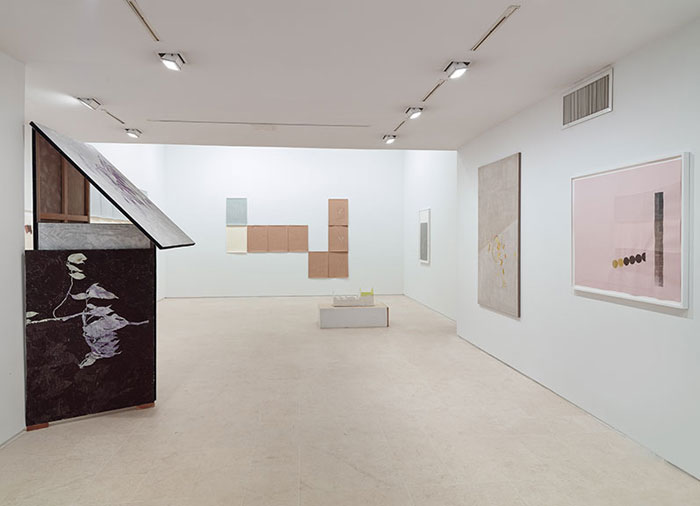
The quarterly exhibitions in our newly named Haber Space showcase a broad variety of work in a series of explorations where art meets science. I enjoy creating complete environments with the work, utilizing and designing the entire space- walls, floor and ceiling. The integration of the two spaces is organic as many book artists work in other media as well: painting, sculpture, installation and video art. In fact, book art often incorporates these other media itself. Therefore both galleries are distinctive but also have an interactive relationship. For each one of these exhibitions we always have a thought provoking art and science panel that puts several artists in the exhibition in discussion with scientists and scholars in the field.
The themes of my exhibitions mostly come from what I see that artists are doing in their studios. I collect files on artists whose work interests me and begin to break the work up into categories of thematic relationships. When I feel there is enough work and enough variety of approaches and media, then I have an exhibition.
We also have a full programming schedule that includes screenings, talks, original performances, readings, lecture series, discussion panels and workshops. And we publish CENTRAL BOOKING Magazine, a quarterly that focuses on book art issues that also contains a full catalog for each of our exhibitions.
CENTRAL BOOKING opened in DUMBO, Brooklyn in September 2009, but as our success grew I was looking for a storefront space that would be more than a destination space. I thought we were going to remain in Brooklyn but after I looked for over a year and had two spaces fall through, I spoke with other Brooklyn galleries that were moving to LES and heard the same story – that it was a growing gallery neighborhood and the rents were often less than in Brooklyn. I was encouraged when I found in my first walk around a number of possible spaces. And I love the fact that it is still a bit of the New York I grew up with, a real neighborhood where people live and shop and is still full of old family businesses. The other galleries have also been open and welcoming, though unfortunately there isn’t a lot of time for too much interaction, we’re all so busy. But I found that storefront with quite a large window frontage and a space big enough to comfortably fit my whole program. And one in which my community can share as we build it together. I feel a real part of something in LES and have made friendships with a number of my neighbors, many who have already become regulars in just the few months since we opened there.
LO: Why do you think art is important to people and to the world?
MR: Humans were drawing on cave walls when they could barely grunt communications. Art is part of our humanity, do we really need to argue why it is important? Good or bad, what in our world has not been created by art? Can we even look at a snowflake under a microscope and say that art is irrelevant or non-essential to our lives? Obviously, it’s intrinsic in all nature.
LO: What advice would you give an artist who has just arrived in NYC and who is not sure where to begin?
MR: As a native New Yorker, I took a lot for granted as a young artist. I knew how to navigate the vastness, understanding that NY is just a bunch of neighborhoods strung together. My advice would be to find your community, a place of comfort, and move out from there. Take a class, join a printmaking workshop, get involved in a non-profit, attend events that interest you. And keep your expenses as low as possible so that you have to earn as little as possible and can have as much time to work both in the studio and on organically building a career.
LO: What are your upcoming projects?
MR: Besides the four exhibitions I curate yearly at CENTRAL BOOKING and the 4 issues of the magazine I need to put to bed each year, I have an exhibition at Bennington College, long in the works, that opens in April which brings together artists I have worked with in both parts of the gallery. Also on the curatorial front, I will be co-jurying the summer exhibition at the Center for Book Arts and will also be working on their 40th anniversary exhibition. I am also in the process of two longer term international book art exchange exhibitions with Bristol, England and Poland.
My studio projects include finishing up my current painting series, editioning my new artist’s book, and working on my painting animation.