
• The first Kim Dorland painting I really liked was Bay Blanket #3 in his 2014 exhibition at Angell Gallery. In this work, a young woman—the artist’s wife Lori—kneels on a bed in front of a wall covered with family paraphernalia, holding a Bay blanket to cover her nakedness. Her face and arms are created from thick paint that the artist has partly removed, so it looks cratered. There are heavy patches of paint on the blanket as well as the images on the wall. It is very physical, very energetic, and you can see the movements of the artist’s hand throughout as he layered and manipulated the paint. Somehow it is still able to capture that intimate moment, as the figure hugs her body and looks out from her surroundings. The Bay blanket is emblematic of the North and the other walls are bare, like in a cabin.

    Another, a smaller Bay Blanket, hung in a corner of the Angell Gallery with a cordon around it, warning viewers not to touch it because of wet paint. I’ve seen that kind of sign before for another artist but learned that it was often used for Dorland’s work as he uses an lot of paint, in many layers, so much so that sometimes the work becomes almost sculptural.
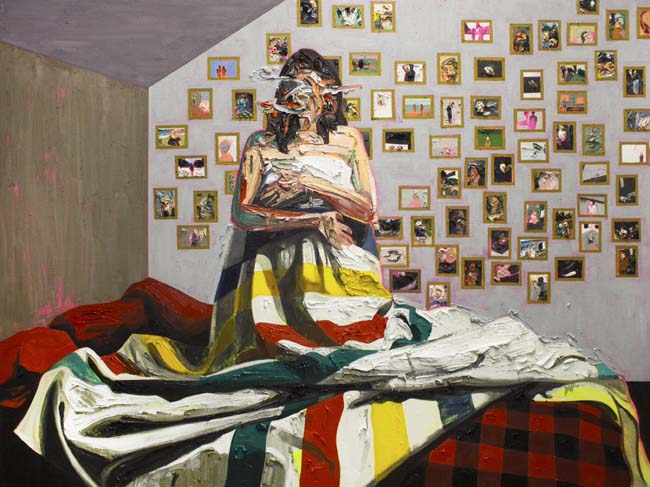
    Bay Blanket 3, 2014, oil and acrylic on linen over wood panel, 72x96inches. Courtesy of Angell Gallery, Toronto

    Bay Blanket 3, 2014, oil and acrylic on linen over wood panel, 72x96inches. Courtesy of Angell Gallery, Toronto

    Dorland is considered a landscape painter. Landscape is big in Canada since the Group of Seven, and many collectors here focus on them. It is not a surprise that Dorland, like many other contemporary Canadian artists, started as a landscapist, but he is more of a city boy. Coming from a tough background in east-central Alberta, he left his mother at the age of 16 and moved into his girlfriend’s (now his wife) Lori Seymour’s home. He described himself then as a “going nowhere teen.” He had no vision of the future, not even a single idea, until he opened a book about Tom Thomson and the Group of Seven. Thumbing through the book he felt enlightened. He found what he wanted. He found art. After that discovery he went to Emily Carr University of Art + Design and York University.

    Tom Thomson is still one of his favourites. They share the same hermit-like attitude and Dorland is mostly in his studio “lab” in Toronto. Their painterly roads crossed, when McMichael’s chief curator, Katerina Atanassova invited Dorland to become artist-in-residence and to visit the places Thomson did, as well as look at his work in the museum. Dorland was hesitant at first, as he said, “If you through me in a canoe, handed me an axe and told me to survive, I’d be dead pretty quickly.” But he agreed, and paddled into Algonquin Park where he felt the spirit of the land, a “supernatural air.” The result was the exhibition titled You Are Here: Kim Dorland and the Return of Painting. 90 freshly painted canvases of Kim Dorland were exhibited with 38 Thomson sketches as well as works by Emily Carr, David Milne and members of the Group of Seven. Dorland’s paintings were mainly landscapes, some of them even rethinking Thomson sketches, like Woodland Waterfall (After Tom Thomson). The star of the show was French River, a very large triptych, showing Dorland at his best as a traditional landscape painter. People compared him to Tom Thomson, Atanassova called him a “Tom Thomson on acid” because of his vibrant, neon-like colors. It doesn’t matter how much Dorland admires Thomson, there are more differences than similarities in their work. First and foremost, Dorland is not an outdoor man like Thomson, but a city dweller. He might paint forests, lakes, hills, trees, sky, campsites and animals – but he is an outsider in nature. “My identity as an outdoor man is not part of my practice.” – he said to James Adams of The Globe and Mail – “My work is really about the perfect psychological moment. Sometimes that moment is in nature. Sometimes it’s in my living room.” He may paint landscapes, but he’s painted them in his own way. Thomson found drama in nature; Dorland brought drama into nature. His vision of a forest, or other parts of nature, is very different from any realistic or idealistic view. Even in his landscapes he wants “to tell his own story.”
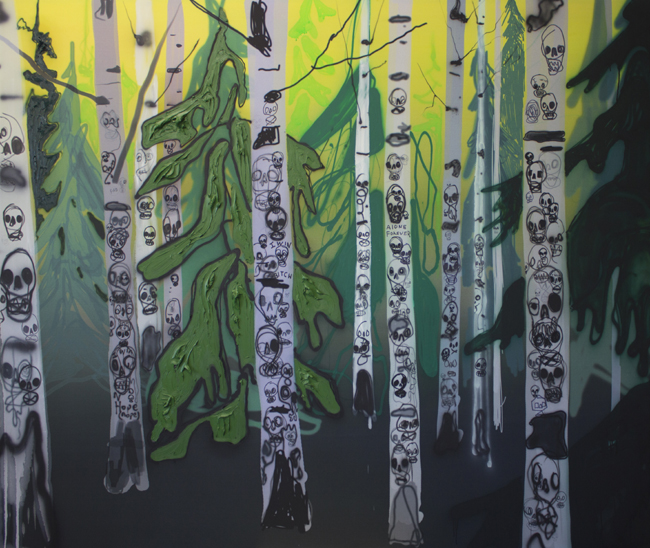
    Kim Dorland, All work and no play...2, 2016, oil and ink over iPad print on polyester, 60x72inches, Courtesy of Angell Gallery, Toronto

    Kim Dorland, All work and no play…2, 2016, oil and ink over iPad print on polyester, 60x72inches, Courtesy of Angell Gallery, Toronto

    There are some returning motifs in Dorland’s oeuvre. The first painting he sees as his “own”, a turning point in his career, is The Loner, from 2005. It depicts a young guy, half hiding behind a tree, holding a plastic bag. He looks like a teenager escaping from the nearby city for some quietness or who knows what mischief. The trees are stylized, showing their outlines only and with a few patchy details, like falling off bark – almost abstract, like all the other trees in his paintings. The trees on Fuck Love (2008) are truly hurt; their trunks are covered with carvings of letters and messages, with spray paint and something that looks like asphalt. These images of the city’s cat-piss-smelling, graffiti-covered alleyways are creeping into the forest. All the supposedly happy butterflies seem fake here and the dirt dominates. Then, in his latest show, I Know that I Know Nothing (Angell Gallery, 2016 October), All Work and No Play …2 (2016) the dead tree trunks in a pine forest are covered with skulls and images that might be left behind by a zombie-walk of sick-minded teenagers.

    We associate landscapes with nature, beauty and the freedom of the outdoors. Landscapes represent creation as well and are supposed to be welcoming. Not so in most of Dorland’s paintings. Here You Are, (2013) a self-portrait of the artist, depicts him standing in front of his easel, surrounded by dark trees. It looks like a nightscape but the light coming through between the trees suggests otherwise. Most of the surface is covered with heavily textured black paint, only the canvas and easel shines with pink. This is not a welcoming forest, but a forest like Hansel and Gretel’s from the Brothers Grimm tale—a forest of nightmares that threatens to swallow the intruder. Darkness surrounds the artist and he might easily disappear into it. Only the creation of the painting, a canvas-within-a-canvas, give us some hope. It makes you wonder if the artist is aware of the dangers or totally absorbed in his activity or maybe doesn’t care at all. In most of Dorland’s landscapes the trees are bare, the sky is purple, the sun is blinding or darkness covers everything. The trunks of trees are covered with ugly carvings of skulls and zombie heads. Even the small bridge over a spring is spray-painted with graffiti. As in Dorland’s 2015 show, I’ve seen the future, Brother, the city with its aggressive decoration seems to invade nature. Will this be the future? I hope not, and note his message on the bridge: Go Back.
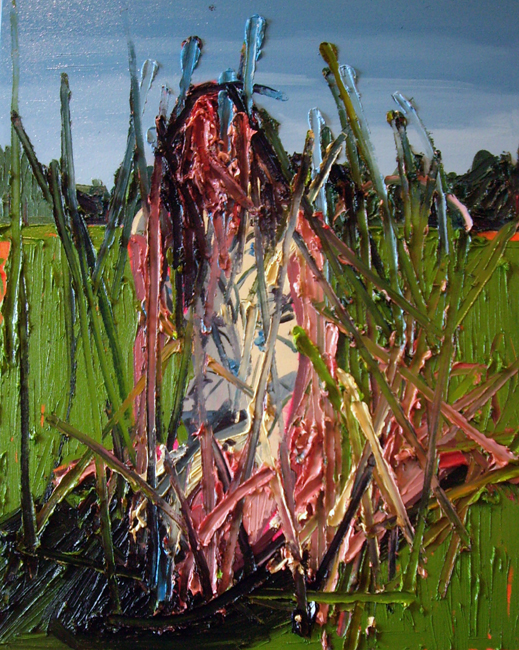
    Kim Dorland,Yellow Dress, 2007, oil and acrylic on canvas, 44 x 36inches, Courtesy of Angell Gallery, Toronto

    Kim Dorland,Yellow Dress, 2007, oil and acrylic on canvas, 44 x 36inches, Courtesy of Angell Gallery, Toronto

    Dorland is also considered a portraitist, including self-portraits, double portraits with his wife Lori and his painting series of Lori. All his portraits are faceless. In the age of a hundred selfies a day this seems strange. Why is that? “I literally just started piling on the paint because I wanted to remind the viewer that they are not photographs; they’re paintings.”, he explained. In Here You Are, his back is to us, and in Self-portrait at 38, (2012) his blood-red face is scratched until it’s unrecognizable. In the double portrait, Grown-ups, (2012) red dominates again and only the posture of the couple suggests what being an adult means. The brightness doesn’t mean happiness; a sense of loneliness and melancholia radiates from the painting.
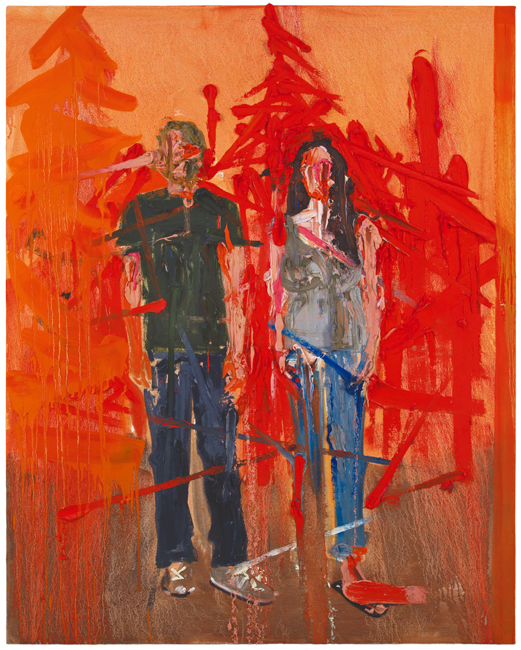
    Kim Dorland, Grown-ups, 2012, oil on linen - 60x48inches, Courtesy of Angell Gallery, Toronto

    Kim Dorland, Grown-ups, 2012, oil on linen – 60x48inches, Courtesy of Angell Gallery, Toronto

    Dorland has painted his wife and muse Lori throughout his entire career, even dedicating some exhibitions completely to her: For Lori, (2011 at Mike Weiss Gallery, New York) and his latest show I Know that I Know Nothing (2016 at Angell Gallery, Toronto) where the larger room was filled with images of her. Dorland painted these images more from memory than for creating memories. They are not traditional “love” paintings. There is certainly some intimacy in them. Sometimes Lori looks vulnerable in her posture, as in Yellow Dress, (2007) when she kneels in a nice summer landscape. She is all over Dorland’s canvases; enjoying the cool water at Emma Lake, in a dark forest, walking and disappearing into the night sky (The Girl Disappears, 2010), a ghost, a vision—real and imagined. But Dorland does “not shy away from the brutality of love” either, as Allison Meier stated in her review in Hyperallergic (For Lori, Mike Weiss Gallery, 2010). Lori swims in a night lake where her body is blood red, surrounded with black and deep purple rivulets, like dried blood, seemingly swimming in dangerous waters (Night Swimming, 2013). In some other, darker, portraits her face appears like a skull and even the paper is ripped. Still, Dorland’s vision of Lori is not always that dark. Last visit, (2013) or After the Party, (2014) depict some nice moments from his family life. Lori’s beauty shines in his 2016 show, as she relaxes under trees on that Bay blanket or while admiring her image in a peaceful lake (Untitled, Lori on purple, 2016). It seems that some harmony has been found.

    Dorland pushes the limits of his media. He paints very physically. His strokes are sometimes even brutal and he uses an abundance of paint, layers upon layers, until it’s so heavy and textural that it looks like colored clay and might fall away from the canvas. To prevent that he uses screws to keep it in place. Within the layers of oil and acrylic paint he incorporates different materials such as wood, strings, fur, feathers, glitter and enhances the outcome with glow-in-the-dark pigments. His paintings are impossible to dismiss. When the surprise of his technique fades away, a deeper meaning emerges as Dorland wants to engage in a psychological dialog with the viewer.

    Emese Krunák-Hajagos, NY Arts
    Marlborough Barcelona is pleased to announce a solo exhibition of Polish artist Magdalena Abakanowicz
    From November 17th to January 7th, Marlborough Barcelona will present a group of works by Magdalena Abakanowicz (Falenty, 1930), who is recognized as one of the most innovative sculptors of the last fifty years. The exhibition will consist of fourteen works that were created from 1987 up to the present day.
    The artist’s work is fully connected with her personal experience and the political and cultural events unleashed in Poland during the second half of the 20th century, where she has lived and worked all her life. The German occupation during World War II and the subsequent Communist regime imposed by the Soviet Union made a deep and lasting impression on the artist, who at an early age witnessed the innate human tendency for destruction and cruelty.
    In the mid-sixties, Abakanowicz became known worldwide due to the use of fiber in her creations, especially with her Abakans, large fabric structures in red, ocher or black which hung from the ceiling. Later, she gained praise for the astonishing sculptural ensembles, Crowds, Walking Figures and Standing Figures. These frequently appear as groups of headless bodies placed next to each other forming a kind of army. Through explorations in a variety of materials (wood, stone, paper, clay and especially bronze) Abakanowicz has shown her commitment to the many facets of the human experience and to the body itself. In addition to the Crowds, the artist also creates sculptures of individual body parts, many of which can be found in the exhibition: representations of the face, the hand, torso–all embodiments of the intrinsic life force in human beings.
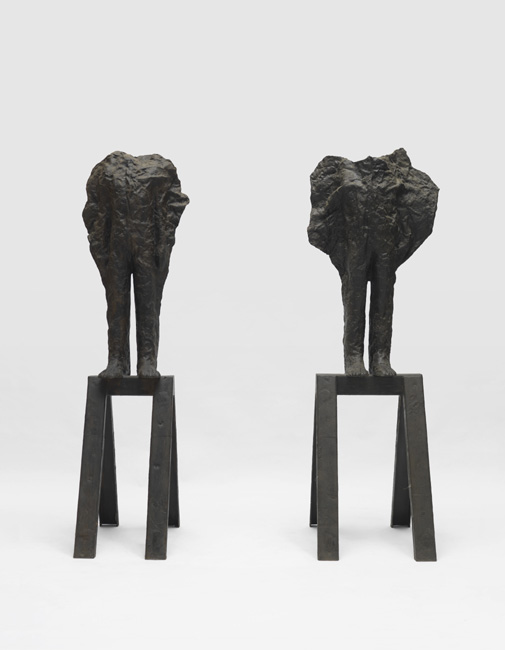
    Among the exhibited pieces is Plaster Body 5 (1987), an imposing headless figure that retains its own kind of dignity. Within the cycle Anatomy are the pieces Anatomy Cycle: Anatomy 31 and Anatomy 21 (both from 2009), a hand and an arm detached from the body. Other important works come from her series Anonymous Portraits (1987) and Anonim (2009), in which the artist presents heads without bodies, their faces blurred and anonymous. As Gloria Moure states in her catalogue essay, “It is the body understood as a unit of awareness and memory, as a common place of sensations, emotions and feelings. Then, the work is a transit, a journey, a flow”. In Figure in Iron House (1989-90) viewers witness a lonely figure in an iron cage. Also included in the exhibition are the sculptures Winged Sister and Winged Brother (2005-06), two figures without heads in bronze that are regal monuments to the human condition. Finally, the gallery will present a selection of the artist’s drawings with examples such as Drawing from Cycle Flowers – Falenty Flower or Flower of Minimus Pali (1998-1999), in which body and nature appear to converge within the same form.

    Abakanowicz, Winged Brother and Sister, 2005-06, bronze

    Abakanowicz, Winged Brother and Sister, 2005-06, bronze

    Magdalena Abakanowicz has been the subject of over 150 solo exhibitions in Europe, North and South America, Japan, South Korea, and Australia. She has exhibited at The Metropolitan Museum of Art in New York, the Jardins du Palais Royal in Paris, and the Muzeum Narodowe in Poznań. Her recent solo exhibitions include the Palacio de Cristal, Museo Nacional Centro de Arte Reina Sofía, Madrid and the Institut Valencià d’Art Modern (IVAM), Valencia, both in 2008, and the Fondazione Arnaldo Pomodoro, Milan, in 2009.
    Several examples of her work were on display in the Energy and Process galleries at the Tate Modern, London for all of 2010, as well as in her survey exhibition, The Human Adventure exhibited at the Akbank Art Center, Istanbul, in 2013. Among numerous awards and distinctions, Abakanowicz has received seven honorary doctorates from universities in Europe and the United States as well as the Commandeur de l’Ordre des Arts et des Lettres from the French Ministry of Culture. She was also awarded the prestigious International Sculpture Center’s Lifetime Achievement Award in 2005.
    Over the past three decades Abakanowicz has developed a number of site-specific sculpture installations that incorporate multiple figures or elements of increased scale. Among these are Negev at the Israel Museum, Jerusalem, 1987; Space of Dragon, Olympic Park, Seoul, South Korea, 1985; Space of Becalmed Beings, Hiroshima City Museum of Contemporary Art, Japan, 1993; Sarcophagi in Glass Houses, Storm King Art Center, New Windsor, New York, 1994; Space of Unknown Growth, Europos Parkas, Lithuania, 1997-98; Unrecognized, Citadel Park, Poznań, Poland, 2002; Space of Stone, Grounds for Sculpture, Hamilton, New Jersey, 2002 and, most recently, Agora, a sculptural group comprised of 106 unique cast-iron figures measuring over nine-feet tall that was permanently installed in Chicago’s Grant Park in 2006.
    Abakanowicz’s work can be found in numerous public collections including: the Israel Museum, Jerusalem; Ludwig Museum, Cologne; Musée National d’Art Moderne de la Ville de Paris and the Centre Georges Pompidou, Paris; The Tate Modern, London; The Museum of Contemporary Art, Chicago; The Museum of Modern Art (MoMA) and The Metropolitan Museum of Art in New York; Storm King Art Center, New Windsor, New York; Frederic Meijer Gardens, Grand Rapids, Michigan; San Francisco Museum of Modern Art (SFMOMA), San Francisco; Nelson-Atkins Museum of Art, Kansas City, Missouri; Nasher Sculpture Center, Dallas; National Gallery of Art and the Hirshhorn Museum in Washington D.C., and the Sezon Museum, Tokyo, to name a few.


    Courtesy of Galería Marlborough

    November 4, 2016–April 2, 2017

    Morris A. and Meyer Schapiro Wing, 5th Floor

    This exhibition contains sexually explicit content and may not be suitable for all audiences, including minors. Viewer discretion is advised.

    Marilyn Minter’s sensual paintings, photographs, and videos vividly explore complex and contradictory emotions around beauty and the feminine body in American culture. She trains a critical eye on the power of desire, questioning the fashion industry’s commercialization of sex and the body. Marilyn Minter: Pretty/Dirty is the first retrospective of her work.

    Spanning more than four decades, the exhibition begins with the artist’s earliest artworks, from 1969 through 1986, including rarely exhibited photographs as well as paintings incorporating photorealist and Pop art techniques. It continues with works from the late 1980s and 1990s that examine visual pleasure in visceral depictions of food and sex. The exhibition culminates in Minter’s ongoing investigation of how the beauty industry expertly creates and manipulates desire through images.

    Marilyn Minter: Pretty/Dirty is co-organized by the Contemporary Arts Museum Houston and the Museum of Contemporary Art Denver. The Brooklyn presentation is organized by Catherine Morris, Sackler Family Curator, and Carmen Hermo, Assistant Curator, Elizabeth A. Sackler Center for Feminist Art, Brooklyn Museum.

    The accompanying book is published by Gregory R. Miller & Company, the Contemporary Arts Museum Houston, and the Museum of Contemporary Art Denver.

    This exhibition is supported by generous grants from Gregory R. Miller & Co.; Amy and John Phelan; Jeanne Greenberg Rohatyn/Salon 94, New York; and Lizzie and Jonathan Tisch. Generous support for the Brooklyn Museum presentation is provided by The Fuhrman Family Foundation; Amy and John Phelan; the May and Samuel Rudin Family Foundation, Inc.; Mary Bucksbaum Scanlan and Patrick Scanlan;  the Taylor Foundation; Lizzie and Jonathan Tisch; The Robert Mapplethorpe Foundation; Salon 94, New York; Maharam; Naomi Aberly and Larry Lebowitz; Sherry Brous and Douglas Oliver;  Richard Edwards and Baldwin Gallery, Aspen; Christina and Emmanuel Di Donna; Stefan Edlis and Gael Neeson; Linda and Gregory Fischbach; Danielle and David Ganek; Dominique Lévy and Dorothy Berwin;  the Bertha and Isaac Liberman Foundation; Regen Projects; Richard B. Sachs; Jennifer and Jonathan Allan Soros Foundation; Fern and Lenard Tessler; Isabella and Theodor Dalenson; Emily Glasser and William Susman; Gregory R. Miller and Michael Wiener; Antinori Wines; Barbara and Michael Gamson; and Richard and Beth Heller.
    Marilyn Minter: Pretty/Dirty is part of A Year of Yes: Reimagining Feminism at the Brooklyn Museum, a yearlong series of ten exhibitions celebrating the 10th anniversary of the Elizabeth A. Sackler Center for Feminist Art. Leadership support is provided by Elizabeth A. Sackler, the Stavros Niarchos Foundation, the Calvin Klein Family Foundation, Mary Jo and Ted Shen, and an anonymous donor. Generous support is also provided by Annette Blum, the Taylor Foundation, the Antonia and Vladimer Kulaev Cultural Heritage Fund, Beth Dozoretz, The Cowles Charitable Trust, and Almine Rech Gallery.


    Courtesy of Brooklyn Museum

    © Brooklyn Museum 2016


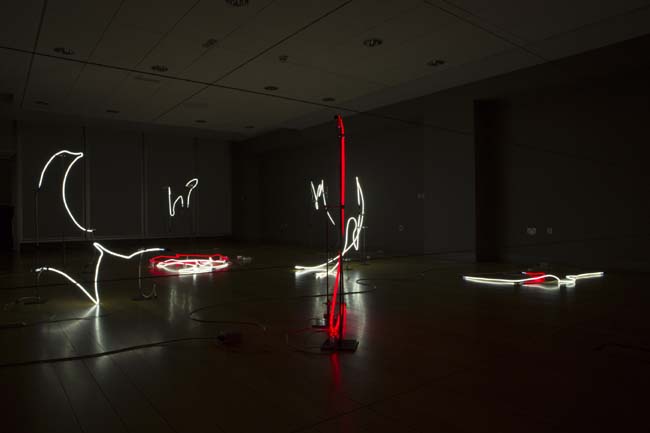
    Certain Moments, Kevin Killen

    Certain Moments, Kevin Killen

    Artist Statement – Movement
    Certain Moments

    In my work, light plays a role in translating ephemeral movement into tangible sculptural forms. The series of light compositions are created through collaborations between performance artists, dancers and myself. My initial role is that of observer and photo-documenter, studying patterns that are created when the artist performs. I then create site-specific neon light sculptures and installations that are the aftermath of our combined experience. In this way, the static sculptures embody the transients of the performance.

    The performances take place in a darkened space, where the dancers or performance artists hold
    lights. As their performance begins, I photograph their choreography using the camera as a drawing tool; long-exposures that track the staccato beams of light and their gestures over time. The result is photographic drawings that trace the lines of their actions; as the camera moves with the dancers, accidents occur, adding spontaneity and playfulness to the drawings. In a sense, the line drawings are a re-enactment of the performances, of which the end results extend beyond the original performance both as an archive and a vehicle for creating the neon work.

    The weightless, suspended floating and free-standing neon forms are unique compositions that exist independently or with the dancers. In some cases the performers dance alongside the neon, and in other cases they are displayed alone. The viewer can move around the sculptural works, imagining the path of the performers’ bodies and our collaboration within the space.

    Within the installations, an important part of the process for me is to record the timing of the dancers’ breath. I correlate the different inhalation rhythms to match the sequence of the neon lights as they turn on and off, embodying the real-time kinetics of the original performance, activating the space with dark pauses in one instance and bright glows the next. In some ways, I’m questioning how far the human emotion and gesture of performance can be captured in my final neon sculptures.

    Creating the neon is a solitary exploration, a fragmented memory of the now ended performance. Some essence of the original performance remains in the final sculptural works, but there is also something that is created new in the final neons.

    The neon are luminous, fleeting moments, echoing the sensitivity, gestures and emotions initially conveyed during the performances. They are metaphors of past and present; maps of the artists’ performance, yet symbolic of our collaborations.

    link to website.
    www.kevinkillen.com


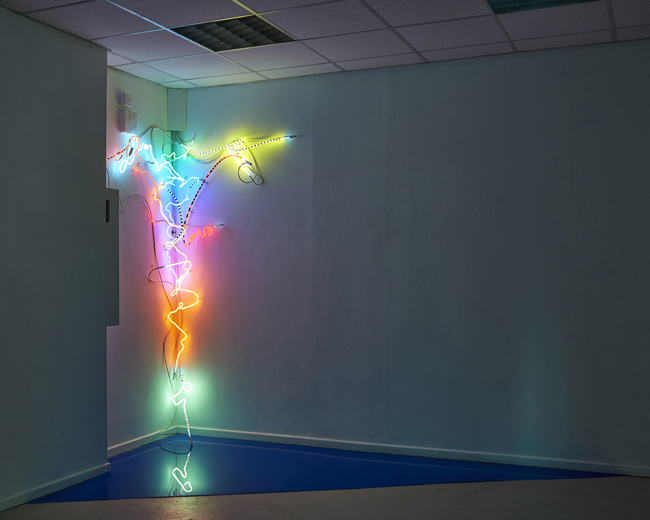
    Tipping point, Kevin Killen

    Tipping point, Kevin Killen

    Artist statement – Neon Cartography
    Tipping point

    In this series of light arrangements, I’ve set out to map the urban landscape around me. I’ve used the city streets as my canvas. City lights is the ink and my camera becomes a drawing tool capturing these fleeting patterns in “light paintings”.

    My initial role is that of observer and photo-documenter, studying the outlines created by city
    lights and as the traffic moves. I control the freehand long exposure of my camera allowing me to track trails of light.

    This process involves a degree of chance. As the camera moves when I walk, accidents occur,
    recording unexpected images and adding spontaneity and playfulness to the light drawings.
    Objects and people also imprint as black marks, as they obstruct the lights from the traffic and
    city lights. I later deconstruct and visualize these photographic images in three-dimensional neon installations, translating the urban setting into to kinetic light pulses.

    An important part of the process for me is to record the sounds of the city as I walk through,
    taking long exposure photographs. I correlate the different sounds I hear—cars going by, people
    talking, ambulance passing by or seagulls overhead—to match the sequence of the neon lights as
    they turn on and off. I’m searching for ways to embody the real-time kinetics of the original
    Cartography, activating the space with dark pauses in one instance and bright glows the next.

    Enabling the viewers to peer into previously unseen patterns and glimpse transitory movements
    now captured in light. Neon, somewhat transitory in its own physical qualities. It can often be loud and insistent but through careful manipulation, it can produce a subtle poetic light that radiates, inviting the viewer to see in new ways.

    As an artist, I construct each aspect of my neon sculptures. Through this, I gain a degree of
    control and can challenge the medium, adapting traditional neon techniques to free the medium
    from its conventional restrictive space. This allows me an unrestricted approach to both my
    research and practical work. I’ve attempted to “tame” the medium so that the neon’s light
    whispers, inviting the viewer in closer to the work.

    link to website.
    www.kevinkillen.com

    INDEPENDENT CURATORS

    with support of

    Consulate General of Georgia in New York

    PRESENT

    GEORGIAN Video Art: INTRO

    Program Screening and Art Reception

    Sunday, October 30th, 5-9 pm.

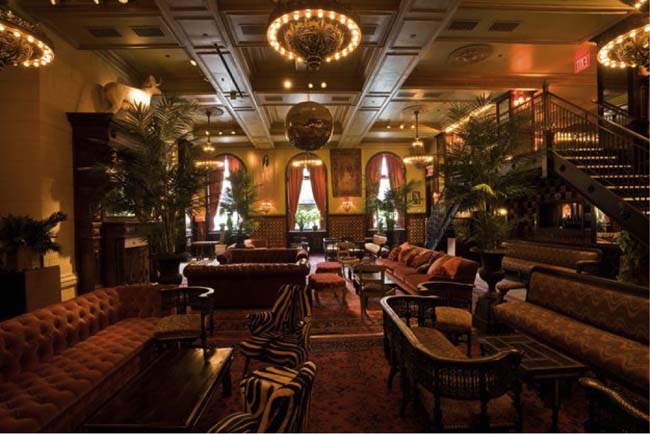
    The Jane Hotel, 113 Jane Street, New York, NY, 10014.

    jane-hotel-1


    A new take on Video Art Show format in a fabulous hotel, and a new look at the old mysterious country Georgia and its contemporary esthetics will be presented to NY audience at the end October, which is Halloween, and the final “closing” of worldwide harvest celebrations.  A 90-minute program of video art pieces, each between 2 to 5 minutes long, will be projected on a large screen with surround sound.

    untitled-3

    Courtesy of Irina Gabiani

    NY based Georgian born independent art curator and video artist Marika Maiorova will introduce a list of current video artists who were born and raised in Georgia. The creators of Georgian Video Archive Alexi Soselia and Galaqtion Eristavi are co-curators of the program.  Artists list: Irina Gabiani, Uta Bekaia, Levan Mindiashvili, Nika Machaidze, Gegi Khaburzania, Koka Tskvediani, Salome Latsabidze, Dimitri Tsutskiridze, Melano Sokhadze, Irakli Skhirtladze, Tamar Khmiadashvili, Alexi Soselia, Maria Chambers, Thea Telia, Zura Apkhazi, Lia Bagrationi and others.

    untitled-4

    Beyond the Form

    The idea is to once again introduce the contemporary Georgian videoart to New York City on a large screen and in intimate hotel setting, and create better integration opportunities for the artists and the curators. Some of the presented artists live and work in different countries around the world, some of them are in NY.

    Georgia, a small country with strong Christian traditions, goes back to Prehistoric Period and at some point in time was nearly bordering waters with Ancient Greece. It is located on the South wing of the Caucasus Mountains. Some villages there are still located up on over 5100 meters above the sea-level, and have never been abandoned. National history of the country is dramatic, same as geography. And so are the recent and the constant changes in the system and the political parties, with progress in everyday life and technologies, in mentality, in philosophy, in art.

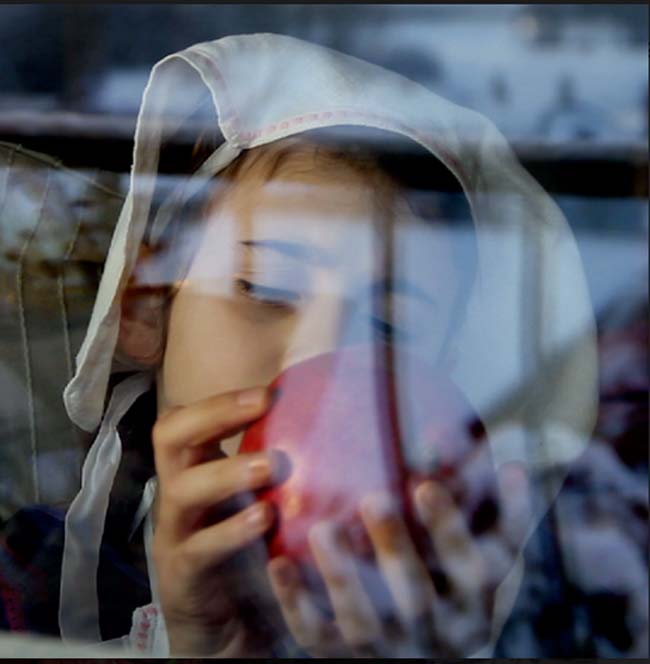
     Courtesy of Nika Machaidze

    Courtesy of Nika Machaidze

    Today Georgia is represented as a developing, economically reviving, fun, interesting and beautiful country all set for international tourism. However, the greatest asset of any country will always be its culture. New York’s Museum of Modern Art in the recent  years has presented a very comprehensive retrospective of Georgian Film – motion pictures that predated video art as artistic medium. This series “Discovering Georgian Cinema” covered Georgian film production in the years 1907-2014, and has a great impact on overall perception of Georgian nation in the United States.


    The event at The Jane Hotel Georgian Video Art: INTRO starts a new series of events discovering Georgian video art for American audience.

    For more information, please contact georgianvideoartshowny@gmail.com +1 347 607 57 18

    Sunday, October 30th, 5 pm to 9 pm.

    113 Jane Street, New York, NY.10014

    Screening 6 pm.

    Special Performance 8 pm

    Vocal trio of sisters Diana and Madona Iremashvili will perform Georgian romances after the video program.Program is curated in collaboration with the Georgian Video Archive.


    1_dj_writings_cover

    Tuesday, November 15
    7:00pm

    Cooper Union, The Great Hall
    7 E 7th St
    New York, NY 10003

    Donald Judd Writings, co-published by Judd Foundation and David Zwirner Books, is the most comprehensive collection of the artist’s writings assembled to date. Available in November 2016, this timely publication includes Judd’s best-known essays, as well as little-known texts previously published in limited editions. Moreover, this new collection includes unpublished college essays and hundreds of never-before-seen notes, a critical but unknown part of Judd’s writing practice.

    Judd’s earliest published writing, consisting largely of reviews for hire, defined the terms of art criticism in the 1960s, but his essays as an undergraduate at Columbia, published here for the first time, contain the seeds of his later writing, and allow readers to trace the development of his critical style. The writings that followed Judd’s early reviews are no less significant art-historically, but have been relegated to smaller publications and have remained largely unavailable until now. The largest addition of newly available material is a collection of Judd’s unpublished notes—transcribed from his handwritten accounts of and reactions to subjects ranging from the politics of his time to the literary texts he admired most. In these intimate reflections we see Judd’s thinking at his least mediated—a mind continuing to grapple with questions of its moment, thinking them through, changing positions, and demonstrating the intensity of thought that continues to make Judd such a formidable presence in contemporary art.

    The panel will examine Donald Judd’s relationship to the written word over the four decades contained in the new publication. The panel will include: Flavin Judd, Curator and Co-President of Judd Foundation, co-editor of Donald Judd Writings, and son of Donald Judd; Roberta Smith, Co-Chief Art Critic of The New York TimesAnn Temkin, Marie-Josée and Henry Kravis Chief Curator of Painting and Sculpture at The Museum of Modern Art. Moderated by Michael Govan, CEO and Wallis Annenberg Director of The Los Angeles County Museum of Art.

    Tickets can be reserved at https://www.eventbrite.com/e/donald-judd-writings-tickets-28232313610?ref=estw.

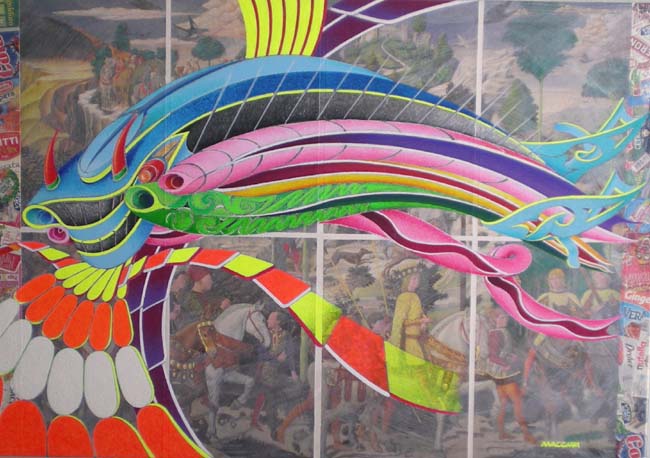
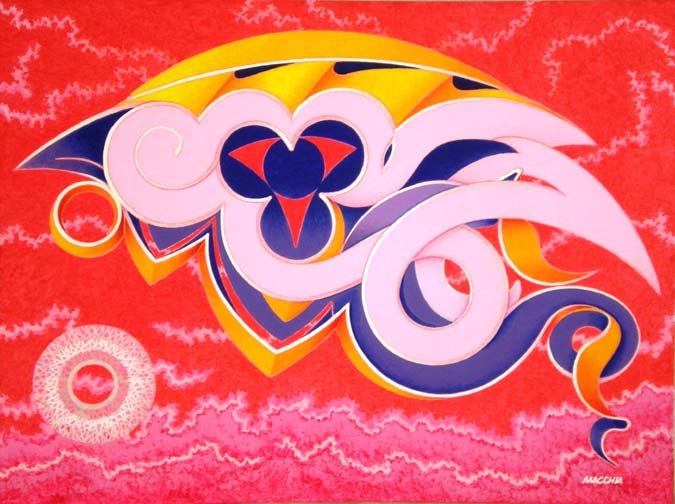
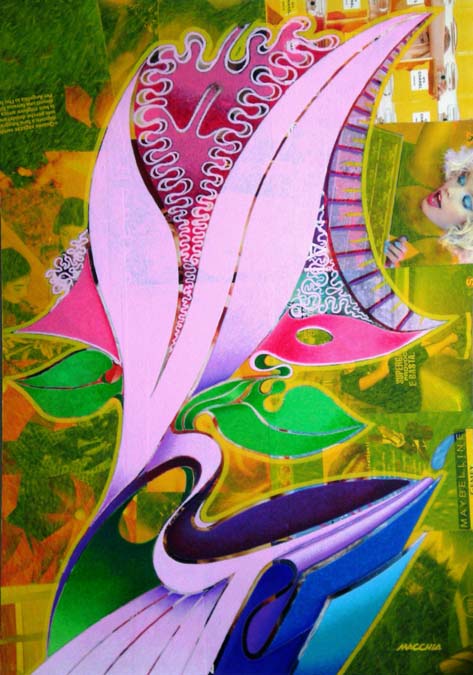
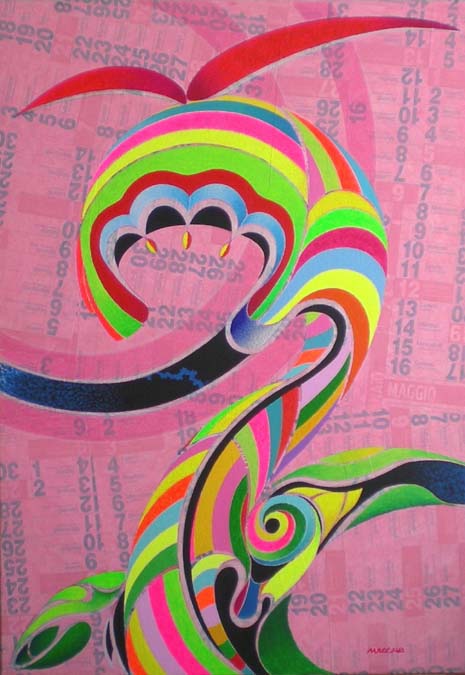
    Michele Macchia was born in Corato (Ba), where lives and works in 56 G. Carducci street. He attended the School of Art in Corato (Art Institute-Ceramics). He participated in different exhibition throughout in Europe and in U.S.A.. His painting have been published in several catalogues and art books.

    Selected Artworks:

    Time Travelers. Acrylic on advertising and canvas- 70cmx100cm. 2014

    Time Travelers. Acrylic on advertising and canvas- 70cmx100cm. 2014

    Solaris 2, acrylic on canvas. 60-x-80cm. 2012

    Solaris 2, acrylic on canvas. 60-x-80cm. 2012

    Creative nature, acrylic on advertising and canvas. 100cmx70cm. 2012

    Creative nature, acrylic on advertising and canvas. 100cmx70cm. 2012

    Generator Space Time, acrylic on advertising and canvas. 100x70cm. 2012

    Generator Space Time, acrylic on advertising and canvas. 100x70cm. 2012


    About the artist:

    Michele stain lives and works in Corato (Bari), Via Carducci, 56 – Art Institute Diploma – tel. 0808986632 – cell. 3287037171, e-mail michele.macchia009@gmail.com He has participated in several editions of the National Contest “The Slope”, Corato (1984-1988), has exhibited in numerous national and international galleries, as well as in national and international competitions. His works belong to the collections of galleries and museums.

    EXIBITIONS

    -Prize Saatchi & Saatchi for young artists, Milan, 1988;
    -Competition For the Football World Cup, 1990;
    -Community Montana Murgia North Western, 1993;
    -Estemporanea Cttà Cisternino (Br), 1993;
    -Expoarte, Bari, 1993;
    Gold -Medaglia International Prize Phrometeus, Massa Marittima, 1993;
    – Gallery at the “Centaur”, Bari, 1994
    -prize “Alessandro Volpi”, Pisa, 1995;
    -Oscar of Art, Lecce, 1995;
    -Artexpo, Javits Convention Center, New York, 1996;
    – Palazzo Caputi, Ruvo di Puglia (Ba), 1996;
    -Art In Video, Miami (U.S.A.), 1997;
    -EXPO Levante – Space Art, Bari, 1998;
    -Great International Art Prize “Carrara-Hallstahammar”, Sweden, 1998;
    -Vetrina Of Contemporary Artists, Florence, 1998;
    -Biennale Of Contemporary Art, Florence, 1999;

    2008
    -8 ° National Art Award “City of Novara”, Novara;
    -3 ° International Art Prize “Arte Laguna”, Mogliano Veneto;
    – Art Prize “Cairo”, Milan;

    2009
    -3 ° International Art Prize “La Colomba”, Venice, 2008-2009;
    -Show, Positano city;
    -3 ^ Biennial of Contemporary Art, Genoa;
    -Show, Town of Corato (Ba);
    -prize International “Terna 02″, Milan / New York;
    -Fair of Levante, Bari;
    -8 ^ Biennial of Contemporary Art, Rome;
    – Gallery “New Paint”, Bari;

    2010
    – International Prize of New York City, U.S.A..;
    – “Of the horse’s Art Gallery”, Valleggia of Quiliano (Sv);
    – City of Sorrento, “Villa Fiorentino – Sorrento” Foundation;
    -Show Ceramics, “Palazzo Ducale – Sala Liguria Open Space”, Genoa;
    -Show Ceramics, “Fornace – Il Tondo”, Genoa;
    -Show Ceramics, “Gardens extending to the sea”, Genoa;
    – “Cultural Centre The Pillar”, Santa Maria Capua Vetere (Ce);
    – “House of Culture”, Cosenza;
    – “Foundation Villa Benzi Zecchini”, Caerano di San Marco (TV);
    – Prize International Contemporary Art “Giorgione”, Castelfranco Veneto (TV);
    – “Episcopal Seminary”, Bedonia (Pr);
    – Prize Nazionale d’Arte Contemporanea “Archer Island Sant’Antioco”, Cagliari;
    – “Museum of Contemporary Art – Terra del Lavoro”, Capua (Ce);
    – “Italian Cultural Institute”, Cologne, Germany;
    – “Orlando” Foundation, Pescopagano (Pz);
    – Ceramiche D’Autore “Creative City Museum”, Salerno;
    – “Navy League – Villa Comunale”, Soverato (Cz);
    – Gallery “Espace Kiron”, Paris, France;
    – “Town Hall”, Massalubrense (Na);
    – “Castello Ducale”, Bisaccia (Av);
    – “Castle of the Imperials”, Sant’Angelo dei Lombardi (Av);
    – “Villa Fondi”, Sorrento (Na);
    – International Art -Simposio – Pisciotta, Palinuro (Sa);
    – Palace of the Province “Salone della Dogana”, Foggia;
    – “The Imperial Palace”, Francavilla Fontana (Br);
    – “Reggia di Caserta” Caserta;
    – “Eureka” – Spoleto Art Festival, Spoleto, 2010;
    – International Art Prize “Tuyap”, Istanbul, Turkey;
    – “Art Gallery of the University of Melo”, Gallarate (Va);
    – “Complex Burovich” Sesto Al Reghena (Pd);
    – “MUSEUM Pulcinella”, the Baronial Castle, Acerra (Na);
    – “Municipal Gallery – Castello Aragonese, Taranto;
    – “Mazziotti’s Palace”, Caiazzo (Ce);
    – “Hyram on Art Study Center,” Villa Marianna, Sant’Arpino (Ce);
    – “Nativity in Giffoni”, Giffoni Valle Piana (Sa);
    – “Nativity in Sermoneta”, Palazzo Caetani – MUSEUM Ceramics, Sermoneta (Lt);
    – “Gallery Italy portray Sharjan Millenium”, Dubai – U.E.A. (United Arab Union;

    2011
    – “Castello d’Aquino”, Grottaminarda (Av);
    – “House of Culture”, Calitri (Av);
    – “Reggia di Caserta” Caserta;
    – “Terme di Lignano” Lignano Sabbiadoro / Riviera (Ud);
    – “Royal Castle of Valentino – Hall of Columns”, Torino;
    – “International Institute of Egyptian Culture”, Madrid, Spain;
    – Artist Wanted “The Power of Self”, New York, U.S.A.;
    – “Villa Gualino” Torino;
    – “Art Takes London”, London;
    – “Villa Mosca” Alghero (Costa Smeralda – Sardinia);
    – “Ex Bourbon Prison”, Avellino;
    – Show Art Ceramics at the “Palazzo Ducale”, Genoa;
    – Show Ceramics at “Sala Ceramics – Il Tondo”, Celle Ligure (Sv);
    – “Casina del Principe – The 150 Unification of Italy”, Avellino;
    – Show Ceramics at the “Museum of Ceramics”, Grottaglie (Ta);
    – “Brehova Gallery”, Prague;
    – “The Saloon of Porto Cervo”, Porto Cervo (Costa Smeralda – Sardinia);
    – “3RD WORD – New York -Taipei”, New York, U.S.A..;
    – “Italian Cultural Institute”, Stockholm, Sweden;
    – “Contemporary Art Gallery”, (1 ^) Phoenix, Arizona, U.S.A.;
    – “Italian Cultural Institute”, Monaco Munich, Germany;
    – “International Exhibition of Contemporary Art”, Villa Mitolo, Monopoli (Ba);
    – “Contemporary Art Gallery”, (2 ^) Phoenix, Arizona, U.S.A.;
    – “33 Contemporary Gallery”, Chicago, Illinois, U.S.A.;

    2012
    – “54th Biennale of Venice” – Tibet Pavilion, Venice;
    – “Birla Millennium Art Gallery”, London (GB); 1 ^
    – “Foundation Villa Benzi Zecchini”, Caerano di San Marco (TV);
    – “Gallery Zone K”, Milan;
    – “MUSEUM Regional Natural Science”, Torino;
    – International Prize “Celeste Prize”, Rome;
    – “Art Takes Miami”, Florida, U.S.A.;
    – “Rayko Alexiev MUSEUM Community Center – Ministry of Culture”, Sofia, Bulgaria;
    – “Miami River Art Fair”, Miami, Florida, U.S.A.;

    2013
    – “Unpopular” at “Space Mantegna”, Milan;
    – “House of Dante – Florence Contemporary”, Florence;
    – “See Me”, New York, U.S.A.;
    – “Birla Millennium Art Gallery”, London (GB); 2 ^
    – “MIIT – MUSEUM International Italian Art”, Torino;
    – “Luxury Art” – “MUSEUM Altes Dampfbad”, Baden Baden, Germany;
    – “MUSEUM Kunstleforum ‘, Bonn, Germany;
    – “Zhou Brother Art Center Foundation”, Chicago, Illinois, U.S.A.;
    – “50 artists for a MUSEUM”, Museum MIIT, Torino;
    – “City Gallery” of the Middle -See, Jackson Avenue, Long Island, New York, U.S.A.;
    – “Creatives Rising”, New York, Pat .;
    – “Art Takes Paris”, Paris, France;
    – “Art Takes Miami Progress”, Florida, U.S.A.;

    2014
    – “Year in Review”, New York, U.S.A.;
    – “Emerging Art”, Beers Lambert Gallery, London, GB;
    – “New York Now,” Factory Art New York, New York, U.S.A.;
    – “Oscar Contemporary Arts” – MIIT MUSEUM, Torino;
    – Royal Opera Arcade Gallery, London, G.B .;
    – The “Museum of Memory”, Lipari, Aeolian Islands, Sicily;
    – Gallery “Am Art” Brussels, Luxembourg;
    – Italian Cultural Institute, Vienna, Austria;
    – Art Fair “Messe Stuttgart – ICS International Congresscenter”, Stuttgart, Germany;

    2015
    S.A.C.I. “Studio Art Center International”, New York, U.S.A. – International Art Exhibition Award, Florence;
    Museum SCALVINI, Villa Tittoni Traversi, “The Reality and Matter”, Desio, Milan;
    “Castello Doria”, Dolceacqua, Imperia, Liguria;
    “Novara Development Foundation – Palazzo Renzo Piano”, Novara, Piedmont;
    “The Billboard Creative”, Los Angeles, California, U.S.A.;
    “EXPO 2015 – THE TASTE OF ART”, Palazzo Bellini, Oleggio, Novara;
    “Artavita Gallery”, Santa Barbara, California, U.S.A.;
    “Framers’ Gallery, London;
    “Art Up Close”, New York, U.S.A.;
    Museum of Modern Art “Salvador Dali”, Berlin, Germany;
    “Art Museum Site Oud Sint-Jan”, Bruges, Belgium;
    “Monumental Complex of Castor”, Quirinale, Rome, Italy;
    “Spectrum Miami / Art Basel”, Miami, Florida, U.S.A.;
    Award “Artist of the Year 2015/2016″, Palermo, Sicily;

    2016
    “Art History – Artist in History”, Palermo, Sicily;
    International Award “TIEPOLOS”, Palazzo Clerici, Milan;
    “ArtboxProjet” Miami, Florida, U.S.A.;
    “T.I.N.A.Prize”, Venice ,;
    “T.I.N.A.Prize”, Moscow, Russia;
    “T.I.N.A.Prize”, Sydney, Australia;
    Museum of Modern Art “Paolo Sciortino”, Palermo;
    “Tokyo International Art Fair”, Tokyo, Japan;
    “Art Takes Manhattan” New York, U.S.A.;
    “Chamber of Commerce of the Russian Federation”, Moscow, Russia;
    “Exhibition Center of the Union of Painters of St. Petersburg”, St. Petersburg, Russia;
    Modern Art Gallery “2432”, Venice;
    “ART In AMERICA”, Yearbook / Guide for Museums, Galleries and Collectors, 2016, New York, U.S.A.;
    “Factory Art Projet”, New York, U.S.A.;
    “Neverwhere” – The Crypt Gallery St Pancras, London;

    It is inserted in numerous art publications such as Elite 1994 – The European Masters of the ‘900 years 1994/95/96 – National Catalogue of Contemporary Art 1997/98 – Regional Catalogue of Modern and Contemporary Art of Puglia – Art Leader, Mondadori, 1998 – Top Arts, Mondadori, 2000 – New Art, Mondadori, 2009 – “Europe in Art, International Contemporary Art Catalogue”, Ed. Platinum Collection, 2010/2011 – LIVE Catalog Modern Art No. 47 Mondadori, 2011 – Visual Sensations, Mondadori, 2011 – Catalogue “Art Takes Miami” 2012/2013, Miami, USA – Product Monograph Michele Macchia, 2013, Ed. Platinum Collection – Starring Dell’Arte from the nineteenth century to today, Ed. Effect Art – Kunste Heute 2014, Germany – SanGiorgio Publisher, The Joy of Art 2014 – “Artist in History”, Ed . Effect Art, 2015 – Guide Yearbook “Art In America 2015/2016″ (Art upclose), New York, USA – Art States (U.S.A.), Ed. Effect Art, 2015/2016; Artist of the Year 2015/2016 Effect Art, Palermo – Exhibooks, London, 2015/2016; Art In America “Annual Guide 2016″, New York, U.S.A.;

    e-mail michele.macchia009@gmail.com

    Michele Macchia
    Via Giosuè Carducci, 56
    70033 Corato – BA – Apulia –  Italy

    Tel. Cell. 3287037171 – 0808986632

    Artavita.com – ART UpClose.com – See.Me – ARTBoxProjets – Factory Art – Instagram:MicheleMacchia – Facebook Macchia Michele – Twitter: Michele Macchia


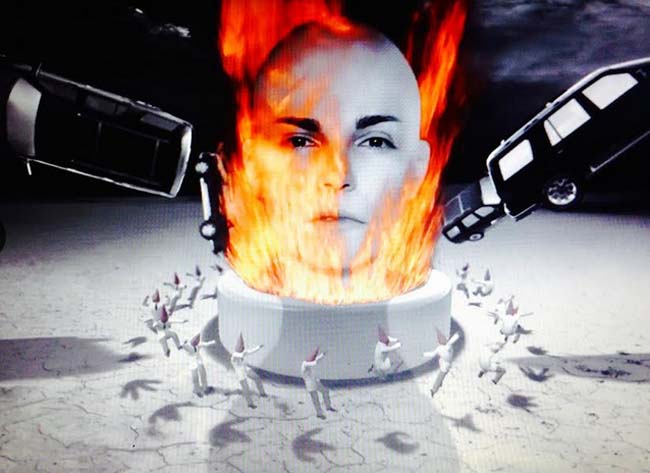
    Pussy Riot – Straight Outta Vagina (feat. Desi Mo & Leikeli47)

    The band wrote:

    Published on Oct 25, 2016

    Female power and female sexuality are yet need to be discovered. Discussed. Performed. Lived up.

    Women were slaves of the world for centuries. Women’s got their right to vote less than 100 years ago. Russia (1917), US (1919), Switzerland (1971). We’re still just about to build another roles, norms, ethics for vaginas owners.

    And the owner of vaginas is not some narcissistic stupid orange ape who’d claim that he could easily grab women by their pussies. The owner of vagina is a woman. Who wears her vag as a badge of honour.

    Pussy is a new dick, ladies.
    Oh bondage, up yours

    – – – –

    “Straight Outta Vagina” was written and performed with great love and respect by
    David Andrew Sitek, Nadya Tolokonnikova, Desi Mo Bradley, Leikeli47, and Josh Werner; vagina was mixed by Chuy Flores

    Produced by David Andrew Sitek

    – – – –

    Music video is a Super Fun Production
    Directed by Phillip R Lopez

    DP: Peter Mosiman
    Post-Producer: Matthew McCluggage
    Choreography: Roya Carreras
    Styling: Stephanie Strate
    Hair: Dritan Vusha
    Make up: Loren Camby
    Art Department: David Brown
    Location: The Theatre at Ace Hotel in Los Angeles

    Starring: Imrryr

    Dancers: Sarah Prinz, Alicia Slaughter, Emily Meister, Megan Fowlerheight, Mackenzey Lil, Roya Carreras

    Weightlifters: Whitney Mcveda, Tamara Mack, Twana Barnett-Ferguson

    Men in Black: Alex Rodriguez, Cheyne Hannegan, BJ Williams, Jack Krizmanich

    Thanks yet again to Rob Healy and the Ace Hotel!
    Thanks to Dave Ayers and to Big Deal Music!
    Thanks to Brandon Creed and his incredible team.
    Thanks to Peter Verzilov!

    Be PUSSY RIOT!


    Shared via wearepussyriot – youtube


    October 25, 2016–January 29, 2017

    Exhibition Overview

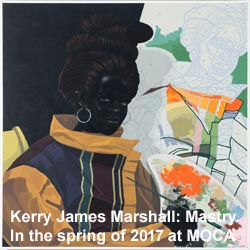
    This major monographic exhibition is the largest museum retrospective to date of the work of American artist Kerry James Marshall (born 1955). Encompassing nearly 80 works—including 72 paintings—that span the artist’s remarkable 35-year career, it reveals Marshall’s practice to be one that synthesizes a wide range of pictorial traditions to counter stereotypical representations of black people in society and reassert the place of the black figure within the canon of Western painting.

    Born before the passage of the Civil Rights Act in Birmingham, Alabama, and witness to the Watts rebellion in 1965, Marshall has long been an inspired and imaginative chronicler of the African American experience. He is known for his large-scale narrative history paintings featuring black figures—defiant assertions of blackness in a medium in which African Americans have long been invisible—and his exploration of art history covers a broad temporal swath stretching from the Renaissance to 20th-century American abstraction. Marshall critically examines and reworks the Western canon through its most archetypal forms: the historical tableau, landscape and genre painting, and portraiture. His work also touches upon vernacular forms such as the muralist tradition and the comic book in order to address and correct, in his words, the “vacuum in the image bank” and to make the invisible visible.

    #KerryJamesMarshall
    #MetBreuer


    he exhibition is made possible by the Ford Foundation, Kenneth and Rosalind Landis, and the H. Tony and Marti Oppenheimer Foundation.

    Additional support is provided by The Andy Warhol Foundation for the Visual Arts.

    The exhibition is organized by The Metropolitan Museum of Art, New York; Museum of Contemporary Art Chicago; and The Museum of Contemporary Art, Los Angeles.


    Courtesy of  The Met Breuer

    One of the Largest Names in the International Mural Scene, KOBRA, Begins Massive New Mural in Jersey City

    Kobra’s Iconic Murals Include Portraits of Gandhi, Abraham Lincoln, Bob Dylan, Nelson Mandela, and John Lennon, with Murals in More than 20 Countries and 30 U.S. Projects

    Fresh off setting the Guinness Book of World Records for the “largest spray paint mural by a team” with his Rio 2016 Olympic Games-inspired “Ethnicities,” internationally-renowned, Brazilian street artist Eduardo Kobra is bringing his unique vision and talent to Jersey City.  

    Widely known simply as Kobra, the sought-after artist has begun work on a 180-foot tall mural on the façade of 837 Jersey Avenue in downtown Jersey City.

    Kobra, whose murals of notable historical figures include Gandhi, Abraham Lincoln, Bob Dylan, Nelson Mandela, and John Lennon, are painted utilizing bright colors and bold lines while incorporating a kaleidoscope theme.  Much of Kobra’s work represents fraternity, respect for the other cultures and acceptance and love for differences, which was one of the reasons he was approached for the Jersey City Mural Art Program that is rooted in the city’s diversity.

    Kobra has worked in more than 20 countries and created more than 30 projects in the United States alone, with murals in London, Athens, Lyon, Los Angeles and New York.

    “Jersey City has one of the most diverse and expansive mural arts programs in the country and we couldn’t be more excited to welcome Kobra to contribute to the artistic landscape of our city,” said Mayor Fulop.  “His work is recognized around the world and his Jersey City mural will not only be our largest to date, but will also be an iconic image that will draw people here to visit the mural and our entire collection of outdoor art.”

    Expected to take approximately two weeks to complete, the new mural will be an exciting addition to the more than 86 other public works of art created throughout the city by local and international artists in the past three years as part of the city’s flourishing Mural Arts Program.

    “It’s great to see that Jersey City has embraced street art through its mural program and I’m very happy to be a part of it,” said Kobra.

    Launched in 2013 by Mayor Steven Fulop to foster arts and cultural awareness, the Mural Arts Program has effectively transformed the City into an outdoor gallery through the creative works of local, national and international street artists, including Shepard Fairey, Pixel Pancho, Karski & Beyond, Fintan McGee, Faith47, and WK Interact, and local artists Mustart, Fermin Mendoza, Lissanne Lake and Catherine Hart.  

    The new installation is taking place during Jersey City’s Annual ARTober festivities that kicked off with the 26th Annual Jersey City Art and Studio Tour (JCAST), a city-wide showcase of the arts featuring nearly 1,000 participating artists in hundreds of venues that include private studios, galleries, local businesses, and pop-up and public spaces. 

    To further integrate the Kobra mural into the local Jersey City art celebration – which runs through the end of October, – a 10,000-square-foot pop-up gallery has opened in the 17th Street retail space of the Cast Iron Lofts building that displays a collection of works from nearly half of the participating artists in Jersey City’s Mural Arts Program.   Entitled “OUTSIDE/in,” the gallery features more than 85 pieces of visual artwork from acclaimed mural artists such as Distort, Emilio Florentine, Hell Bent, John T. Ruddy, Pawn and many others. The exhibition also includes indoor murals and large-scale installations, and is open to the public every Saturday in October from 12pm to 4pm.

    The Kobra mural and “OUTSIDE/in” exhibit reflect Jersey City’s emergence as an important art and cultural destination that attracts the creative class.  The Mural Arts Program has commissioned works that support local art and beautify neighborhoods by programming public spaces with outdoor paintings that deter graffiti and incorporate the cultural and historical aspects of different neighborhoods.  Jersey City’s Mural Arts program has been compared to those in Brooklyn, Los Angeles, Detroit and Miami’s Wynwood neighborhood.  The Kobra mural, and others like it in Jersey City, offer accessible, authentic artwork that can help enhance and re-energize neighborhoods through creativity and aesthetic beauty.


    Courtesy of The Kobra and City of Jersey City Press Secretary

    News | Exhibitions